Church of the Assumption in Nowa Cerkiew: A Medieval Parish Church in Poland


Site at a Glance
- Rating
- 4.8
- Popularity
- Very Low
- Country
- Poland
- Primary era
- Early Modern
- Eras represented
- Medieval, Early Modern, Modern
- Civilizations
- German, Polish–Lithuanian Commonwealth, Teutonic Order
- Site type
- Religious
- Remains
- Church
On this page8 sections
History
The Church of the Assumption in Nowa Cerkiew is a Roman Catholic parish church in Poland, with origins reaching back to the fourteenth century. Its brick construction was completed in 1312 on the site of a thirteenth-century wooden church that had burned down. The parish itself was established in 1274, and the churchyard cemetery dates from the fourteenth century.
Medieval parish and Cistercian connections
The church served as the parish church of the Assumption of the Blessed Virgin Mary. Cistercians, members of a Catholic monastic order associated with monasteries and religious administration in medieval Europe, maintained a special connection with the building. They could attend services through a suspended polygonal gallery above the sacristy, a room used for vestments and liturgical equipment, which was reached from outside.
Fires and Baroque reconstruction
In 1764, a fire almost completely destroyed the church and its tower. The walls and the vault in the presbytery, the area around the high altar reserved for clergy, survived. Abbot Isidor Tokarzewski rebuilt the church during the same year, and his coat of arms was placed on the bell-turret weathervane. The extensive rebuilding added side aisles and gave the building its Baroque character, while the interior acquired a unified combination of Baroque and Rococo decoration.
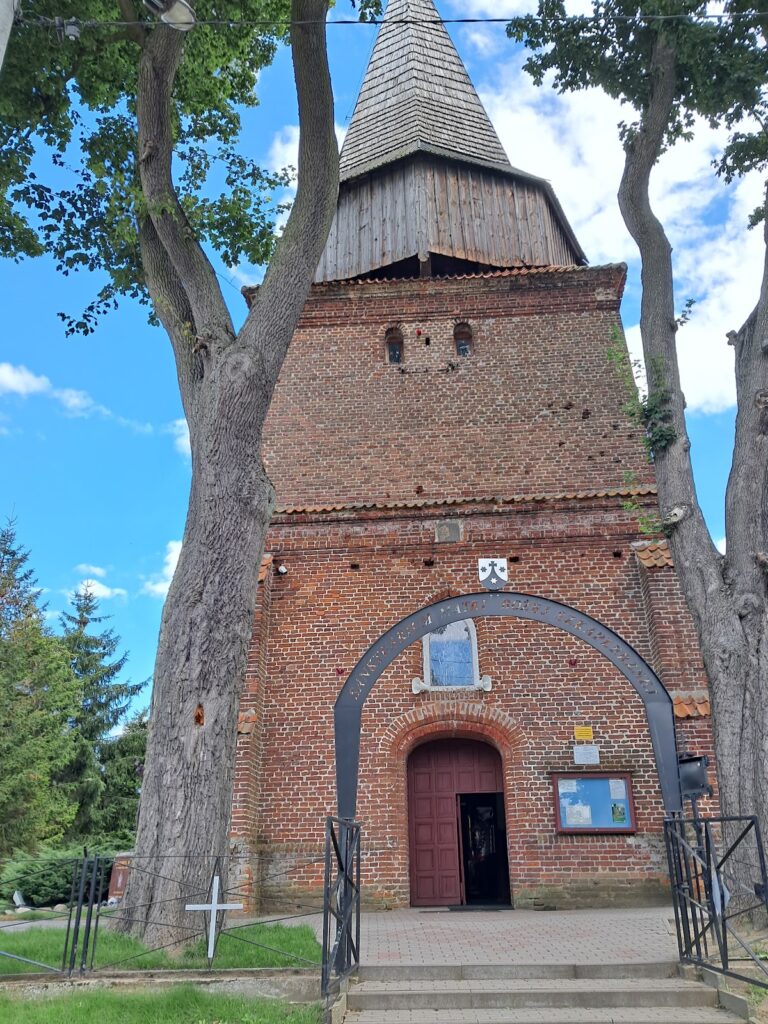
A second fire in 1844 burned out the interior and damaged the tower. Its upper section was rebuilt in 1851 with plain brick in the Lower Vistula style. Military operations in 1945 then damaged the main nave, the southern side nave, and the tower.
Burials, conservation, and parish use
The church remains the seat of the parish of the Assumption of the Blessed Virgin Mary, whose liturgical feast is observed on 15 August. Repairs in 1995 revealed coffins and human remains in the crypts. The same crypts contain the grave of Maciej Prądzyński, the last prior of the Cistercian abbey at Pelplin. After the monastery was dissolved, he became parish priest at Nowa Cerkiew and retained the right to wear his habit, ring, and cross.
During tower repairs in 2005, medieval paintings were discovered and left visible. A restored clock was also installed on the tower after a long interruption. The church was entered in the heritage register under number A-1310 on 24 April 1990.
Remains
Medieval structure and later form
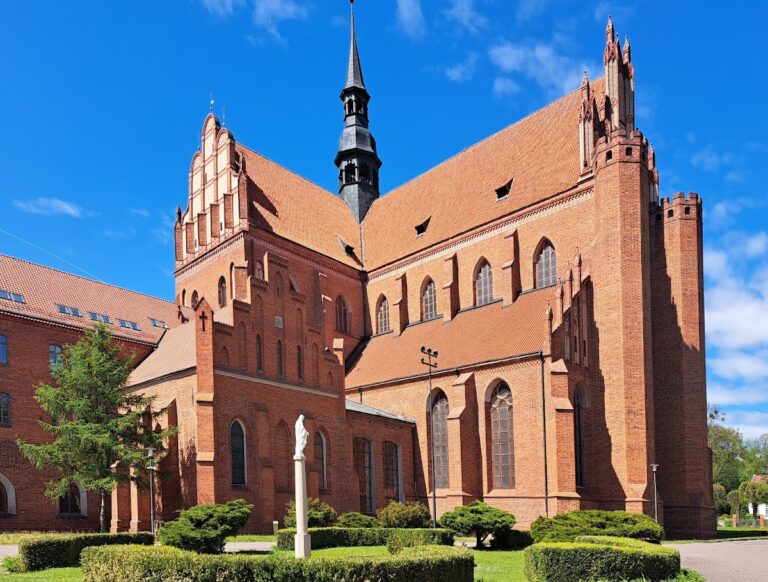
The church is a three-aisled brick building whose present form combines surviving medieval fabric with the Baroque reconstruction after the fire of 1764. The quadrangular tower, presbytery, sacristy, and treasury belong to the surviving elements of the medieval building. The tower’s upper part, rebuilt in 1851, is distinguished by its plain brick construction in the Lower Vistula style.
Interior furnishings and devotional objects
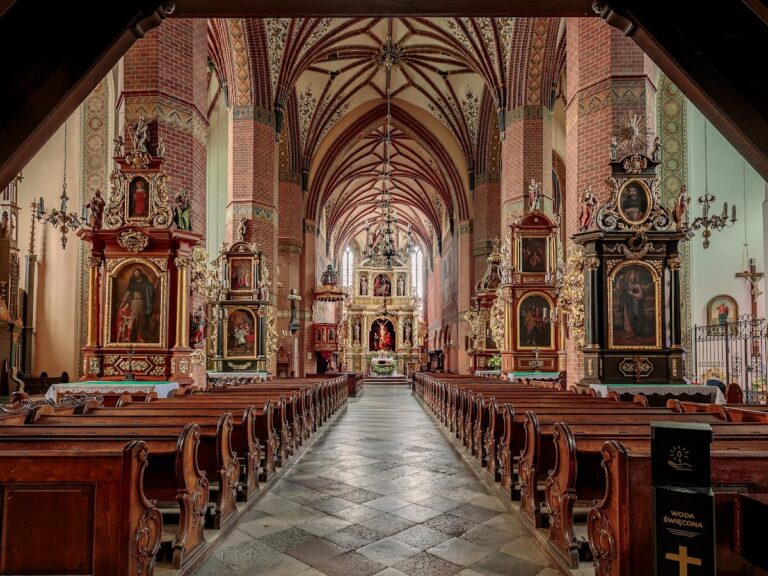
The main altar dates from the third quarter of the eighteenth century and contains a seventeenth-century painting of the Virgin Mary, regarded by local people as miraculous. Its upper tier holds a stone statue of Our Lady of Sorrows, transferred there in 1802 from a roadside chapel in Borkowo. The altar of Our Lady of the Rosary contains a Gothic image of the Immaculate Virgin with a silver covering made in the early eighteenth century by Siegfried Örnstern of Gdańsk.
The main porch contains a medieval holy-water font and a large wooden crucifix made in a folk style. Three Rococo feretories, portable platforms carrying religious images during processions, also belong to the church. A chandelier made during the Second World War remains in the building, with candle sockets fashioned from locally collected cartridge cases.
Tower, gallery, and archaeological evidence
Above the sacristy, the former suspended polygonal gallery provided the Cistercians with an external route into the church for attending services. The tower retains medieval paintings uncovered during the 2005 repairs, which were left exposed. It also has a restored clock. Until 1942, the tower held the Urban bell, cast in 1561 and regarded as one of the oldest bells in the historic Chełmno Diocese, the Roman Catholic diocese whose territory included the region around Chełmno and the lower Vistula. German authorities removed the bell for wartime purposes.