Grote Kerk: A Historic Church in Wageningen


Site at a Glance
- Rating
- 4.3
- Popularity
- Low
- Country
- Netherlands
- Primary era
- Medieval
- External website
- Open
- Eras represented
- Medieval, Early Modern
- Civilizations
- Holy Roman Empire
- Site type
- Religious
- Remains
- Church
On this page13 sections
History
Grote Kerk, also known as the John the Baptist Church, is a historic church in Wageningen, Netherlands. It was built after Wageningen received city rights in 1263 and began in the Romanesque style, a medieval form known for heavy masonry and rounded shapes.
Medieval development
The church grew and changed over the following centuries. A Gothic north aisle, a long passage running beside the main nave, was added in the fifteenth century. During the sixteenth century, the rest of the church was remodelled in the Gothic style, associated with pointed arches, vertical emphasis, and more complex structural systems. These phases established the main form of the three-aisled cruciform church.
Ownership and nineteenth-century restoration
In 1810, the church became the property of Wageningen’s Reformed congregation, a local Protestant church institution. The tower remained owned by the civil municipality. Architect L. H. Eberson directed a restoration in 1861 and 1862, during which four gables were added to the tower. These additions later attracted strong criticism.
Wartime destruction and reconstruction
In May 1940, artillery firing from the Grebbeberg destroyed the tower, part of the church, and nearby buildings. The ridge formed part of the defensive fighting around Wageningen during the German invasion. The tower was regarded as a possible observation post for German occupying forces, and a subsequent fire destroyed almost the entire church.
Reconstruction of the church and tower began in August 1941, following designs by A. J. van der Steur. During the German withdrawal in April 1945, the occupying forces blew up the tower again, causing severe additional damage to part of the nave. The tower was restored in 1953 and 1954 according to plans by Van der Steur and G. H. Kleinhout. The church officially reopened on 4 June 1954.
Later stewardship and furnishings
The Grote Kerk was designated a Dutch national monument on 11 February 1970. On 25 August 2017, the Protestant Community of Wageningen transferred ownership to the Old Gelderse Churches Foundation, while the Grote Kerk Wageningen Foundation took responsibility for management and operation. The building continued to host church services, and the supporting foundation sought additional activities to help sustain its maintenance and operation and to give it a broad role in the local community.
The church’s three bells were badly damaged in the destruction of 1940 and were eventually melted down by the occupiers for weapons production. On 1 August 1947, Utrecht Municipality donated the Michielsklok, a bell formerly belonging to Utrecht’s Buurkerk. Johannes Tolhuis cast it in 1542. Two new bells were cast in 1953. The organ built by D. A. Flentrop in 1944 was destroyed, and Flentrop installed its replacement in 1955. Flentrop Orgelbouw revised its intonation in 1993, and a Trompet 8′ trumpet-register stop was added to the pedal in 2005. The organ received monument status in 2022.
Remains
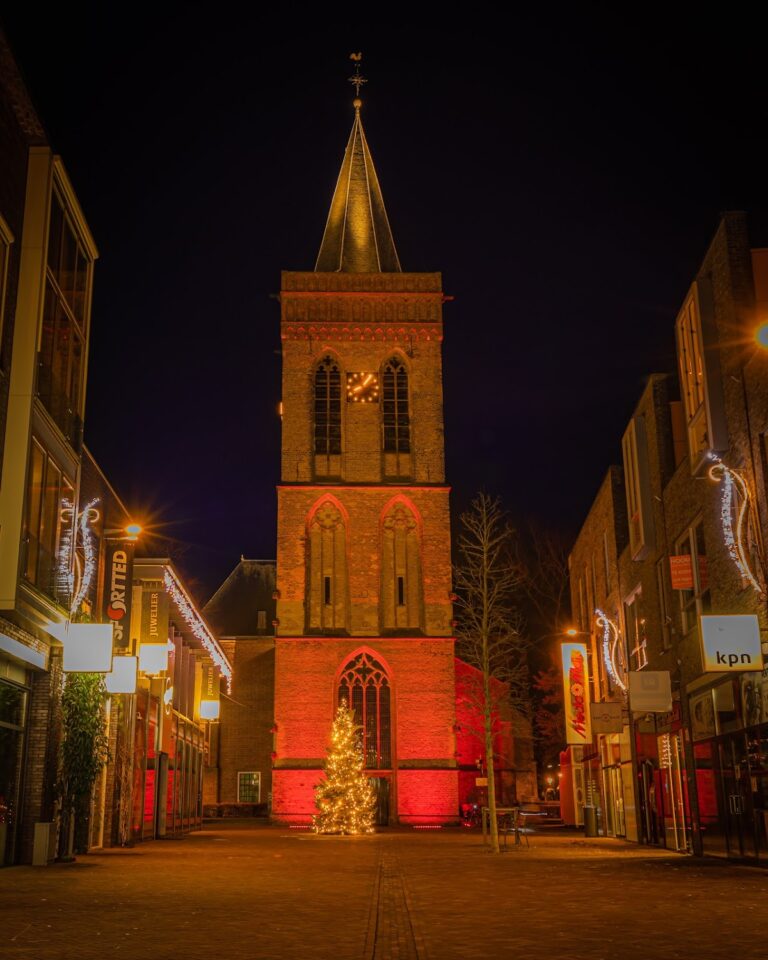
The Grote Kerk stands on the Markt as a three-aisled cruciform church, with a plan shaped like a cross through the intersection of its nave and transept. Its fabric combines the Romanesque beginnings of the building with the Gothic expansion and remodelling that followed. The tower retains a lower section from the twelfth century, while its upper structure belongs to the postwar rebuilding.
Church and tower
Cruciform church
The church is arranged around a main nave with side aisles and a crosswise transept. Its earliest construction was Romanesque, while the fifteenth-century north aisle and the sixteenth-century remodelling brought the building into the Gothic tradition. Much of the present church reflects reconstruction after the wartime fire and later tower demolition.
Tower
The tower’s surviving lower section is approximately three metres high and dates from the twelfth century. Its upper structure was rebuilt after the Second World War according to plans by A. J. van der Steur and G. H. Kleinhout. The tower also retains the four gables introduced during the restoration of 1861 and 1862.
Bells, organ, and memorial window
Michielsklok and later bells
The Michielsklok was cast by Johannes Tolhuis in 1542. It came from Utrecht’s Buurkerk and has separate national-monument status. It is joined by the two bells cast in 1953 after the wartime loss of the church’s original set of three.
Flentrop organ
The present organ was installed by D. A. Flentrop in 1955. Its intonation was revised in 1993, and the pedal received a Trompet 8′ stop in 2005. The instrument became a monument in 2022.
Liberation Memorial Window
At the rear of the church is the Liberation 1940–1945 Memorial Window, also called the National Liberation Window. Octave van Nispen tot Pannerden designed it, and Queen Beatrix unveiled it on 5 May 1987.