Fjære Church: A Medieval Parish Church in Norway


Site at a Glance
- Rating
- 4.7
- Popularity
- Low
- Country
- Norway
- Primary era
- Medieval
- External website
- Open
- Eras represented
- Medieval
- Civilizations
- Norwegian
- Site type
- Religious
- Remains
- Church
On this page8 sections
History
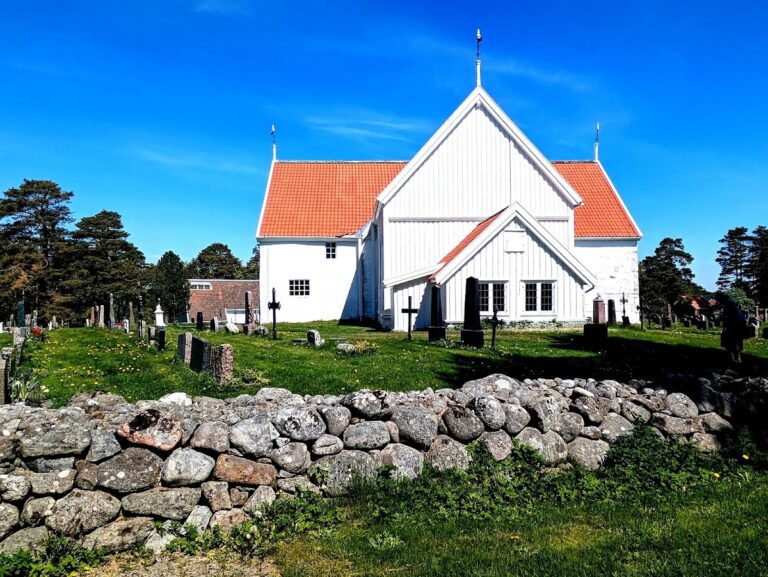
Fjære Church is a medieval stone parish church in Grimstad, Norway, built by the medieval Catholic Church around 1150 and now used as an Evangelical Lutheran church by the Church of Norway. It serves as the main church of Fjære Parish. The earliest surviving written record dates from 1320, by which time the church was already standing.
Medieval origins
The first church on the site was probably a wooden building with a stone altar. It was later replaced on the same location by the present stone church, with the earlier altar retained and enclosed within the new structure. The church is regarded as having been founded before the twelfth century and consecrated around 1150. Its long history reflects the continuity of worship at the site from the Catholic period into the church’s present Evangelical Lutheran use.
Changes from the seventeenth to the nineteenth century
Fjære Church remained essentially unchanged from the early fourteenth century until alterations began in the seventeenth century. The roof structure was modified, a flat ceiling and attic floor were installed, and balcony seating was added over time. During the eighteenth century, settlement damage affected the apse. Its roof was removed, the apse was rebuilt, and a wooden sacristy was constructed on its east side. Around 1745, the gallery along the north wall was extended toward the choir.
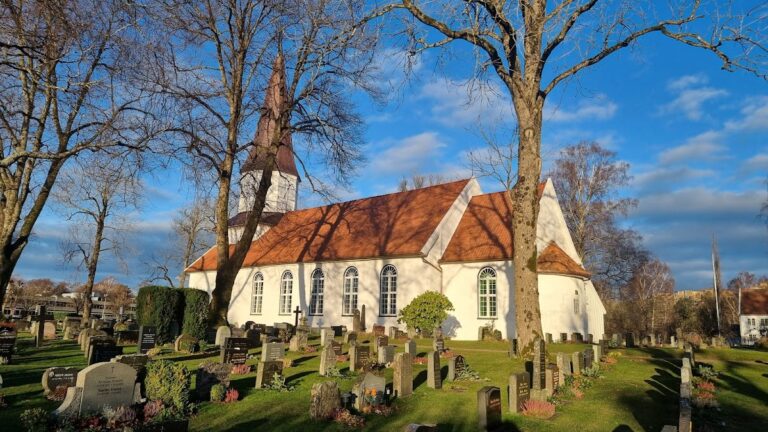
A large wooden tower was added at the west end in 1827. In 1898, the west gallery was enlarged to accommodate an organ, further adapting the medieval building for later forms of worship and congregational use.
Restoration and recent history
Plans for renovation and restoration prepared in the 1930s were interrupted by Germany’s invasion of Norway and the war that followed. Restoration work was completed during the 1950s and 1960s. It corrected sagging and skewed walls, removed the eastern sacristy, added a larger sacristy on the north side of the nave, and revealed wall frescoes beneath later surfaces. Fjære Church is automatically protected as a Norwegian cultural heritage site.
The church also has a literary association with Henrik Ibsen, a major Norwegian playwright and poet. Ibsen wrote Terje Vigen in 1861, and the poem refers to Fjære Church while stating that Terje Vigen is buried there. On 29 October 2021, the church was broken into and vandalised. Parts of the interior, the twelfth-century baptismal font, the seventeenth-century crypt, and the church organ were damaged.
Remains
Stone church and medieval plan
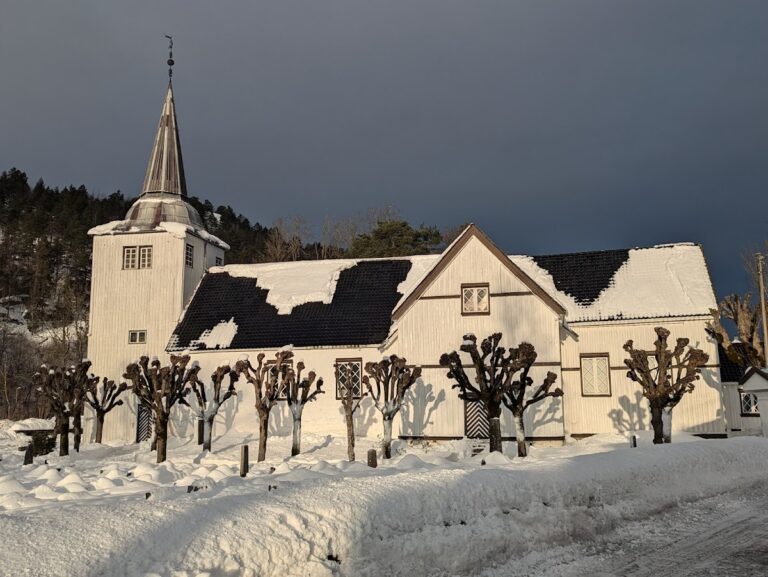
Fjære Church is a white stone long church, a plan in which the nave and choir are arranged along one lengthwise axis. The rectangular nave measures 18 by 12 metres, while the rectangular choir at the east end measures 8 by 10 metres. A semicircular apse projects from the eastern end of the choir. The building stands over the earlier stone altar, which was incorporated into the later church. Its present form also includes the flat ceiling, attic floor, balcony seating, and the large wooden tower at the west end.
Interior spaces and burial chamber
The larger sacristy on the north side of the nave was created during the twentieth-century restoration. A sacristy is a room used to store liturgical objects and prepare for worship. Beneath the church lies a basement crypt, a chamber used for burials, containing 26 bodies. Most were community members regarded as important during the seventeenth century. The crypt was formally closed to visitors in 1997 out of respect for the dead. The west gallery, enlarged in 1898, accommodates the church organ, and the building seats approximately 300 people.
Frescoes, font, and churchyard monument
Wall frescoes, or paintings made on plaster, were uncovered during the restoration of the 1950s and 1960s. The church also retains a twelfth-century baptismal font, which was damaged during the 2021 vandalism. In the churchyard, a large obelisk, a tall four-sided monument tapering toward a pyramidal top, commemorates Terje Vigen and others who died during the war of 1807–1809.