San Domenico: Dominican Church and Convent in Varazze, Italy


Site at a Glance
- Rating
- 4.6
- Popularity
- Very Low
- Country
- Italy
- Primary era
- Early Modern
- External website
- Open
- Eras represented
- Medieval, Early Modern, Modern
- Civilizations
- Genoese
- Site type
- Religious
- Remains
- Monastery
On this page17 sections
History
San Domenico is a Roman Catholic religious complex in Varazze, Italy, consisting of a church and Dominican convent established in the late medieval period. The church is the parish seat of the same name within the Varazze vicariate of the Diocese of Savona-Noli, and friars of the Order of Saint Dominic continue to administer the complex.
Origins and Dominican foundation
The convent, known as San Vincenzo Ferreri or San Domenico, developed from the older hermitage of Madonna delle Grazie. The hermitage had been frequented during the medieval period by Jacopo da Varagine, a Dominican friar and archbishop of Genoa best known for writing the Golden Legend, a collection of saints’ lives. A tradition associated with the complex holds that Jacopo spent part of his youth there.
Saint Catherine of Siena, a fourteenth-century Dominican tertiary, religious reformer, and mystic, stayed in Varazze on 3 October 1376 to pay homage to Jacopo’s remains. Her request to the people of Varazze led to the establishment of the Dominican convent. Pope Martin V authorized its construction in 1419 on the site of the earlier hermitage. The church preserves Jacopo’s relics, maintaining the connection between the Dominican foundation and the local cult of the medieval archbishop.
Expansion and transformation
The complex was enlarged and altered repeatedly until the seventeenth century. By that time the convent had acquired essentially its present form. The chronology of construction is associated with 1419 and 1628, while the church’s present form dates from 1618 and its completion belongs to the nineteenth century.
The adjacent Dominican convent and its cloister were added around the fifteenth century. The church also contains a chapel dedicated to the apparition of Saint Dominic at Soriano, a devotional event dated to the first half of the fifteenth century. Saint Dominic, or Dominic de Guzmán, was the thirteenth-century founder of the Order of Preachers, commonly called the Dominican Order.
Suppression, restoration, and continued use
The complex deteriorated especially toward the end of the eighteenth century under the Napoleonic laws, which included restrictions and suppressions affecting religious institutions. It was gradually restored at the beginning of the twentieth century. The church and convent stand a few metres from the sea in the eastern part of Varazze, outside the walls of the historic centre and near the Sanctuary of Santa Caterina.
Remains
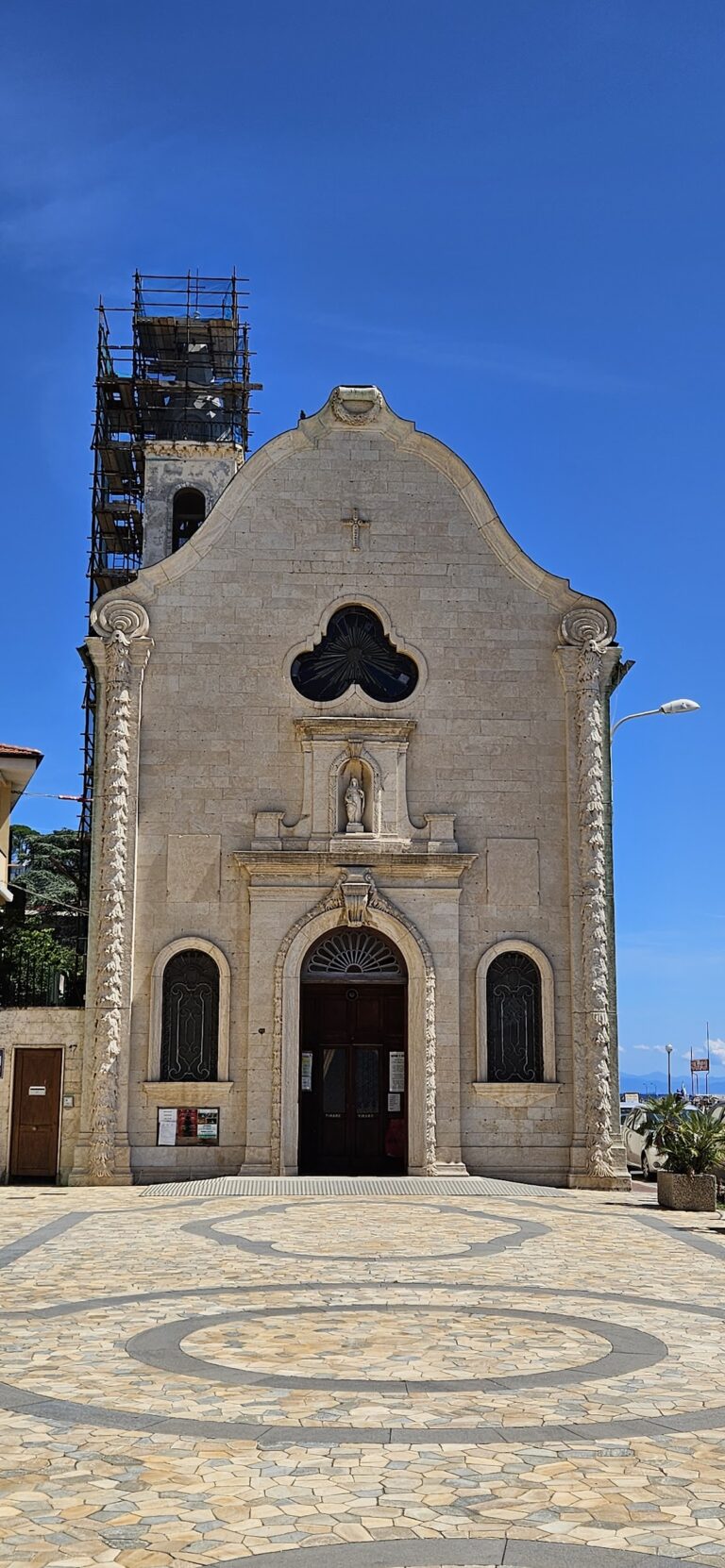
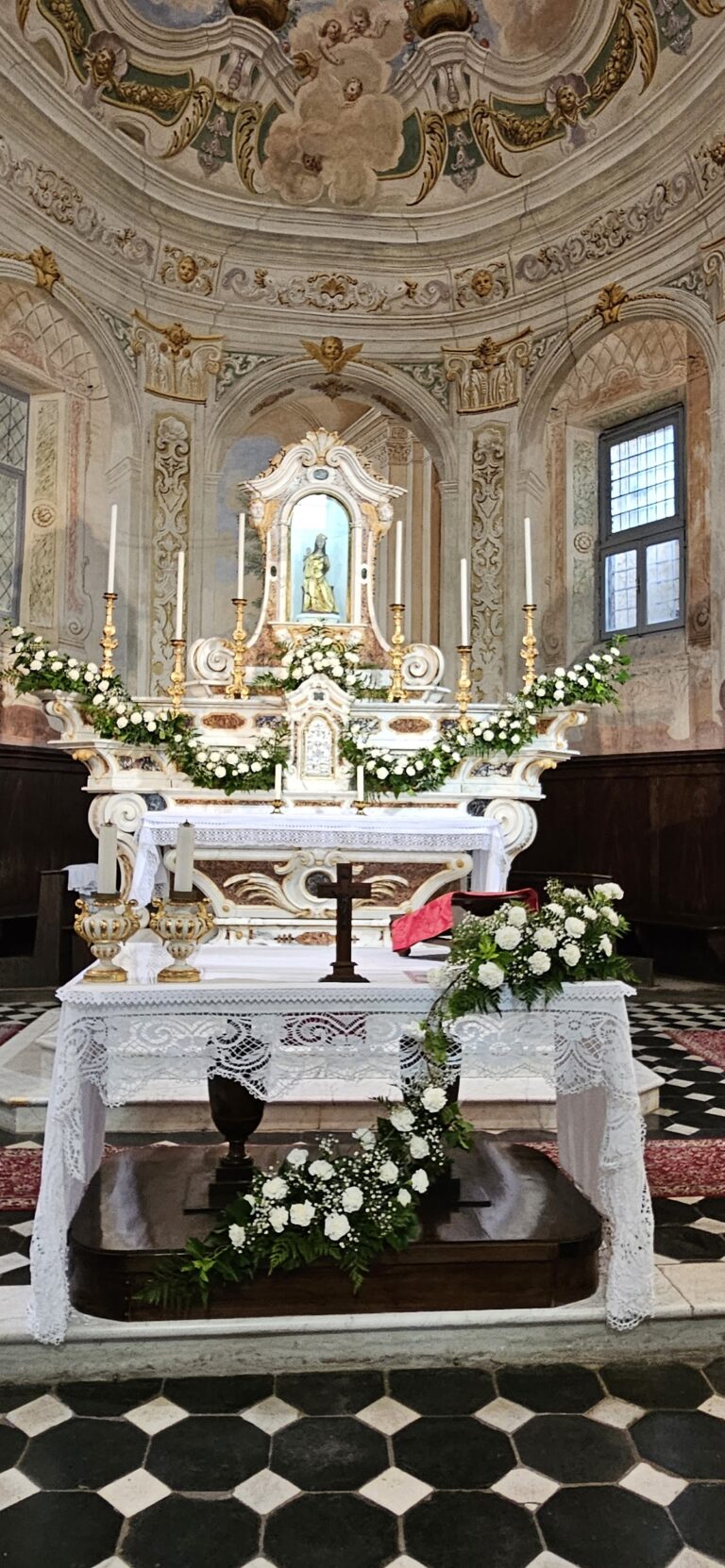
The surviving complex combines a simple Neo-Gothic facade with a richly decorated Baroque interior, a style known for elaborate ornament and dramatic visual effects. The church, convent, cloister, and incorporated remains of the older hermitage form the principal physical elements of the site.
Facade and entrance
The present facade is linear and restrained, with Neo-Gothic forms intended to recall the early Dominican churches of the Late Middle Ages. A cannonball fired by a French ship in 1746 remains embedded in the facade. The central portal is a sixteenth-century work made from stone quarried at Finale Ligure.
Interior chapels and altars
Right-hand nave
The right-hand nave contains the Altar of the Souls in Purgatory and chapels dedicated to Saint Hyacinth Odrowaz, Blessed Archbishop Jacopo da Varagine, Saint Rita of Cascia, Saint Joseph, and Saint Vincent Ferrer. Saint Hyacinth was a thirteenth-century Polish Dominican friar and preacher, while Saint Vincent Ferrer was a Spanish Dominican preacher of the fourteenth and early fifteenth centuries. The same side also contains the chapel of the apparition of Saint Dominic at Soriano.
Left-hand nave
The left-hand nave includes an altar dedicated to Saint Thomas Aquinas, an altar dedicated to Saint Catherine of Siena, and an altar dedicated to Saint Thecla. It also preserves a fresco of Madonna delle Grazie, or Madonna del Romito, probably produced within the Sienese school of painting.
Saint Thecla altar
The altar of Saint Thecla contains a painting by Bernardo Castello dated 1623.
Jacopo da Varagine chapel
In the fifth chapel toward the main altar, an urn holds the bones and ashes of Blessed Jacopo da Varagine. Above it is a Renaissance polyptych, a painted altarpiece made from connected panels, showing Jacopo between Saint Catherine and Mary Magdalene. The work is attributed to Simone da Pavia and dated 1452.
Our Lady of the Rosary chapel
The chapel of Our Lady of the Rosary contains a painting by Giovanni Andrea De Ferrari dated 1635 and a wooden statue of Our Lady of the Rosary by Anton Maria Maragliano. The church preserves the original document recording the Dominicans’ commission of the statue in 1715. It describes a processional image and names Maragliano as its sculptor.
Paintings and earlier fabric
Madonna del Romito
A slate bearing a painting of Madonna del Romito dated to 1100 is preserved in the church. The image relates to the Madonna delle Grazie tradition associated with the earlier hermitage.
Hermitage and rear extension
The rear part of the church incorporates the older hermitage connected with Madonna delle Grazie and Jacopo da Varagine. This area extends toward the present Via Nino Bixio, preserving part of the earlier religious foundation within the later complex.
Convent and cloister
Cloister and apostle paintings
The Dominican convent includes a cloister and preserves paintings depicting the lives of the Apostles. The works were formerly housed in an older chapel dedicated to sailors. That chapel was demolished during the twentieth century to create a lateral connection between the church and convent, while the paintings remained associated with the complex.