Osovica Monastery: A Serbian Orthodox Monastery in Bosnia and Herzegovina

Site at a Glance
- Rating
- 4.9
- Popularity
- Low
- Country
- Bosnia and Herzegovina
- Primary era
- Medieval
- External website
- Open
- Eras represented
- Medieval, Modern
- Civilizations
- Serbian
- Site type
- Religious
- Remains
- Monastery
On this page8 sections
History
Medieval foundation and early records
Osovica Monastery is a Serbian Orthodox monastery in Bosnia and Herzegovina, located in Seferovci near Mount Motajica. Dedicated to the Annunciation of the Most Holy Mother of God, the monastery belongs to the Banja Luka Diocese, the Serbian Orthodox ecclesiastical jurisdiction responsible for it. Its foundation is traditionally placed in the thirteenth century, while foundations found at the site date to the late thirteenth or early fourteenth century.
The monastery’s beginnings are associated with Stefan Dragutin, a medieval Serbian king. Another tradition connects its establishment with the rule of his son Vladislav II, who governed the Usora region in the early fourteenth century. A related tradition identifies Dragutin himself as the monastery’s patron. Osovica is first documented in 1330 through a monastery seal preserved at Gomionica Monastery. In 1883, the seal was recorded as being in the possession of the priest Kosta Dušanić.
Sixteenth-century entries in the Rača memorial book name the hieromonk Isaija and the monks Eufimije and Aksentije of Osovica. A hieromonk is an Orthodox monk who has been ordained as a priest. The memorial book was later transferred to Beočin Monastery after the destruction of Rača Monastery. During the first half of the seventeenth century, Osovica also appeared in the books of Liplje Monastery, which were transferred to Orahovica Monastery after Liplje was destroyed.
Destruction and abandonment
Osovica suffered an initial destruction in the early sixteenth century and was rebuilt several times during the seventeenth century. It was later destroyed during wars between Ottoman and Habsburg forces, including the Great Turkish War. Its history was closely connected with that of Stuplje Monastery, and both monasteries endured destruction during these conflicts.
After the destruction, Muslim settlers moved into the area south of the Sava, a river that had long served as a natural boundary. In the early nineteenth century, a Turkish captain from Kobaš sold the stone from the ruined church to Austrians in Slavonski Kobaš for use in house construction. The historic monastery was consequently reduced to its foundations and remained abandoned for many years.
Rediscovery and reconstruction
The historic foundations were discovered in 2003 at Manastirište, beside the Osovica stream on Mount Motajica. Reconstruction began that year with the blessing of Jefrem, Bishop of Banja Luka. The work included a principal church, a monastic residence, and a refectory, a communal dining hall for the monastic community.
In 2008, the monk Dositej Crnčević was transferred to Osovica. A temporary monastic building and chapel were consecrated, and Dositej served as monastery superior until 2014. Archimandrite Teofil Dimitrić then became superior. An archimandrite is a senior monastic title commonly associated with leadership of an important monastery.
The foundations of the monastery church and residence were consecrated in 2010. In 2013, the Chapel of Saint Procopius was consecrated, while Hieromonk Teofil was transferred from Stuplje and the nun Jelena from Moštanica. On 25 July 2017, Serbian Patriarch Irinej solemnly consecrated the restored monastic complex. The ceremony was attended by Milorad Dodik, president of Republika Srpska, and Željka Cvijanović, its prime minister.
Remains
Monastic complex and surviving foundations
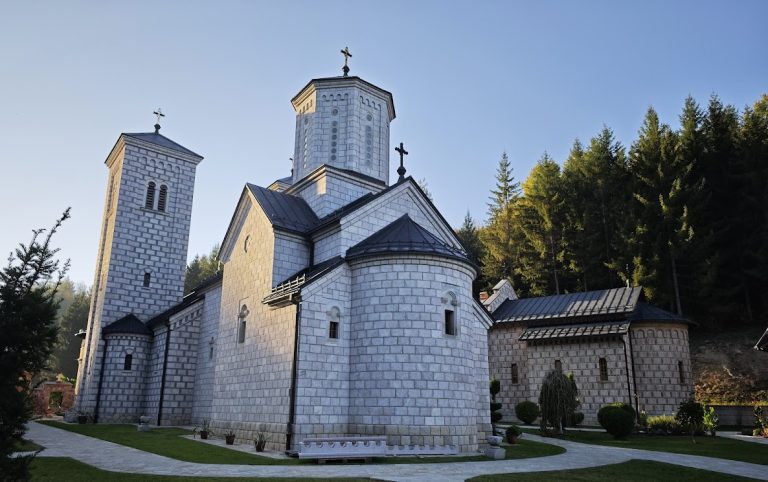
Osovica stands at the foot of Mount Motajica near Nova Ves, in the municipality of Srbac, close to the Croatian border. The historic foundations lie beside the Osovica stream at Manastirište. After the church masonry was removed in the early nineteenth century, the remains of the earlier complex were reduced to foundations. The restored site now organizes the monastery around a principal church, two smaller churches, a monastic residence, and a refectory.
Principal church
The principal monastery church is dedicated to the Annunciation of the Most Holy Mother of God. The Annunciation is the Christian feast commemorating the announcement to Mary that she would bear Jesus Christ. Its foundations were consecrated in 2010 as part of the reconstruction, and the completed church formed the central element of the restored complex consecrated in 2017.
Chapels and monastic buildings
The complex contains two smaller churches, the Chapel of Saint Procopius and a church dedicated to Saint Nicholas. A temporary chapel and monastic building were consecrated in 2008, followed by the consecration of the Chapel of Saint Procopius in 2013. The reconstruction also includes the monastic residence, whose foundations were consecrated in 2010, together with a refectory for communal meals.