San Giovanni Battista: A Servite Church in Bardi, Italy
Site at a Glance
- Rating
- 4.2
- Popularity
- Very Low
- Country
- Italy
- Primary era
- Early Modern
- External website
- Open
- Eras represented
- Early Modern, Modern
- Civilizations
- Duchy of Parma and Piacenza, Holy Roman Empire
- Site type
- Religious
- Remains
- Church
On this page7 sections
History
San Giovanni Battista is a Roman Catholic church in Bardi, Italy, built by Servite friars between 1500 and 1503. It belongs to the Diocese of Piacenza-Bobbio and the Vicariate of Val Taro and Val Ceno, and is now a subsidiary church of the parish church of San Giovanni Battista and the Blessed Virgin of Sorrows in Bardi.
The Servite Foundation
The Servites, also known as the Order of the Servants of Mary, are a Catholic religious order founded in medieval Italy and associated especially with devotion to the Virgin Mary and the Passion of Christ. They established themselves in Bardi in 1478, creating a convent beside the Church of the Visitation of Our Lady. That church was consecrated in 1489, followed by the construction of San Giovanni Battista at the beginning of the sixteenth century.
Restoration and Reconstruction
Prior Trombetti directed a restoration in 1571, and the church was consecrated in 1589. Although its original dedication was to Saint John the Baptist, it was also dedicated to the Blessed Virgin of Sorrows in 1612. After the apse collapsed, reconstruction of the area began in 1688. A new altar dedicated to Saint John the Baptist was added and blessed in 1693, while three side chapels were completed in 1699.
Eighteenth- and Nineteenth-Century Changes
The façade, which had remained unfinished, was completed around 1756. In that year the Boschetti brothers covered the nave, presbytery, and the second and third chapels on both sides with Rococo stucco, a light decorative style using delicate ornament and curved forms. The church was also raised to parish status.
The original bell tower was demolished in 1804. The following year, Napoleon’s suppression of the Order of the Servants of Mary, a measure that dissolved the religious order and confiscated its convent, caused the church to lose its dedication to the Blessed Virgin of Sorrows. A replacement bell tower was built between 1830 and 1832, and the side elevations and statues crowning the façade were completed. In 1873, San Giovanni Battista lost its parish status to the nearby Church of Santa Maria Addolorata. It remains dedicated to Saint John the Baptist and retains its connection with the Servite tradition.
Remains
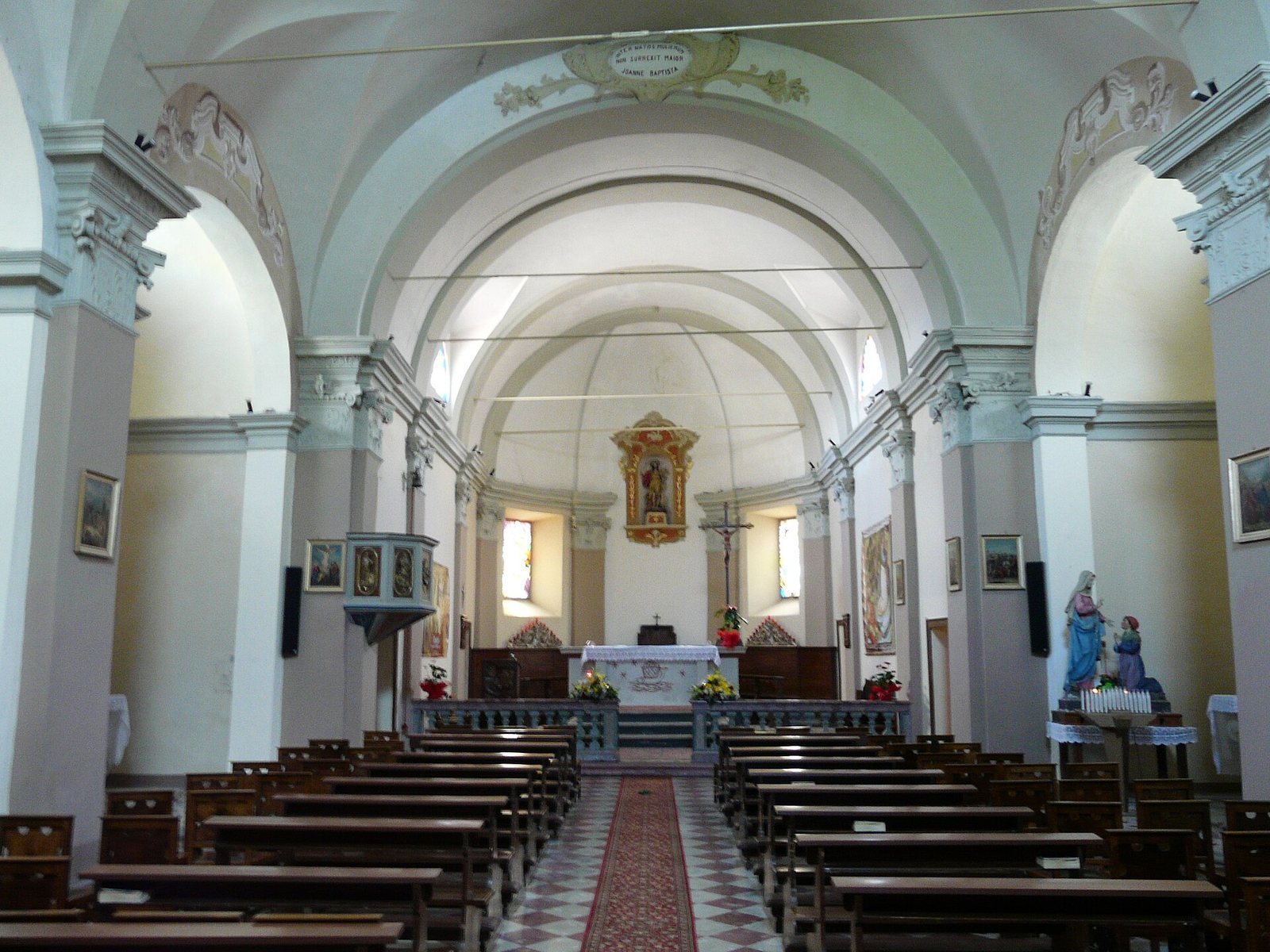
The church has a single nave with three side chapels on each side. A barrel vault, a continuous curved ceiling, covers the nave and is opened by lunettes, or arched recesses, while pilasters with stucco Corinthian capitals divide the interior into three bays. These supports carry surviving fragments of cornice and connect the main space with the decorated chapels.
Façade and Exterior
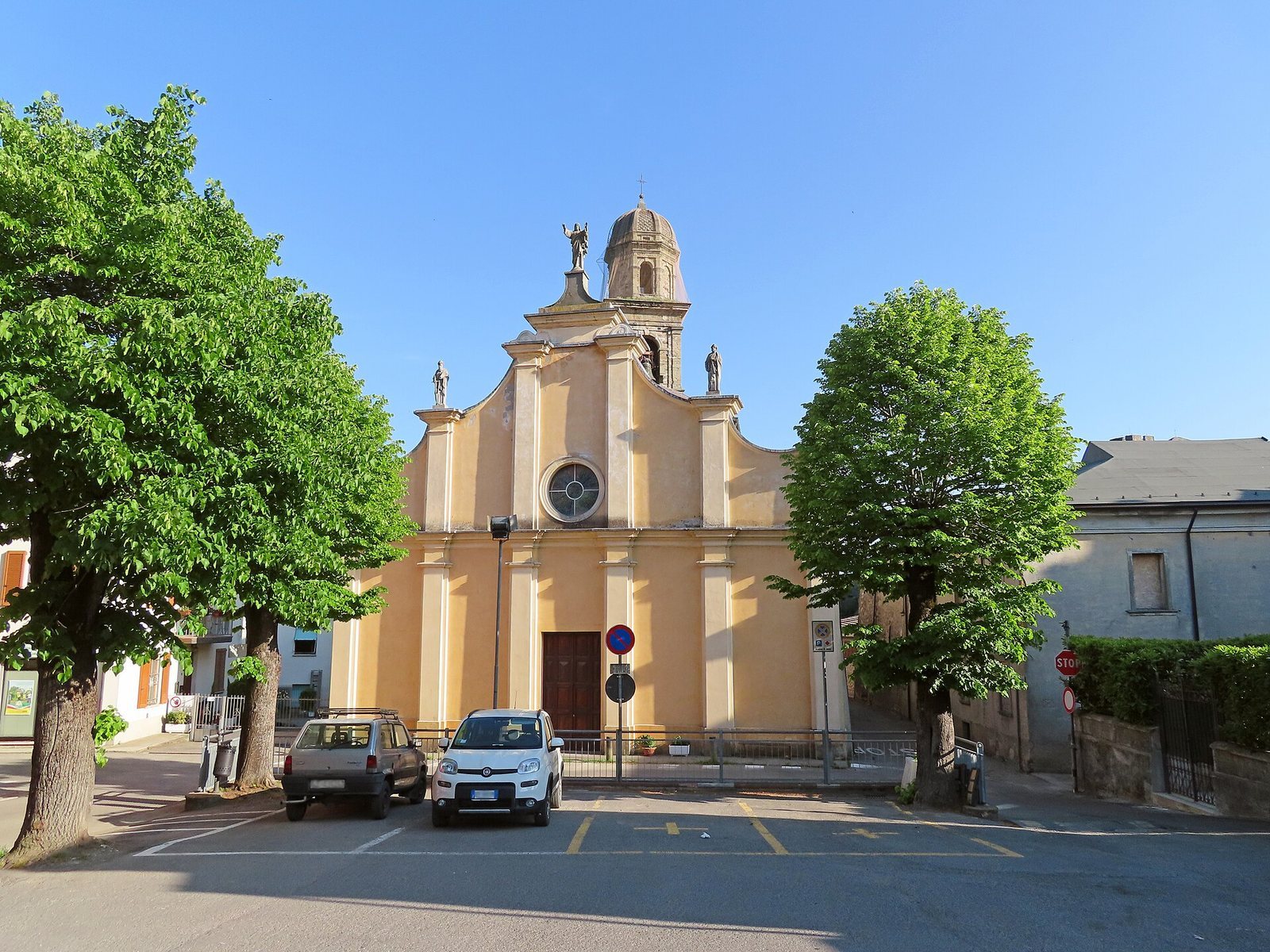
The symmetrical façade is fully plastered and organized by ascending rooflines. A projecting broken cornice divides it horizontally, while two levels of six pilasters with slender Doric capitals provide its vertical structure. At the center, a broad entrance portal is surmounted by a rose window framed with mouldings. The upper pilasters have no crowning entablature and support statues of saints. Above them, a high-based attic carries a statue of Triumphant Christ, with volutes at either side.
The side elevations are partly plastered and lined with lunette windows in their upper sections. Behind the church, the polygonal apse is pierced by rectangular windows. The stone bell tower rises behind the apsidal presbytery. Corner pilasters, string courses, and narrow niches organize its exterior, while broad round-headed arches open the belfry on all four sides. An octagonal lantern crowns the tower, decorated with pilasters, mouldings, and an entablature.
Interior and Presbytery
The rectangular side chapels open from the nave through round arches and have barrel-vaulted ceilings. Stucco pilasters and mouldings continue the decorative scheme of the main interior. Their furnishings include a processional canopy made around the middle of the nineteenth century, possibly by Domenico Borella, together with a seventeenth-century wooden statue of Saint Roch.
An eighteenth-century stucco altarpiece contains a polychrome wooden statue of Saint Sebastian. The chapels also contain a painting of the Madonna and Child with Saints Joseph and Bartholomew. These works remain within the church’s arrangement of chapels and devotional furnishings.
The presbytery, the part of a church reserved for the clergy and altar, has a barrel vault with lunettes corresponding to two lateral lunette windows. Pilasters with Corinthian capitals articulate its sides and semicircular interior apse, supporting a moulded cornice. At the rear, the cornice is interrupted by a niche containing a wooden statue of Saint John the Baptist. Two carved Neo-Rococo candle holders stand on either side of the high altar.