Church San Nicolò: A Medieval Parish Church in Padua
Site at a Glance
- Rating
- 4.6
- Popularity
- Low
- Country
- Italy
- Primary era
- Medieval
- External website
- Open
- Eras represented
- Medieval, Early Modern
- Civilizations
- Holy Roman Empire
- Site type
- Religious
- Remains
- Church
On this page13 sections
History
Church San Nicolò is a medieval Roman Catholic church in Padua, Italy, dedicated to Saint Nicholas of Myra. Its origins predate 1088, and its Romanesque and Gothic character reflects a long history as a parish church and part of Padua’s medieval urban fabric. Saint Nicholas was a fourth-century Christian bishop associated with charity and gift-giving; the transfer of his relics to Bari in 1087 helped spread his veneration across western Europe.
Early parish history
The church may have been among the earliest places of worship dedicated to Saint Nicholas, although its precise foundation date remains uncertain. Archaeological excavations place its existence before 1088. In that year, Bishop Milone of Padua donated the church to the nuns of San Pietro, a religious community. Bishop Gerardo later listed San Nicolò among Padua’s parishes in 1178, when it was already an established centre of parish life.
The church continued under the secular clergy of the Diocese of Padua. Santa Lucia served as its subsidiary rectory. Members of the Forzatè and Sala families held special rights over the church, either from the twelfth century or from the later Carrarese period. Giordano and Marco Forzatè, as well as other members of the Padovan family, were buried inside the church. Baron d’Hancarville, an eighteenth-century antiquarian and writer on art, was also said to have been buried there.
Carrarese transformation
San Nicolò was substantially altered during the fourteenth century. In 1305, it was incorporated into the circuit of the Carrarese palace, the major ruling complex of the Carrara dynasty in Padua. This change connected the church to the political and architectural environment of late medieval Padua. Its medieval form was subsequently reshaped by further building campaigns in the seventeenth and eighteenth centuries.
A pastoral visitation in 1546 counted 11 altars. Several were controlled by Padovan aristocratic families, including the Forzatè and Sala, whose rights linked the church’s religious life to the city’s established families. The building’s artistic and devotional appearance continued to evolve through the early modern period, while the surrounding structures preserved its close relationship with the medieval city.
Nineteenth- and twentieth-century changes
The bell tower was restored in the nineteenth century in Gothic form. During the same century, a fifteenth-century votive shrine attached to the tower was demolished. These interventions altered the external appearance of the complex, which already contained medieval, Renaissance, and Baroque elements.
Between 1966 and 1971, an extensive restoration followed the Second Vatican Council, the twentieth-century Catholic council that encouraged changes in worship and church arrangement. The work aimed to recover the building’s earlier appearance and removed much of its Baroque artistic decoration. The painting by Giovanni Domenico Tiepolo that had served as the high-altarpiece was relocated within the church in 1966. A later restoration in 1997 moved the pipe organ to its present position.
Church San Nicolò has Italian cultural-heritage status. Its surviving fabric and furnishings bring together evidence of its early parish history, its incorporation into the Carrarese palace complex, later aristocratic patronage, and the modern effort to clarify its medieval character.
Remains
Setting and exterior
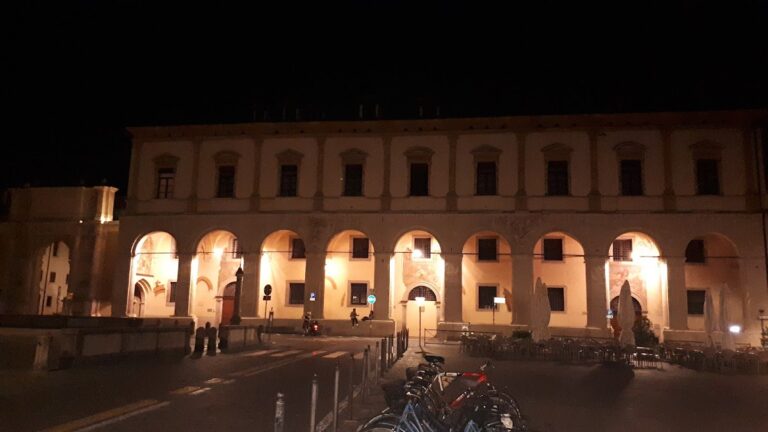
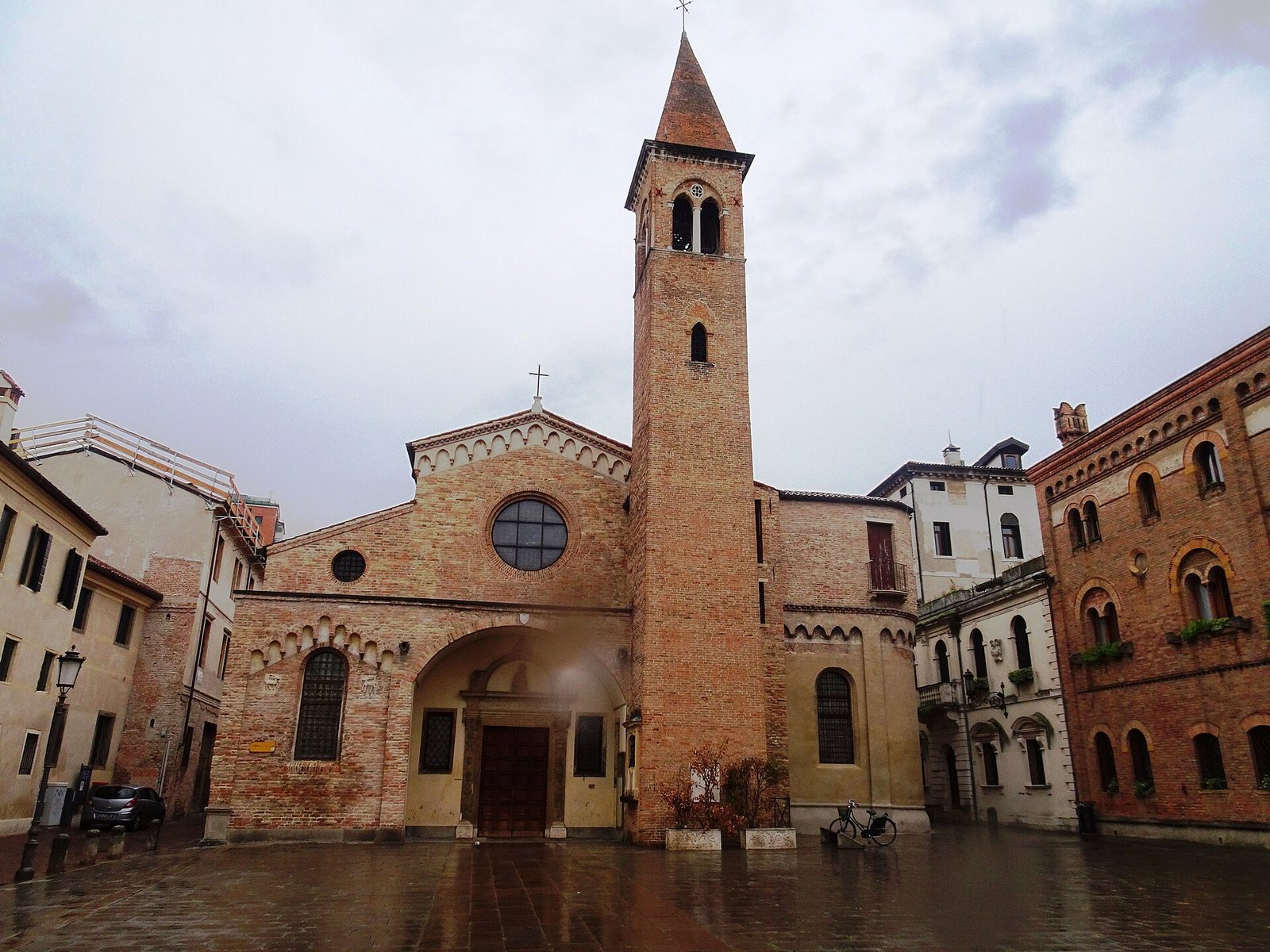
The church is oriented from east to west and faces a space that was used for burials until the Napoleonic period. A complex group of thirteenth- and fourteenth-century buildings surrounds it. Medieval houses rise above the right side, while the left side is built against the fourteenth-century Montorsi Palace. Palazzo Meschini and Palazzo Brunelli-Bonetti are also adjoining buildings in the church complex.
Facade and bell tower
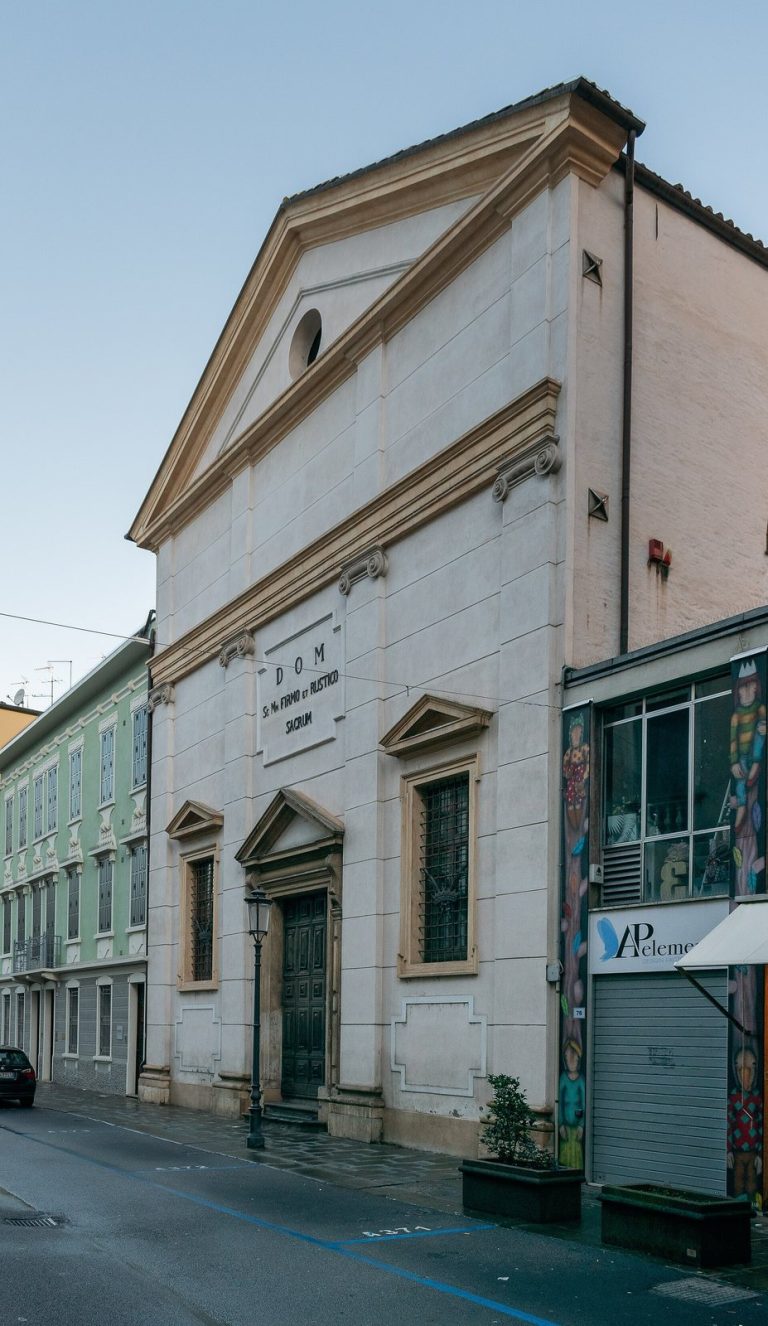
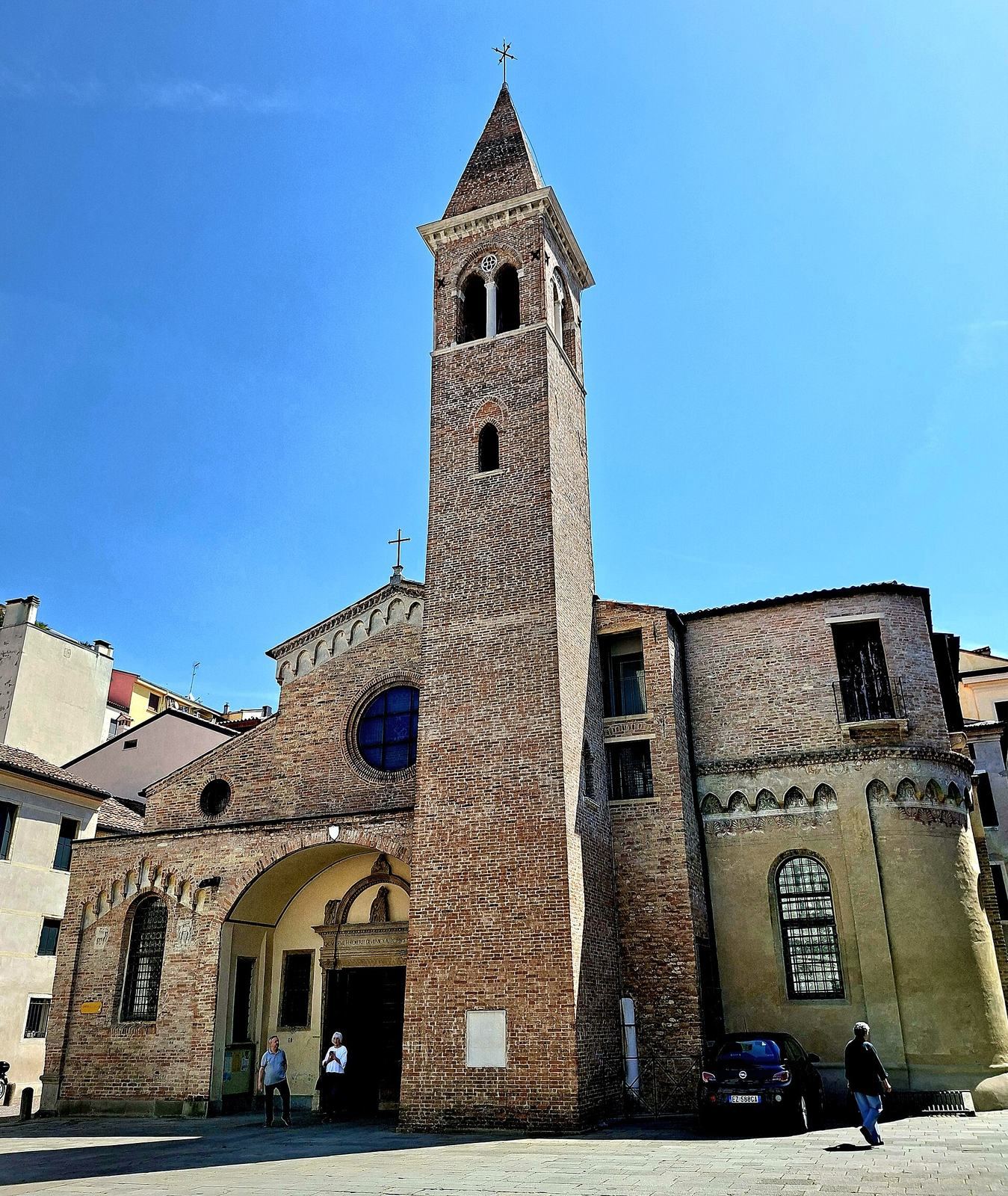
The facade combines a Gothic appearance with arcades and a rose window, a large circular opening filled with radiating tracery. The projecting Forzatè Chapel dates from 1367 and is joined to the Gothic bell tower by an arch. Beneath the arch is the principal Lombard-style portal, made during the second half of the fifteenth century. Its sculpture shows Saint Nicholas wearing a mitre, God the Father, and the Annunciation.
Complex Gothic masonry extends along the right side of the church. Small Gothic arcades, coats of arms, and heraldic paintings decorate the exterior, while additional heraldic representations and decorative elements extend across the building. The arrangement of the chapel, tower, arch, portal, and adjoining medieval buildings gives the exterior its layered character.
Interior arrangement
The interior is asymmetrical because a fourth nave opens toward the south. Arches of differing sizes and spans create an irregular internal space, while the vaulted ceiling dates from the fourteenth century. The chapel on the right contains an altarpiece of Saint Agnes transferred from the former church of Sant’Agnese. The chapel beside it contains a sixteenth-century baptismal font.
Forzatè tomb and Renaissance triptych
Behind the baptismal font stands the red Verona-marble tomb monument of Giordano and Marco Forzatè. A Renaissance triptych, a three-part painted work with a central panel and wings, rises above it in its original frame. The composition depicts Saints Leonardo and James with the Virgin and Child and is attributed to an artist of the Padovan school associated with the Bellini and Parisati traditions.
High altar and presbytery furnishings
The painting of the Holy Family with Saints Francesca Romana and Eurosia, signed by Giovanni Domenico Tiepolo and dated 1777, served as the high-altarpiece until 1966. The angel on its left was added by Giovanbattista Mingardi. The bronze screen that formerly closed the entrance to the presbytery, the area around the main altar traditionally reserved for the clergy, was made by Jacopo Gabano in 1747 and probably belonged to the former high-altar arrangement.
A large wooden high-relief panel represents Saint John the Baptist in the desert, Saint Francis receiving the stigmata, the bilocation of Saint Anthony of Padua, and Saint Bernardino healing a king. Three other panels of the same type survive in the church and probably decorated the stalls of the presbytery. Remnants of front panels from former altars remain along the walls.
Apse and altar features
The restored apse, the terminating part of the church, contains traces of fifteenth-century frescoes, attributed by some to Giovanni da Pisa. Its vault preserves fragments of Romanesque liturgical furnishings and a fifteenth-century fresco. Beneath the vault are liturgical seats dating from the 1970s. The present altar incorporates the mensa, the horizontal slab forming the top of an altar, from the former Baroque altar.
The altar of the Blessed Sacrament incorporates the former tabernacle, the receptacle used in Catholic churches to reserve the Eucharist. Nearby is a panel depicting Saint Liberale, attributed by some to Jacopo Parisati. On the right side of the church, a terracotta Madonna and Child is likewise attributed by some to Giovanni da Pisa.
Frescoes and devotional works
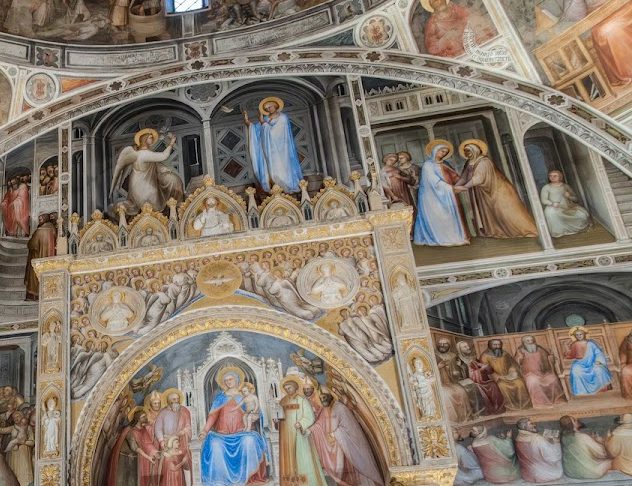
Fragments of frescoes depicting the Crucifixion and episodes from the life of Saint John the Baptist were painted by Gerardino da Reggio. Marco Forzatè commissioned them in 1374, adding a clear connection between the church’s artistic programme and the family’s long-standing patronage.
The 14 Stations of the Cross were made in enamelled copper in 1968 by the Padovan artist Paolo De Poli. Their modern date places them among the works introduced or retained during the period when the church was being restored and its interior reorganized.
Pipe organ
The pipe organ is Mascioni opus 557, built in 1941 to replace a nineteenth-century Pugina organ. It was moved to its present position during the 1997 restoration. The electrically operated instrument has two 58-note keyboards and a concave-radial pedalboard of 30 notes. Its case is largely confined to the wooden base, while the independent mobile console stands in the left side nave.