Bayham Old Abbey: A Premonstratensian Monastery in Kent and Sussex


Site at a Glance
- Rating
- 4.6
- Popularity
- Low
- Country
- United Kingdom
- Primary era
- Medieval
- External website
- Open
- Eras represented
- Medieval
- Civilizations
- English
- Site type
- Religious
- Remains
- Monastery
On this page8 sections
History
Bayham Old Abbey is a medieval Premonstratensian monastery in the United Kingdom, near Tunbridge Wells on the Kent and Sussex border. It was founded around 1208, when the failing monasteries of Otham in Sussex and Brockley in Kent were merged under the authority of Robert of Thurnham. The abbey was built for Premonstratensian canons regular, clergy who lived in a religious community while following the Rule of Saint Augustine.
Foundation and benefactors
Otham had been established around 1180 by Ralph de Dene, a Norman landowner. His son Robert and especially his daughter Ela helped endow the monastery. Ela de Dene was successively married to Jordan de Sackville and William de Marci, and the Sackville family later became Otham’s principal supporters. For generations, members of the family used the monastery for burials. The Brade family, associated with the Broad estate at Hellingly in East Sussex, also provided support.
The two communities that formed Bayham had different institutional backgrounds. Brockley was connected with Sulby, while Otham was possibly linked to Durford. After their merger, Prémontré Abbey became Bayham’s mother church, meaning the founding and supervising monastery from which the new community derived its affiliation.
Suppression and royal control
Cardinal Wolsey suppressed Bayham in 1525 as part of his attempt to obtain resources for two colleges he was establishing. Wolsey, an English churchman and chief minister of Henry VIII, faced local resistance to the decision. Villagers rioted and occupied the abbey before it passed into the control of Henry VIII in 1538, during the wider transfer of English monasteries to the Crown.
The former monastic estate was leased to Anthony Browne, 1st Viscount Montagu, and Queen Elizabeth I later sold it outright. After several changes of ownership, Sir John Pratt acquired the property in 1714. It remained with his family until 1961, when it was donated to the state and subsequently came under the care of English Heritage.
The abbey as an estate landscape
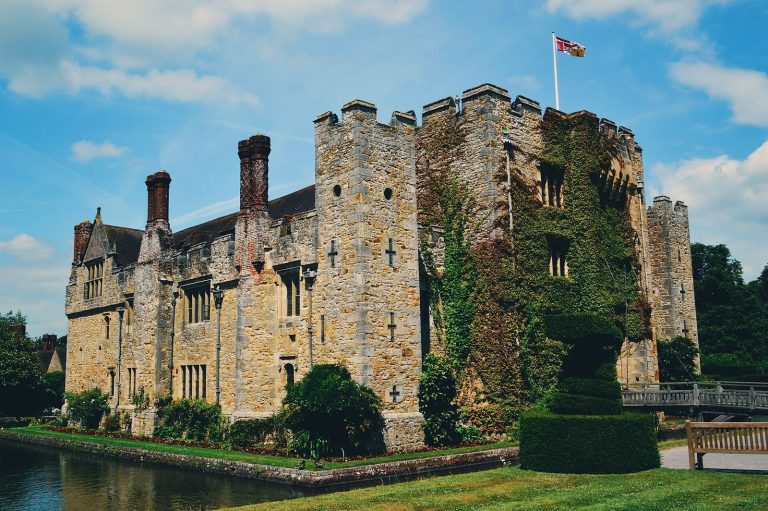
The Camden family, descended from the Pratts, built the Dower House, also called Bayham Old Abbey House, as the estate’s earlier residence. A dower house was intended for a widowed landowner’s wife or for the retired senior generation of a landed family. In 1872 the family moved to the newly built Bayham Abbey House on the opposite side of the River Teise valley.
During the late eighteenth century, parts of the ruins were modified as a landscape feature for the grounds of the new mansion. Humphry Repton incorporated them into his plans, preserved in one of his most complete Red Books, illustrated proposals for estate improvements. Samuel Hieronymus Grimm sketched the ivy-covered ruins around 1785, emphasizing their scale and picturesque appearance. The remains have also been used for family infant burials. A brief archaeological survey was published in 1966.
Remains
Abbey complex
Church and conventual rooms
Bayham Old Abbey stands in the valley of the River Teise, where the river supplied water and adequate drainage. Premonstratensian canons built the complex from local sandstone during the first half of the thirteenth century. The surviving remains consist largely of partial walls, but the arrangement of rooms can still be identified across the ruins.
The original design was enlarged in the fifteenth century with new transepts, while the earlier transepts remained visible within the later structure. Numerous ornate capitals and other carved stones survive, including the stone frameworks of the nave’s three large windows. The quality of this architectural work is particularly fine for a late-thirteenth-century Premonstratensian abbey.
Kentish Gate
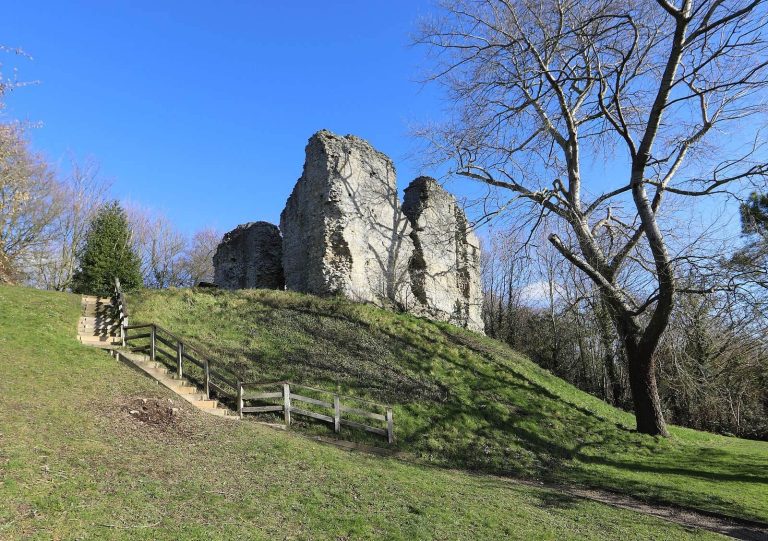
Because the abbey occupies the Kent and Sussex border, it is thought to have had an entrance in each county. The surviving ruins of a gatehouse known as the Kentish Gate stand on the grounds and form part of the wider archaeological remains of the monastic estate.