Alva Church: A Medieval Romanesque Church on Gotland
Site at a Glance
- Rating
- 4.2
- Popularity
- Very Low
- Country
- Sweden
- Primary era
- Medieval
- External website
- Open
- Eras represented
- Medieval, Early Modern, Modern
- Civilizations
- Swedish
- Site type
- Religious
- Remains
- Church
On this page11 sections
History
Medieval construction
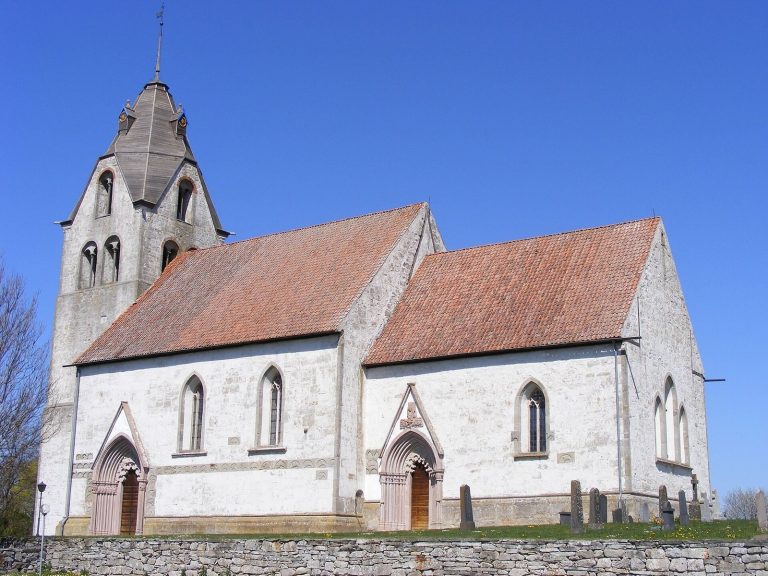
Alva Church is a medieval church in Sweden, on the island of Gotland south of Hemse. Its earliest construction belongs to the period around the turn of the twelfth and thirteenth centuries and followed the late Romanesque style, a medieval tradition known for substantial masonry, rounded arches, and sculpted portals. The choir and apse were built first, followed by the nave.
About a century later, work began on a broad western tower. Construction stopped before the tower reached its planned height, which was intended to be approximately twice its present height. The reason for the interruption is unknown, and the building activity appears to have ended abruptly. The southern portal also seems to have been completed irregularly.
Religious and later development
Alva Church was formerly Catholic and now belongs to the Church of Sweden in the Diocese of Visby. The Reformation, the sixteenth-century transformation that ended Catholic ecclesiastical authority in Sweden and established Lutheran state churches, changed the religious setting in which the church was used.
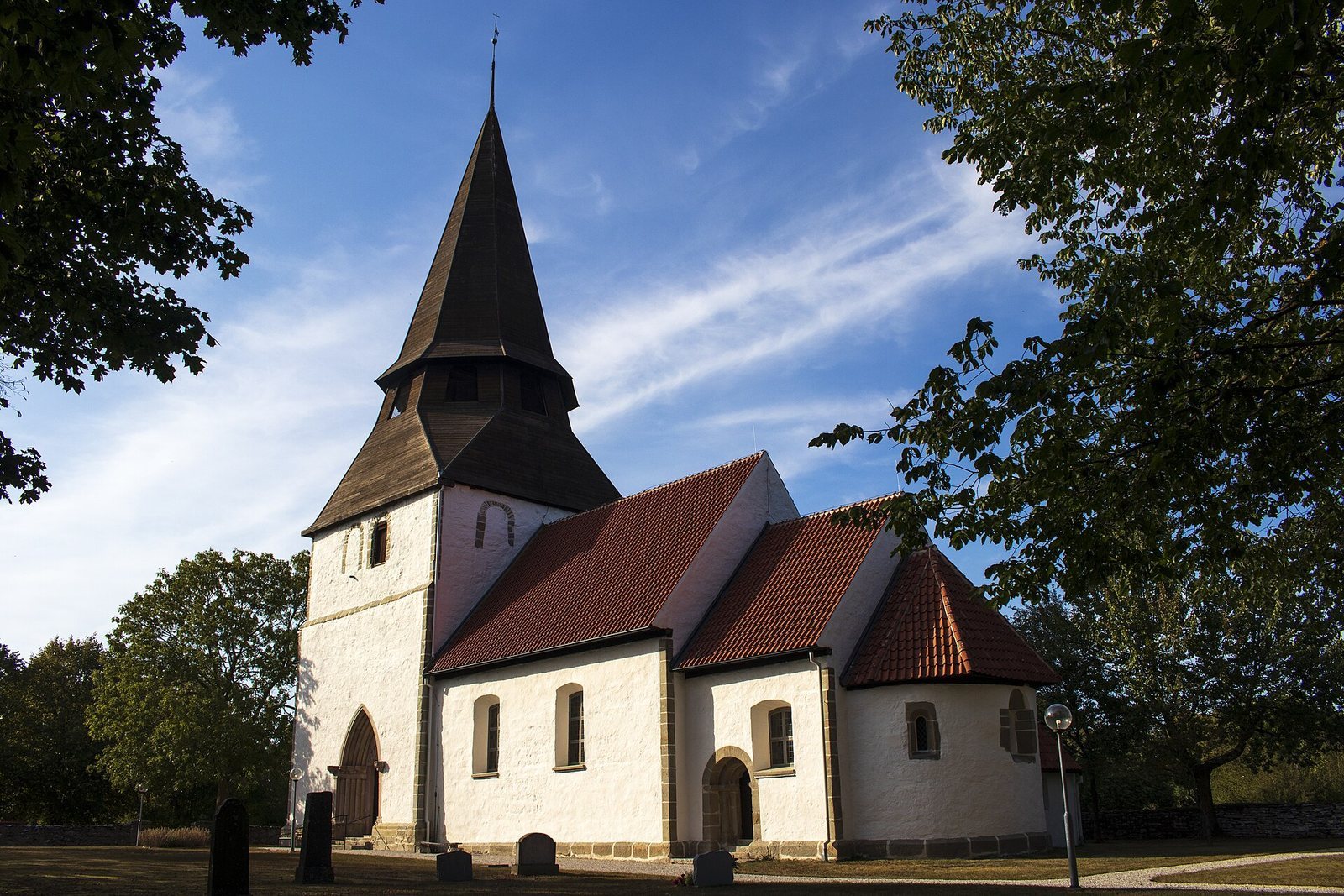
A sacristy was added around 1780. In the early nineteenth century, the windows were enlarged and the earlier roof covering was replaced with ceramic tiles. These changes altered the medieval building while preserving its principal structure.
Twentieth-century restoration
The church underwent extensive renovation in 1953 and 1954 under the direction of the Swedish architect Gösta Wiman. The ceiling and floors were replaced, and electric lighting and heating were installed. The façades, interior, and wall paintings in the nave and tower were retained.
The interior was reconstructed in 1990. The walls were cleaned, and the wooden nave roof was painted white. An exterior restoration in 1993, undertaken at the request of the architect Jan Utas, included limewashing the façades, repairing the roof, and conserving the portals.
Remains
Medieval structure
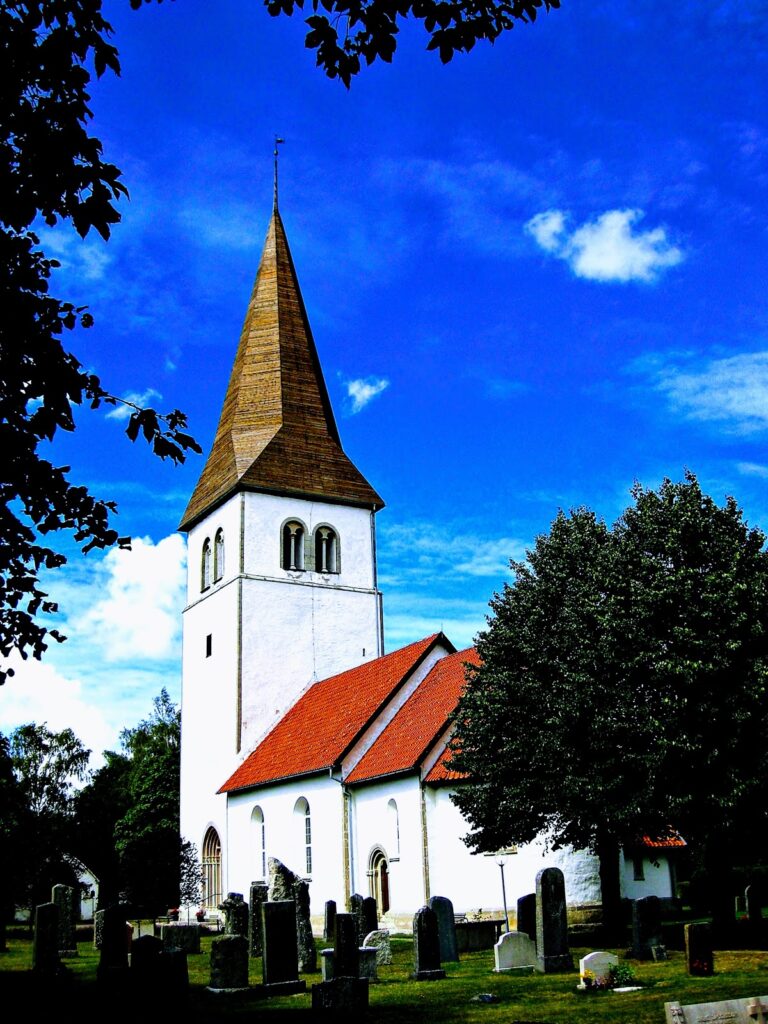
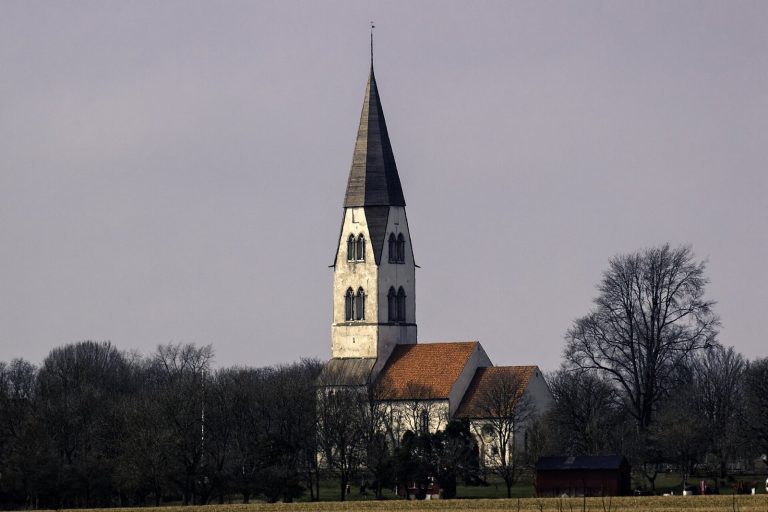
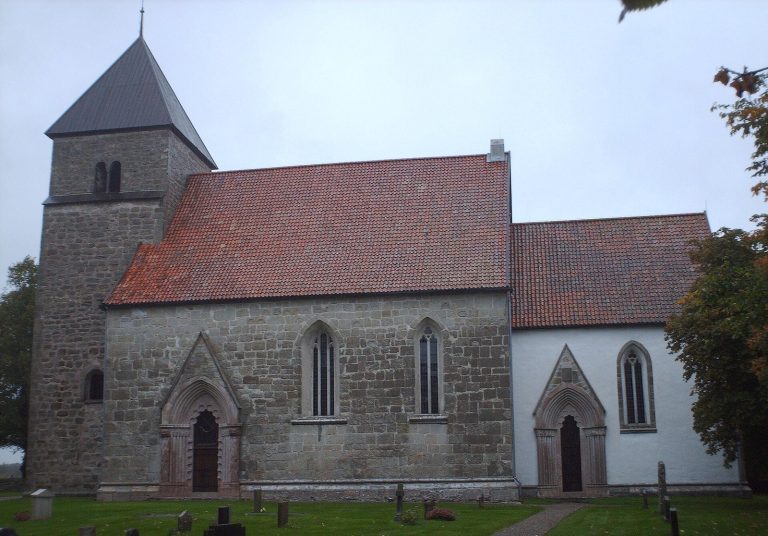
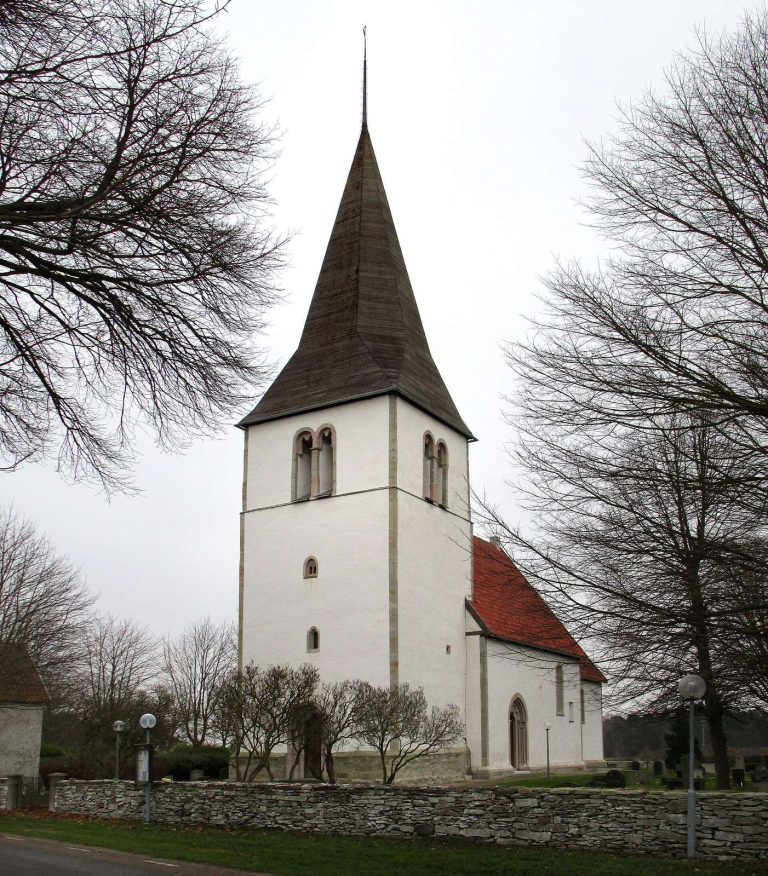
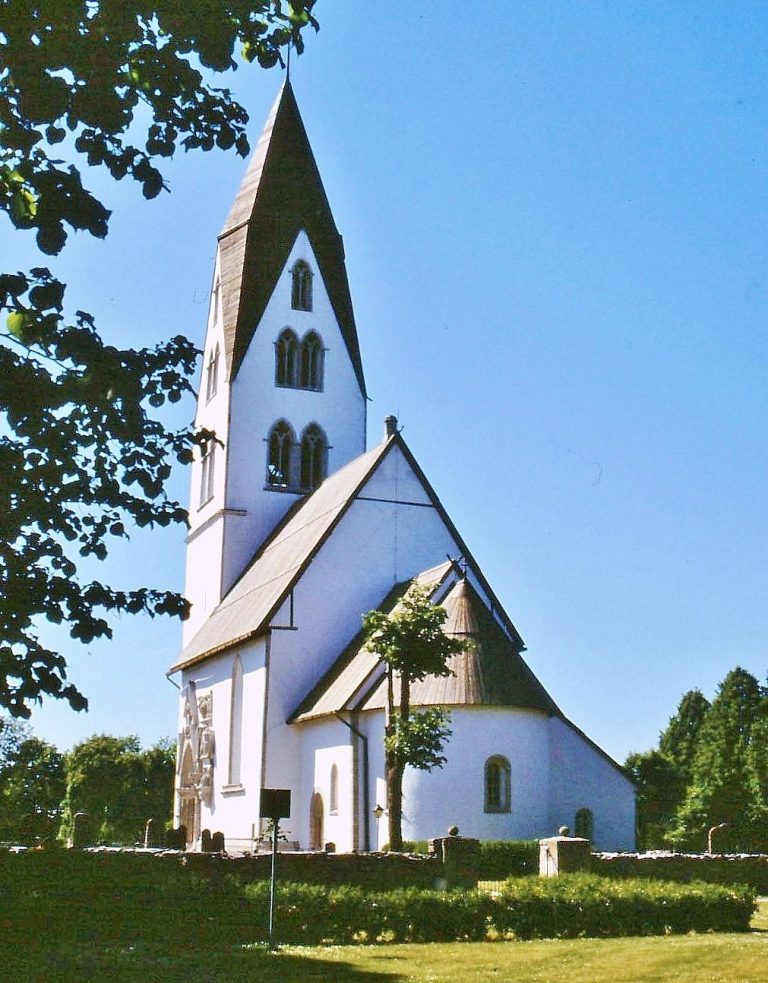
Alva Church has a stepped silhouette and unusual proportions created by its very broad, low western tower. The unfinished tower gives the building a form distinct from the height originally intended for it. The late Romanesque choir and apse are the oldest surviving parts. The apse is unusually rounded for Gotland. Sandstone was used for the choir and nave, while the later tower was built of limestone.
Portals and tower details
Choir portal
The Romanesque choir portal has columns resting on bases decorated with sculpted animal reliefs. The carvings are possibly attributable to Sigraf, the name used for a medieval Gotlandic stone-carver or workshop whose biography is not securely known.
Southern portal
The large southern portal shows signs of interrupted or poorly organized construction and is described as Gothic, a later medieval style generally associated with more pointed and vertically oriented forms. Some surviving portal elements were reused as the ceiling of a staircase in the northern wall of the tower.
Nave portal
The nave portal is now positioned on the north side. Its sculpted capitals depict an eagle biting beyond a ring and a male head. The portal is Romanesque in character, linking its decoration to the earlier architectural tradition of the church.
Interior furnishings and decoration
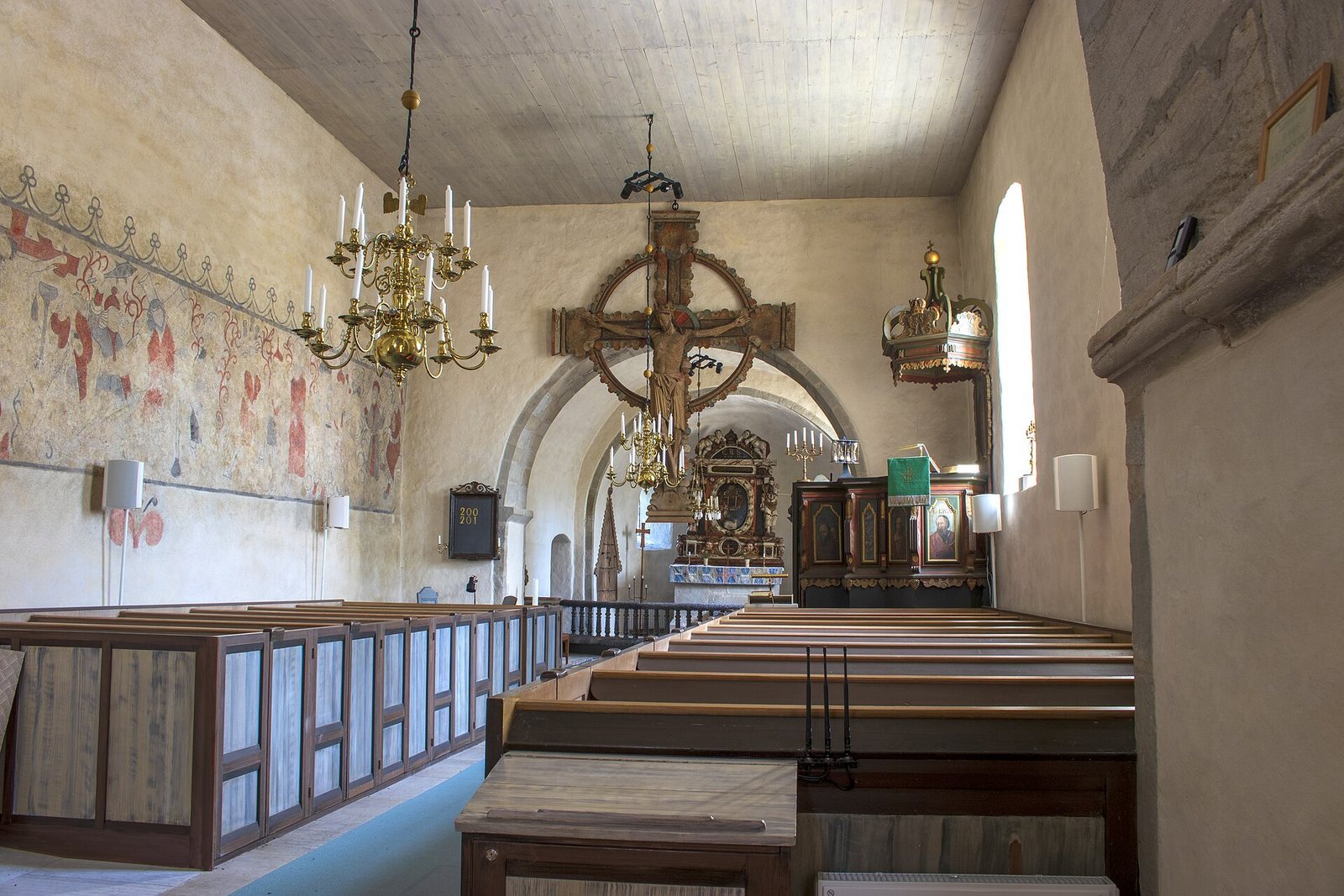
Late-medieval wall paintings survive inside the church, including paintings on the north wall of the nave. They were probably made immediately before the Reformation and may have been produced by the same artist who decorated Lau Church. The paintings are also conventionally associated with the designation “Master of 1520.”
The limestone altar table has an unusual base. Behind it stands a partly preserved Romanesque baptismal font with a relief-decorated base, probably made by Hegvald, the name given to a medieval Gotlandic stone-carver or workshop, in the late twelfth century. A large triumphal cross, the crucifix traditionally placed between the nave and choir, dates from the middle of the thirteenth century.
Later furnishings include an unusually decorated altarpiece from 1653 and a pulpit from 1740. Beside the entrance to the sacristy lies a medieval grave slab. Its inscription states that Botvi, the wife of Botvid of Alva, died on 1 January 1317 and expresses the wish that she rest in peace.