Old Uppsala Church: A Medieval Cathedral and Parish Church in Sweden


Site at a Glance
- Rating
- 4.6
- Popularity
- Low
- Country
- Sweden
- Primary era
- Medieval
- External website
- Open
- Eras represented
- Medieval, Early Modern
- Civilizations
- Swedish
- Site type
- Religious
- Remains
- Church
On this page13 sections
History
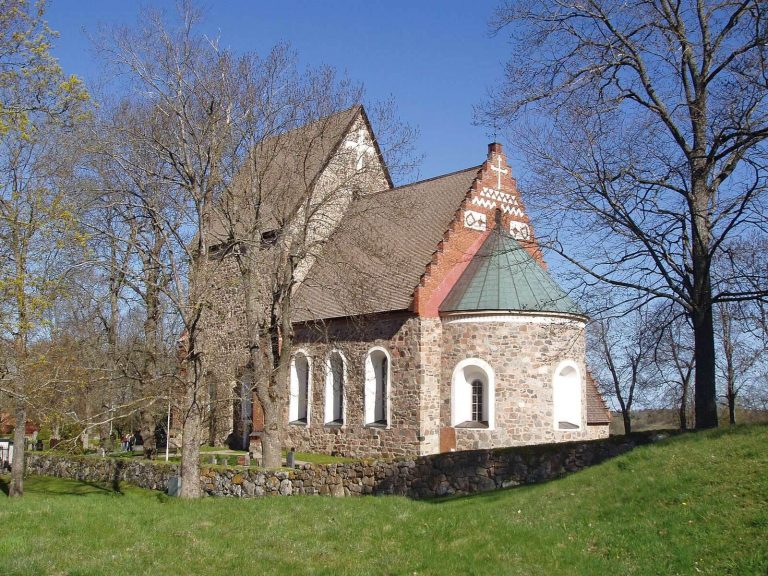
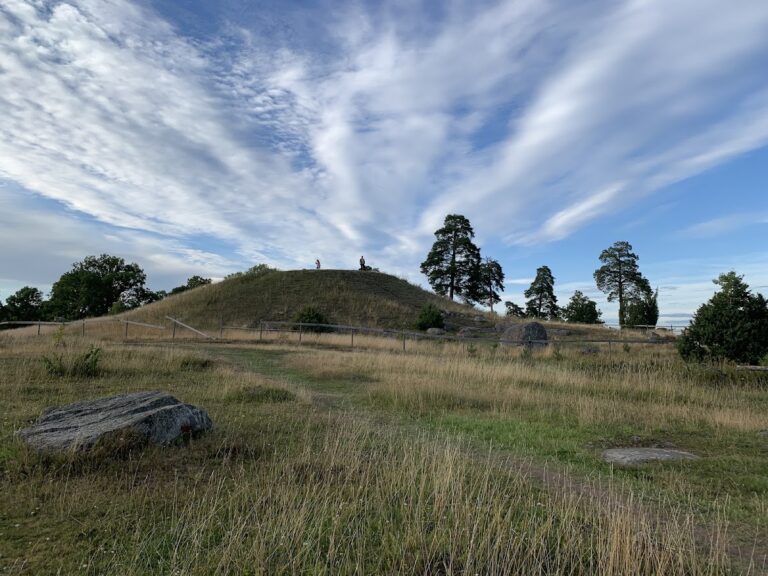
Old Uppsala Church is a medieval Christian church in Uppsala, Sweden, built as a Romanesque stone cathedral during the twelfth century and completed in the first half of the thirteenth century. It stands in Gamla Uppsala beside the ancient royal burial mounds and now serves as the parish church of Gamla Uppsala within the Church of Sweden and the Diocese of Uppsala.
Earlier sanctuaries and the Christian church
The church may occupy the site of a pre-Christian Nordic temple described by Adam of Bremen, an eleventh-century German ecclesiastical chronicler, around 1076. Wooden posts and other timber remains found beneath and around the building indicate that one or more earlier wooden structures stood here. Their identification with Adam of Bremen’s temple remains probable rather than certain. A Christian wooden church later preceded the present stone building.
The stone cathedral was begun in the mid-twelfth century and completed before a fire around 1240. Its construction belongs broadly to the twelfth century, while its completion falls in the first half of the thirteenth century. During Sweden’s final Christianization, Gamla Uppsala became a bishop’s seat after the episcopal seat moved from Sigtuna. In 1164 it was raised to an archbishopric, a church province governed by an archbishop, after Sweden had previously been subordinate to the Danish Archdiocese of Lund.
Saint Eric and the transfer of the archbishopric
King Eric IX was murdered in the Gamla Uppsala area around 1160. Later venerated as Saint Eric, he became associated with the developing cult of the new archdiocese and soon became the patron saint of the Swedish kingdom.
The fire around 1240 damaged the cathedral. Part of the building was dismantled, while a sacristy and porch were added. Later fires contributed further to the reduction and rebuilding of the complex. Around 1273, the archiepiscopal seat moved to Östra Aros, about five kilometres away, where a new cathedral was being built. The name Uppsala was transferred to Östra Aros, while the former cathedral at Gamla Uppsala became a parish church. Gamla Uppsala had originally borne the name Uppsala and had gradually lost economic importance.
Later rebuilding and continuing use
During the fifteenth century, the church was partly rebuilt after the earlier destruction. It received wall paintings and acquired the form that has largely survived. The building was restored during the episcopate of Jöns Bengtsson Oxenstierna, and painted coats of arms preserve aspects of that work. Anders Celsius, the physicist and astronomer, is buried in the church.
Old Uppsala Church was formerly Roman Catholic and became Lutheran after the Reformation. It has remained the parish church of Gamla Uppsala. Under Chapter 4 of Sweden’s Cultural Heritage Act, it has protected ecclesiastical-monument status because it was erected before the statutory 1939 cutoff.
Remains
The surviving church is a Romanesque stone building made chiefly of granite or dressed stone, with brick used decoratively. It represents approximately half of the original cathedral. The first cathedral had a Latin-cross plan with three aisles, a transept whose two arms ended in apses, and probably twin western towers. A central tower rose above the crossing and was formerly taller than the structure that survives.
The surviving cathedral core
Central tower
The lower part of the former central tower is one of the principal medieval elements still standing. It occupies the crossing of the original cathedral and preserves part of the building’s former central vertical structure.
Former choir and apse
The former cathedral choir also survives, together with its apse, a usually semicircular end to a church or chapel. The former choir now serves as the nave, while the apse forms the present choir, or presbytery.
Later additions and interior features
Bell tower
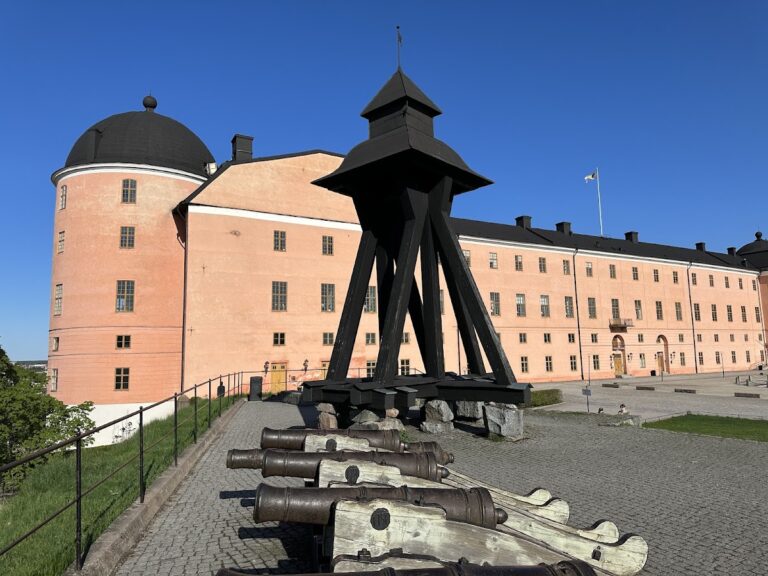
A separate wooden bell tower stands north of the church. Built in the mid-seventeenth century, it is supported by wooden posts about 13.5 metres high. The posts measure approximately 60 centimetres in diameter at their bases and 50 centimetres at their tops.
Sacristy and porch
A sacristy was added on the north side of the choir, and a porch was built on the west side after the cathedral’s earlier damage. The porch contains late Gothic wall paintings, while the church interior also preserves other late Gothic paintings and painted coats of arms connected with the restoration under Jöns Bengtsson Oxenstierna.
Medieval furnishings
Some surviving furnishings may date from the twelfth century. Among them is a triumphal crucifix formerly suspended in the chancel arch. The damaged figure of Christ has a cavity in the chest, interpreted as a former reliquary for a saint’s relics. The church also preserves a wooden chest carved from a single oak trunk. Its main altar belongs to the later medieval furnishings and carries carved and painted figures of saints.
Archaeological setting
Archaeological work beneath and around the church has exposed wooden posts and other timber associated with earlier structures. Behind the church, terraces are identified with the area where ancient royal buildings stood, placing the surviving medieval building within the wider setting of Gamla Uppsala’s earlier royal and religious landscape.