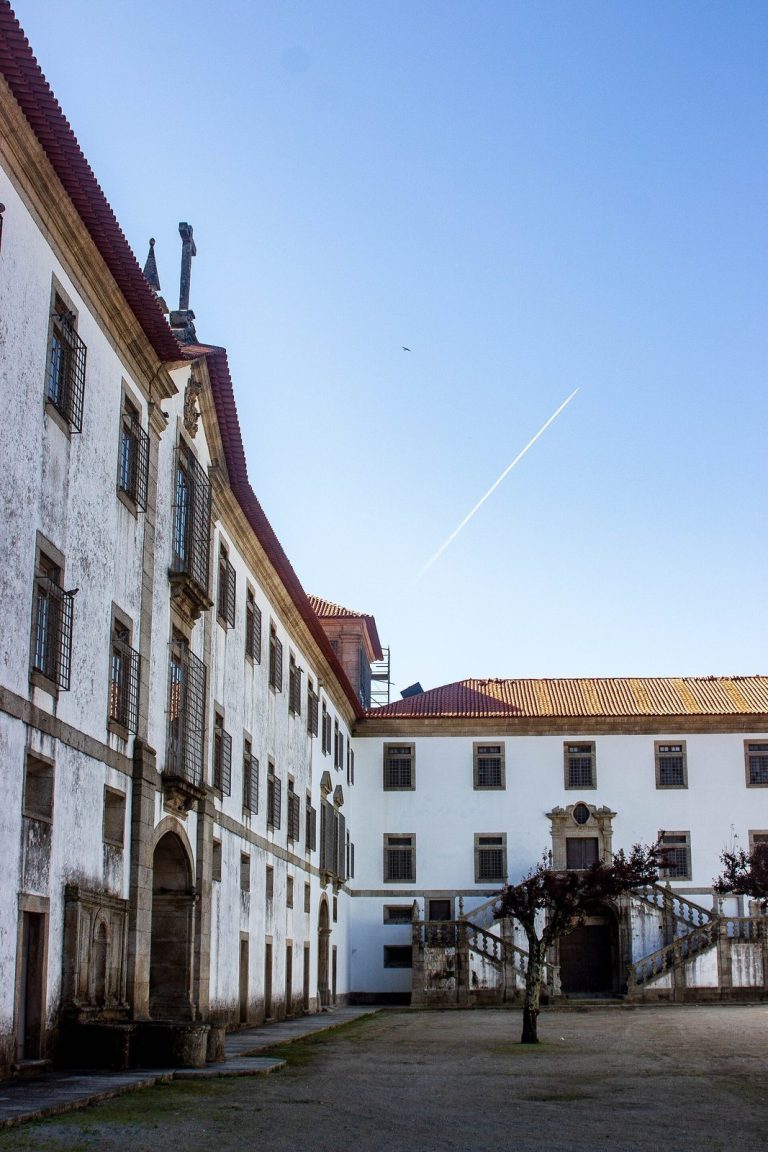
Monastery of Jesus and the Tomb of Saint Joana in Aveiro


Site at a Glance
- Rating
- 4.6
- Popularity
- Medium
- Country
- Portugal
- Primary era
- Medieval
- External website
- Open
- Eras represented
- Medieval, Early Modern
- Civilizations
- Portuguese
- Site type
- Religious
- Remains
- Monastery
On this page15 sections
History
The Monastery of Jesus and the Tomb of Saint Joana is a historic monastery in Aveiro, Portugal, founded in the fifteenth century as a cloistered convent of Dominican nuns. Its origins date to 1458–1460, when Beatriz Leitoa and Mecia Pereira withdrew to a small house on the site. A papal bull authorized the foundation on 16 May 1461, construction began in the following year, and the convent began operating in 1465.
Foundation and Joana of Portugal
Joana, Princess of Portugal, was the daughter of King Afonso V and a Portuguese royal infanta, meaning a daughter of the monarch who was not the heir apparent. She entered the convent in 1472 and lived there as a modest nun until her death in 1490. Because she remained a potential royal successor, she was not permitted to take solemn vows. Joana was beatified in 1693, and her presence gave the monastery a lasting religious and royal association.
Baroque transformation
The monastery was restored and improved during later centuries, particularly under King Pedro II and King João V. Important Baroque ensembles were added during this period. Baroque art is characterized by elaborate ornament, dramatic sculptural forms, richly decorated surfaces, and strong visual effects, qualities expressed here through carved and gilded woodwork, sculpture, marble, and tiles.
From convent to museum
Portugal’s religious orders were dissolved in 1834, but the convent remained active until the death of its last nun in 1874. The church and its artistic heritage then passed to the Royal Brotherhood of Saint Joana Princess. Dominican religious women continued to oversee the remaining premises and opened Saint Joana College, which closed in 1910 after the establishment of the Portuguese Republic.
In 1911 the former convent was transferred to the Municipality of Aveiro, and the Aveiro Museum was established there. João Augusto Marques Gomes played a major role in developing its holdings, gathering objects from former religious houses in the Aveiro region and elsewhere in Portugal. The former monastery has been classified as a National Monument since 1910. Its conventual buildings are now incorporated into the museum, whose collections cover artistic periods from the fifteenth to the twentieth centuries, with particular strength in sacred art and Portuguese Baroque art.
Remains
The surviving complex combines the Church of Jesus, conventual spaces, the cloister, and rooms incorporated into the Aveiro Museum. Its interiors are especially marked by extensive glazed decorative ceramic tiles, known as azulejos, and by talha dourada, the Portuguese tradition of gilded carved woodwork used for church interiors, chapels, and sanctuary spaces.
Church of Jesus
High chapel
The high chapel was made in Porto between 1725 and 1729. Woodcarvers and sculptors António Gomes and José Correia worked on the ensemble, while the painter Manuel Ferreira e Sousa also contributed. Its richly ornamented Baroque decoration forms part of the church’s broader combination of gilded carved woodwork and tile covering.
Tomb of Saint Joana Princess
The interior choir frames the tomb of Saint Joana Princess. Designed by the royal architect João Antunes and produced between 1699 and 1711, the tomb is made of polychrome marble and includes sculptural elements in an Italianate style. The surrounding wall decoration combines gilded carved woodwork with tiles, creating an integrated memorial setting for the princess and religious figure associated with the convent.
Saint Joana sanctuary room
The Saint Joana Princess sanctuary room contains a group of paintings set within an extensive covering of gilded carved woodwork. Together, the paintings and carved decoration give the room a strongly unified devotional character.
Conventual spaces
Cloister
The cloister dates from the fifteenth and sixteenth centuries and preserves an architectural part of the convent’s earliest development. It belongs to the group of former monastic spaces now incorporated into the museum.
Refectory
The refectory contains an elegant reading tribune, while tiles cover its walls. The room retains the relationship between communal convent life and the decorative treatment applied to important interior spaces.
Tombs and museum collections
Tomb of João de Albuquerque
The museum preserves the fifteenth-century Gothic tomb of the knight João de Albuquerque, lord of Angeja. Its presence adds a medieval funerary monument to a complex otherwise especially associated with Joana of Portugal and later Baroque decoration.
Sacred art collections
The museum’s collections include paintings, sculpture, gilded woodwork, tiles, goldsmiths’ work, furniture, and ecclesiastical vestments dating from the fifteenth through the twentieth centuries. Among the named works are the Holy Family by Machado de Castro, an important Portuguese sculptor of the eighteenth-century tradition; an eighteenth-century polychrome wooden sculpture of Our Lady of Pity; and a work by António André, dated 1618–1625, depicting Brother Bartholomew of the Martyrs, bishop of Braga.
Other works include an eighteenth-century Lamentation of Christ with the Virgin Mary, Saint John the Evangelist, and Saint Mary Magdalene by an unknown artist, as well as a fifteenth-century portrait of Saint Joana Princess, also by an unknown artist. Objects from the Monastery of Jesus stand alongside material from other dissolved monastic institutions in Aveiro and elsewhere in Portugal, preserving a broad record of Portuguese sacred and Baroque art within the former convent.