Parish Church of St. Andreas, Teltow: A Lutheran Landmark in Germany
Site at a Glance
- Rating
- 4.5
- Popularity
- Very Low
- Country
- Germany
- Primary era
- Modern
- External website
- Open
- Eras represented
- Medieval, Modern
- Civilizations
- Holy Roman Empire, Margraviate of Brandenburg
- Site type
- Religious
- Remains
- Church
On this page12 sections
History
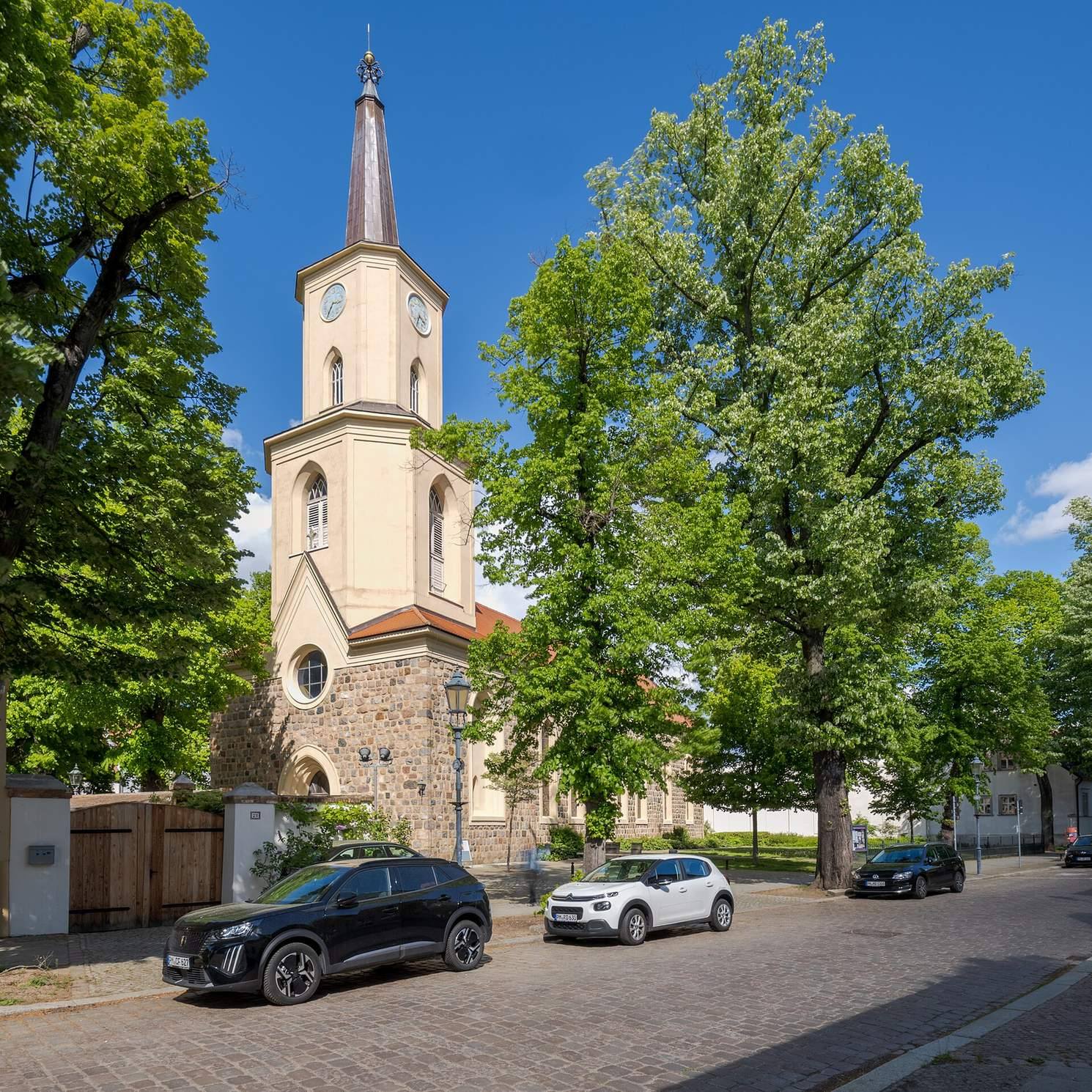
Parish Church of St. Andreas is a Lutheran parish church in Teltow, Germany, standing in the town’s old centre between Ritterstraße and Breite Straße. Built by the medieval communities of the Mark of Brandenburg, it began as a fieldstone church around 1230, although its origins are also placed broadly in the twelfth century. The church is regarded as a landmark of Teltow and belongs to the Evangelical Church in Berlin, Brandenburg, and Upper Lusatia.
Medieval origins and repeated fires
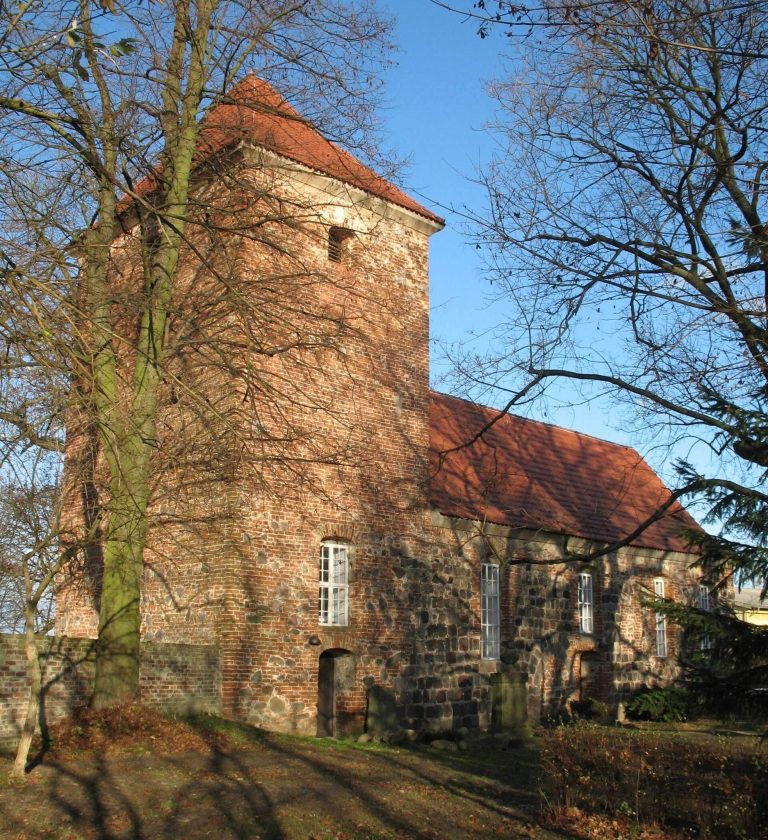
The first building was a large fieldstone hall with a broad western tower and a set-back rectangular choir. Its tower was conceived as a defensive structure, an arrangement characteristic of small-town churches in the thirteenth-century Mark of Brandenburg. Fieldstone, made from naturally gathered stones laid in mortar, was widely used in the region because suitable dressed stone was scarce. The form was unusual for an urban parish church.
The church and its successors endured several destructive fires. Major town fires damaged the buildings in 1515, 1573, and 1711. On 17 August 1801, fire destroyed the church completely, bringing the existing sequence of medieval and later buildings to an end. The original masonry is the surviving fabric that connects the present church with its first construction period.
Schinkel’s reconstruction
Rebuilding began in 1810 with plans prepared by building inspector Balkow. Building inspector Schwarz objected to the initial design, after which the plans were revised. Karl Friedrich Schinkel, the leading Prussian architect and designer of the early nineteenth century, strongly influenced the final result, especially the new choir wall and the upper part of the tower. His work combined the clear forms of Neoclassicism with historically inspired Gothic elements.
The tower superstructure was erected in 1811 and 1812 and was finished with a crown. This feature referred to the former patronage rights of the margraves of Brandenburg and was intended to identify Teltow as their crown estate. The rebuilt church was rededicated on 13 September 1812. In the same year, an organ from the Jungfernstift of Groß Glogau was installed as a gift from King Frederick William III. Its maker is unknown.
Twentieth-century alteration and preservation
Structural defects prompted another major renovation in 1910. The interior was thoroughly redesigned, so that Schinkel’s influence could no longer be recognized inside. During this work, the church received a painted wooden barrel vault and a gallery for the organ at the western end. Teltow sculptor August Mattausch produced woodcarving for the pulpit, gallery, and pews. Professor August Oetken of Berlin created the ceiling and wall paintings and designed the church windows, while the South Tyrolean woodcarver Franz Tavella of Brixen made the crucifix above the altar area.
The church windows were destroyed during the Second World War. After the war, whitewash covered the wall paintings, and the three chandeliers were replaced by simple lamps. Exterior renovation from 2006 to 2011 repaired the tower and renewed the roof timbers, bell frame, and copper-sheet roofing. A smouldering fire in December 2009 led to interior restoration, which used the 1910 arrangement as its model. Reconstructions of the three chandeliers restored the former lighting arrangement in 2013, and restorer Moosel Koch reconstructed the lost pulpit sounding board after the 1910 model in spring 2021.
Parish Church of St. Andreas is protected as an architectural heritage monument in Brandenburg. Until the beginning of the nineteenth century, Teltow’s cemetery surrounded the church. A replacement cemetery was established in 1805 at Weinbergsweg on an area of 1,850 square metres. Two tomb monuments there commemorate pastors Heinrich August Encke and Anton Christian Lange, who also served as superintendents of the Kölln-Land I church district. This church district was administered from Teltow between 1850 and 1924. A superintendent was a senior official responsible for overseeing clergy and congregations within such a district.
Remains
Medieval masonry and reconstructed exterior
The surviving medieval fabric is concentrated in the church’s original fieldstone masonry. The first building followed a clear plan, with a broad western tower conceived for defence, a hall for the congregation, and a narrower rectangular choir. Repeated fires and rebuilding transformed the structure, but this masonry preserves the physical link to the church’s medieval foundation.
The nineteenth-century exterior combines Neo-Gothic and Neoclassical elements. Schinkel’s reconstruction introduced the choir wall and the tower’s upper structure, which was built in 1811 and 1812 and carries the crown associated with Brandenburg’s former patronage. Repairs between 2006 and 2011 renewed the roof timbers, bell frame, and copper covering and included work on the tower.
Interior furnishings and musical equipment
Interior arrangement and decoration
The interior follows the arrangement created in 1910. A painted wooden barrel vault replaced the earlier coffered ceiling, and an organ gallery occupies the western end. Mattausch’s woodcarving survives in the pulpit, gallery, and pews. Oetken’s ceiling and wall paintings belong to the same redesign, while Tavella’s crucifix dominates the altar area. The postwar whitewash over the wall paintings and the destruction of the historic windows form part of the church’s later physical history. Reconstructed chandeliers were installed in 2013, and a new sounding board for the pulpit was made in 2021 after the 1910 model.
Organ
The first nineteenth-century organ arrived in 1812 from the Jungfernstift of Groß Glogau. Johann Simon Buchholz replaced it with a new instrument in 1823. Ferdinand Dinse repaired that organ in 1868, followed by Carl Eduard Gesell in 1893, but it had almost entirely ceased to function by 1906. Schuke Orgelbau built the present organ in 1910 as a pneumatic cone-chest instrument, in which air pressure transmits the player’s key movements to cone-shaped valves beneath the pipes. The instrument was repaired several times, its stop arrangement was altered, and Schuke supplemented it after 1945. It now has 17 stops on two manuals and pedal, with the manuals coupled to the pedal and to each other.
Bells and tower clock
Bells
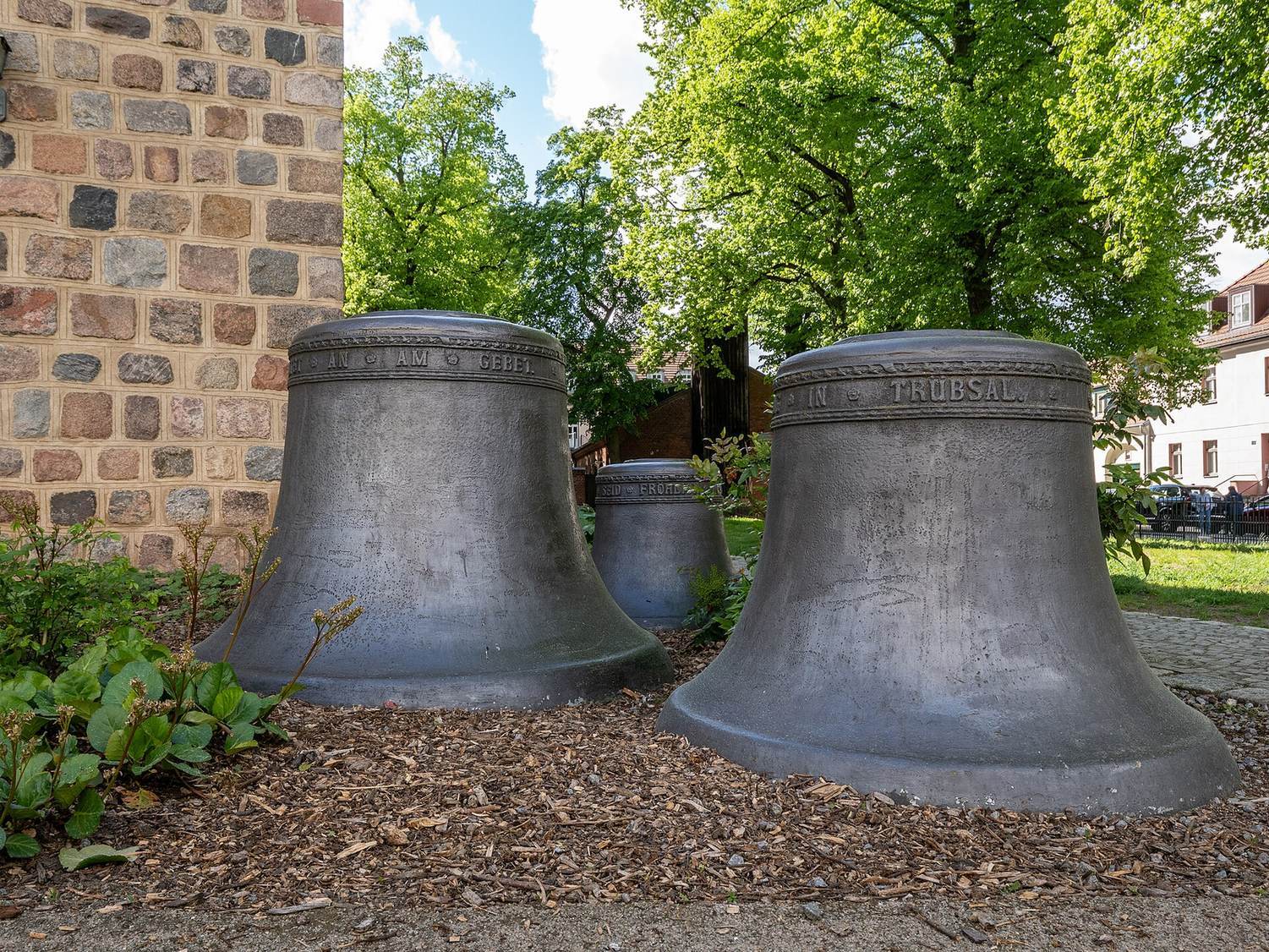
Three old iron bells stand on the grounds behind the church. They were installed in 1924 as replacements for the bronze bells melted down during the First World War. Three new bronze bells now hang in the tower.
Tower clock
The old tower clock remains behind a display window connected with the archive and washing-technology exhibition of the Heimatverein Stadt Teltow 1990 e.V. Its preserved position links the tower’s historic equipment with the church’s later interpretive use.