Hakeburg: A Neo-Romanesque Manor House in Kleinmachnow


Site at a Glance
- Rating
- 3.9
- Popularity
- Low
- Country
- Germany
- Primary era
- Modern
- External website
- Open
- Eras represented
- Modern
- Civilizations
- German
- Site type
- Domestic
- Remains
- Castle
On this page10 sections
History
Hakeburg is a large castle-like manor house in Kleinmachnow, Germany, built from 1906 to 1908 in the Neo-Romanesque style for the nobleman Dietloff von Hake-Kleinmachnow. Designed by Bodo Ebhardt, it served first as an aristocratic residence before becoming a center for postal research, wartime technology, political education, and later redevelopment.
The medieval estate and the von Hake family
A castle already stood at Kleinmachnow by the beginning of the fourteenth century. Ownership passed through the von Löwenberg family, the mint master Thile Brügge, and the von Quast family before the feudal holdings of Kleinmachnow and Stahnsdorf came to the von Hake family at the beginning of the fifteenth century. The von Hakes, a Brandenburg noble family associated with landed estates in the region, soon established themselves at the property.
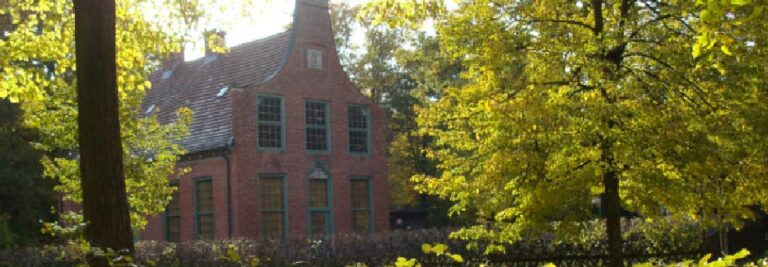
The old estate covered about four hectares and included the earlier castle and a manor house built in 1803 by David Gilly for the von Hake family. It lay behind a watermill whose inscription gives a construction date of 1695 and records its renewal in 1856 by the von Hake brothers. The New Hakeburg was built separately, on the opposite side of Machnower See, for Dietloff von Hake-Kleinmachnow, a cousin of the estate’s owner.
The New Hakeburg, 1906 to 1936
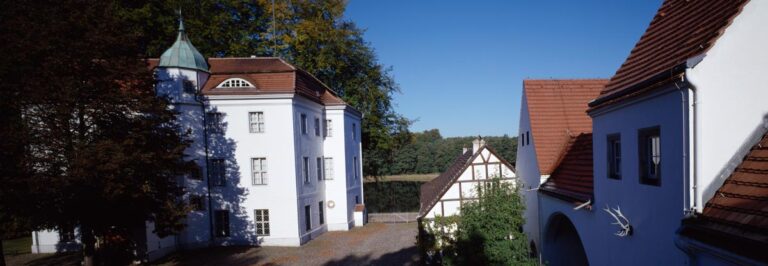
Construction of the New Hakeburg took place from 1906 to 1908. Bodo Ebhardt designed the building in a Neo-Romanesque manner, using forms inspired by medieval Romanesque architecture and its heavy, fortress-like character. The building was intended as an aristocratic residence for Dietloff von Hake-Kleinmachnow, who was also a genealogist.
Financial difficulties brought this phase to an end. In 1936, the New Hakeburg and 44 hectares of land were sold to the Reich Postal Ministry, the German state institution responsible for postal and telecommunications services.
Postal research and the Second World War
In 1938, the building was converted into a residence for Reich Post Minister Wilhelm Ohnesorge, a Nazi-era German politician. The German Reich Postal Research Institute was established there, and the estate developed into a research and testing center. Its work included aircraft, especially flying-wing aircraft, radio-location equipment, transmitters, control devices, broadband cable, and radio and television technology.
These projects were directed by the SS Economic and Administrative Main Office, a central SS agency responsible for economic administration and logistical functions, including oversight of some wartime research and production projects. On 2 December 1943, during the Second World War, a British Lancaster bomber was shot down and crashed near the New Hakeburg. The Norwegian writer and poet Nordahl Grieg died in the crash.
The old castle and the 1803 manor house at the original estate burned out in 1943. The manor house was demolished in 1950, while only parts of the old castle’s foundation walls survive.
Political education in the German Democratic Republic
From 1948, in the Soviet occupation zone and later in the German Democratic Republic, the New Hakeburg served as the party academy of the Socialist Unity Party of Germany. The party was the ruling communist organization of the German Democratic Republic, and its academy trained ideological and political cadres for the party and state. Its lecturers included Wolfgang Leonhard, a German historian and former communist, and Carola Stern, a German journalist, historian, and human-rights activist.
The building later temporarily housed the Joliot-Curie intellectuals’ club before being converted into a guest house for the party. This succession of uses connected the New Hakeburg first with state research and then with the political institutions of East Germany.
After reunification
After the peaceful revolution, Hakeburg GmbH, a hotel company, was established in May 1990. A later investigation into party assets found that the Party of Democratic Socialism had provided the company with a 50,000 Deutsche Mark operating loan in connection with asset transfers. The loan was subsequently repaid.
After German reunification, Deutsche Telekom became the property’s owner, followed by ORCO Germany S.A. The property had been vacant since 2005. The Skyland Group acquired it from the Treuhand, the institution created after the collapse of the German Democratic Republic to administer and privatize state property, around 2006. Between October 1999 and the 2010s, the self-proclaimed government in exile of Sealand also claimed the New Hakeburg on the basis of an alleged 99-year lease.
A 2010 municipal development plan proposed a hotel, an additional accommodation building, and an underground garage. When no suitable hotel operator was found, plans from 2012 onward shifted toward condominiums. The New Hakeburg is protected as a historic monument, and redevelopment was planned in cooperation with monument-protection authorities.
The plans called for the New Hakeburg, coach house, and gatehouse to be restored and converted into apartments. Two additional villas and an underground garage were also proposed. Construction was scheduled to begin in the third quarter of 2021, with the first apartments intended for completion in 2023 and the villas in 2024. In 2020, an investor group acquired the property and undertook a gradual heritage-sensitive restoration. By mid-2025, the final apartment layout in the main building was still not apparent. Hakeburg Grundbesitz GmbH is 94.3 percent owned by OTT Partners of Nicosia, whose director is Jean-François Ott, previously the founder of the ORCO Group.
Remains
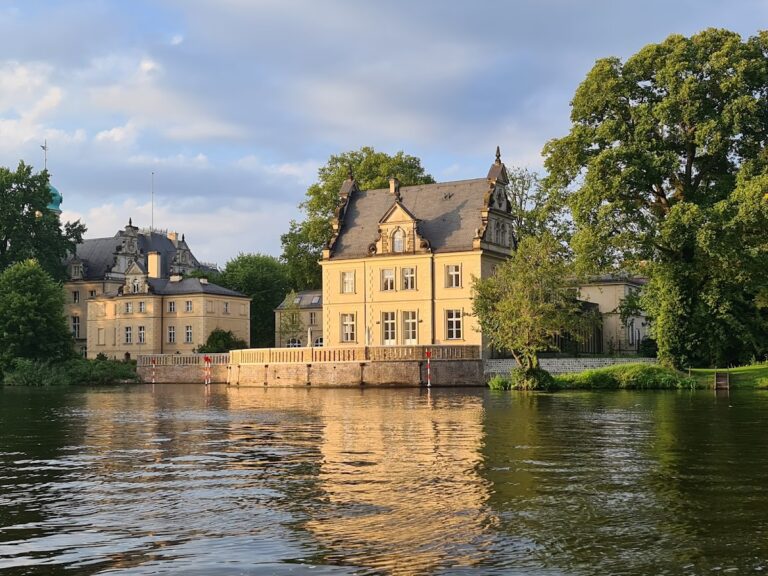
The surviving Hakeburg complex is centered on the New Hakeburg, a large Neo-Romanesque manor house on the Seeberg, on the northern shore of Machnower See near the Kleinmachnow lock of the Teltow Canal. It overlooks the Bäketal nature reserve and stands apart from the former estate on the opposite side of the lake. The wider historic setting also includes the remains of the old castle, the site of the 1803 manor house, the former watermill, and the village church opposite the old estate.
The New Hakeburg and associated buildings
The New Hakeburg was constructed between 1906 and 1908 by Bodo Ebhardt in the Neo-Romanesque style. Its castle-like form gives the building a substantial historicist character shaped by medieval Romanesque models. The redevelopment scheme proposed restoring the main building, coach house, and gatehouse while converting their interiors into housing. The initial plan assigned 18 condominiums to the existing buildings; an earlier version described 16 units in the main building.
The planned apartments ranged from one room to six rooms and were to include fireplaces, solid-wood parquet flooring, terraces or balconies, lifts, and a wellness area with a sauna and a counter-current swimming system. Two new Hake villas were planned to contain a further 16 apartments, with a shared underground garage designed for 31 vehicles. Their architecture was intended to echo the New Hakeburg in form, color, and texture. The design was selected through an architectural competition won by the Berlin firm Thomas Hillig Architekten GmbH.
The old castle and estate
The old castle stood near the entrance to the estate, on the right side of the village road, immediately beside Machnow Castle. Its surviving remains consist of parts of the foundation walls. The original estate lay behind a watermill, whose inscription attributes its construction to Ernst Ludwig von Hake in 1695 and its renewal in 1856 to the von Hake brothers.
The former manor house built by David Gilly in 1803 stood within this older estate. It was constructed in the Classical Baroque style, burned out in 1943, and was demolished in 1950. The old castle and manor house therefore survive in different forms, with the castle represented by foundation remains and the manor house by its former place within the estate’s history.
The village church and von Hake memorials
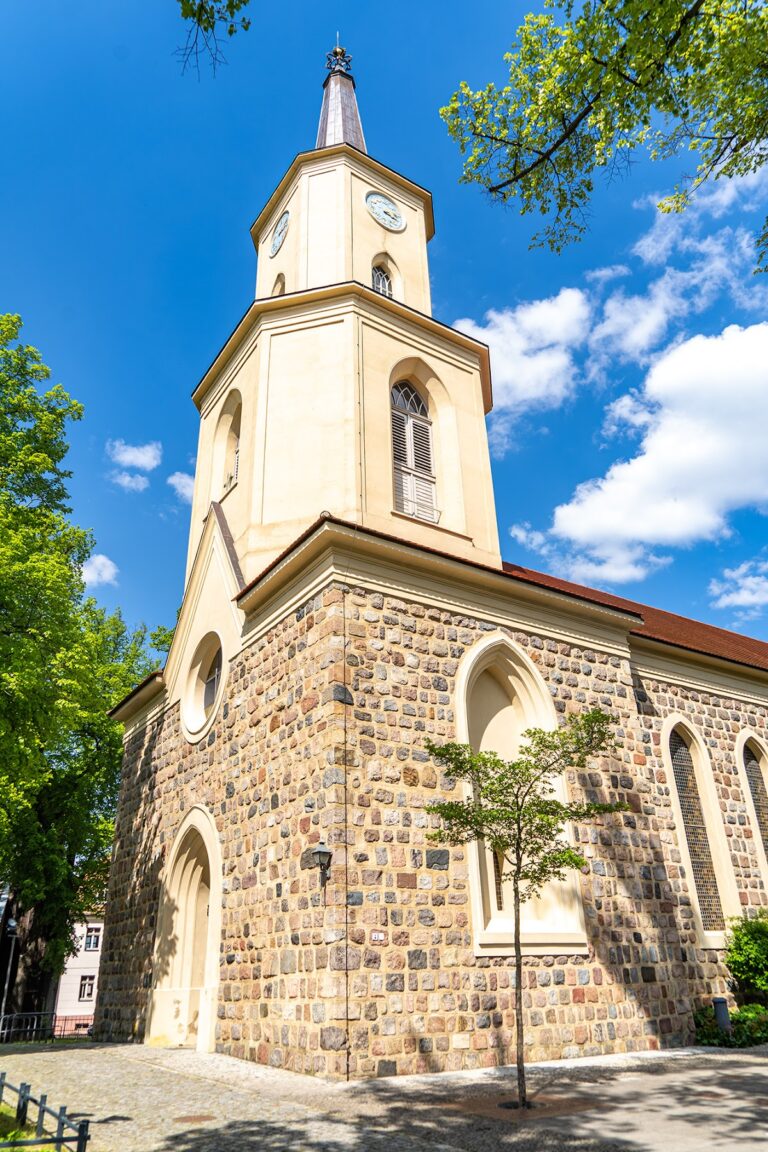
The Gothic brick village church opposite the old estate dates from the sixteenth century. It has a substantial tower and an interior with a groin-vaulted ceiling, a curved vault formed by the intersection of two barrel vaults. The church contains several memorials associated with the von Hake family, including the remains of ten flags dedicated by Ernst Ludwig von Hake to brothers who died in the Ottoman wars.
Other family memorials include a stone commemorating Ernst Ludwig von Hake’s parents, the epitaph of General Friedrich von Hake, and several heraldic panels. Friedrich von Hake held the military rank of general. The family crypt lies beneath the church, adding a further physical connection between the building and the former estate.
Nearby sites