Klein Sankt Martin: Former Parish Church in Cologne
Site at a Glance
- Rating
- 4.5
- Popularity
- Very Low
- Country
- Germany
- Primary era
- Medieval
- External website
- Open
- Eras represented
- Medieval, Modern
- Civilizations
- German, Holy Roman Empire
- Site type
- Religious
- Remains
- Church
On this page8 sections
History
Klein Sankt Martin is a former parish church in Cologne, Germany, rebuilt as a late Gothic hall church during the fifteenth century. Its origins are uncertain, but it may have been established when Cologne’s Rhine suburb was incorporated within the city walls in the second half of the tenth century. The church later became known as Klein St. Martin to distinguish it from the neighboring collegiate church Groß St. Martin, both dedicated to Saint Martin of Tours, a fourth-century Christian bishop and major saint in Western Christianity.
Origins and parish life
Klein St. Martin first appears in Cologne’s urban property records from 1130 to 1140. Records from 1172 to 1176 mention the consecration of its crypt, an underground chapel or chamber used for worship or burial. The parish covered the southeastern corner of the Roman city as far as Marsplatz. It also extended through part of the medieval Rhine suburb, from Heumarkt, excluding the suburb’s northern side, to Rheingasse.
The parish community held a role in choosing its priest. In 1317, an electoral college of thirteen parishioners submitted a proposal to the abbess of Saint Mary in the Capitol, who then presented it to the cathedral provost. Four members of the prominent Cologne patrician Overstolzen family belonged to this electoral college. The church’s valuable furnishings and imposing exterior reflected the growing strength of Cologne’s parish communities.
Late Gothic rebuilding
The church was probably rebuilt between 1460 and 1486. This work included a new west tower and a late Gothic hall, and Johann von Langenberg vaulted the church in 1489. Its high Gothic tower helmet made it one of the few parish churches represented in Anton Woensam’s 1531 view of Cologne. Woensam was a Cologne-associated sixteenth-century artist known for views of the city.
The parish church received a new organ in 1554, built by Vitus ten Bendt. It remained at Klein St. Martin until the church was suppressed in 1802 and was later transferred to the Catholic parish church of Saint Bartholomew in Porz-Urbach. The organ was partly renewed there in 1912 and 1962.
Suppression and the tower’s changing role
Klein St. Martin was suppressed during the Napoleonic secularization of 1802, when religious institutions and property were transferred to secular administration or use. In 1803 its parish was assigned to the neighboring church of Saint Mary in the Capitol. Klein St. Martin closed, and its nave was auctioned for secular use.
The nave was demolished around 1824 after becoming unsafe, but the four-storey tower was retained. Saint Mary in the Capitol had lost its western tower group by the seventeenth or, at the latest, eighteenth century, and its bells had been housed in Klein St. Martin since 1637. The surviving tower therefore continued to serve Saint Mary in the Capitol as a belfry after the parish church itself had disappeared.
The transfer of bells followed the collapse of Saint Mary in the Capitol’s western architectural section in 1637. Five bells, cast in 1338, 1447, and 1508, were moved into Klein St. Martin’s spacious tower. They included the municipal fire and alarm bell known as the Bram-Klock and a clock bell. After the collegiate foundation at Saint Mary in the Capitol was suppressed, its two large bells were sold to Boslar, where the larger one survives.
Later destruction and rebuilding
In 1836, a new three-bell peal replaced the remaining parish and collegiate bells. Georg Claren and Stephan Hilgers of Sieglar cast the bells, which were dedicated to Saint Martin, Saint Mary, and Saint Barbara. Together they weighed about 6,000 kilograms and sounded the notes A, C-sharp, and E. They survived the First World War but were melted down in 1942 during the Second World War. The bell chamber has remained empty since then.
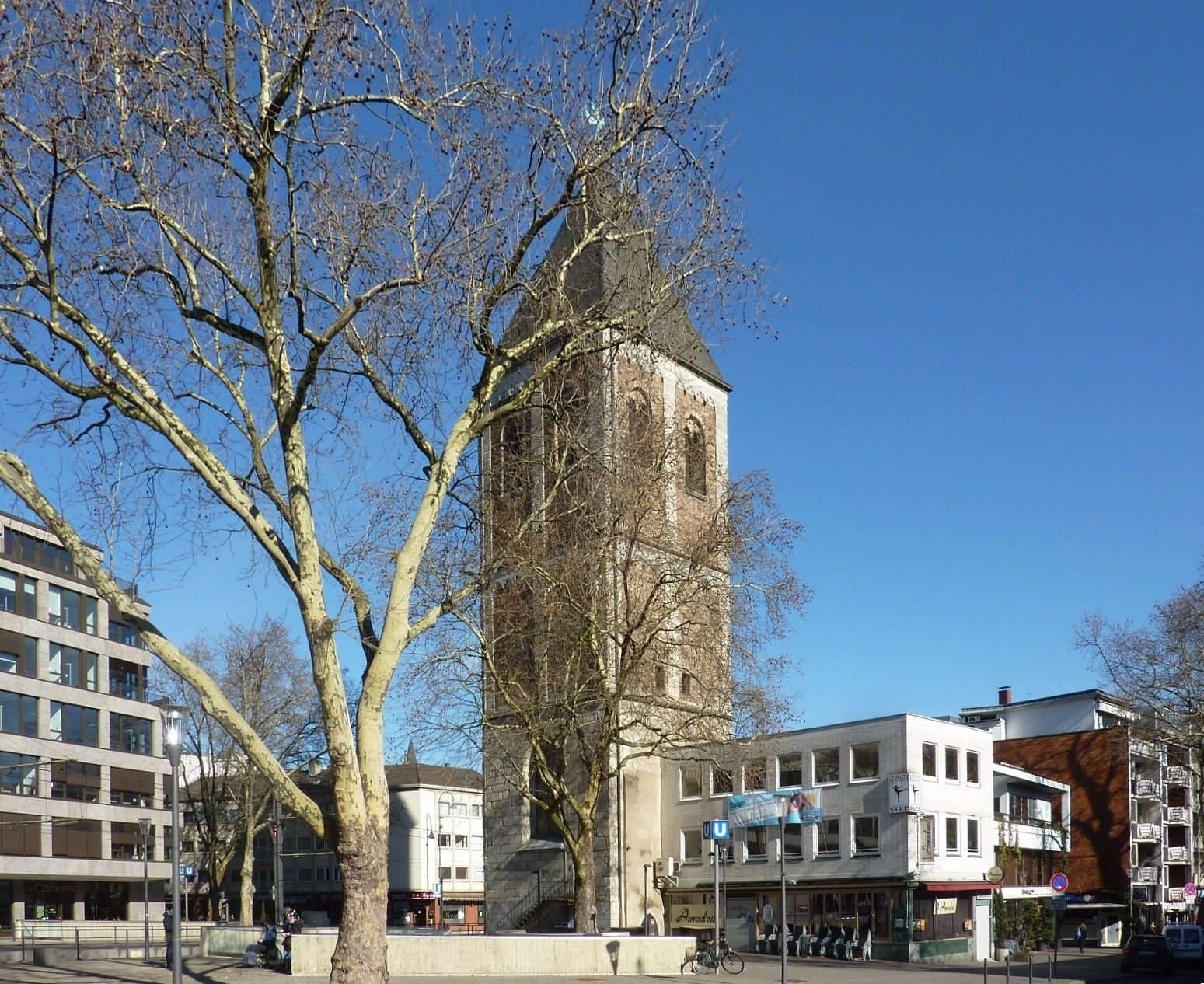
The tower burned out during the Second World War. It was rebuilt because it formed part of Cologne’s Rhine panorama and cultural heritage. Its replacement helmet was much lower than the earlier one. A devotional chapel was installed on the ground floor in 1954, and its bronze portal and tabernacle were designed by Heribert Calleen in 1963.
Remains
The surviving monument is the isolated tower of the former church, which stood in Cologne’s Old Town near the Rhine. The church’s nave had been built with its west side on the old Roman city wall, parallel to the former street called Obermauren. The original church is described as Romanesque in origin, while the fifteenth-century rebuilding created a five-aisled late Gothic hall church with a short chancel beneath a common roof.
Tower and chapel
The tower stood at the south-west side of the church. Before its wartime destruction, it had four storeys and a high, pointed Gothic helmet. The rebuilt tower now carries a blunt, Romanesque-style helmet shaped as a low pyramid, rising only slightly above the Rhine-front skyline. A weather vane by Elmar Hillebrand, showing Saint Martin of Tours, stands at its summit. The ground floor contains the devotional chapel installed in 1954, with a bronze portal and tabernacle designed by Heribert Calleen.
Bells
The former parish peal comprised two large bells for Sundays and feast days, a small Mass bell in the roof turret, and a small clock bell. The principal bell was cast in Cologne in 1721 by Edmund Pippin and dedicated to Saint Martin. It weighed about 1,100 kilograms, while its predecessors had been cast in 1455 and 1570. The second large bell, dedicated to Saints Martin and Sergius, was cast in 1571 by the Cologne founders Derich and Heinrich and weighed about 900 kilograms.
The small clock bell was cast in Cologne in 1500 by Johann Schursgyn. It weighed 120 kilograms, measured 56 centimetres in diameter, and was sold in 1836 to Saint Antonius in Seligenthal, where it remains. The bells transferred from Saint Mary in the Capitol in 1637 included examples dated 1338, 1447, and 1508, together with the Bram-Klock fire and alarm bell and another clock bell. The larger collegiate bell later sold to Boslar is preserved there, while the three bells installed in 1836 were destroyed in 1942, leaving the tower’s bell chamber empty.