Zobor Abbey: A Benedictine and Camaldolese Monastic Site in Slovakia


Site at a Glance
- Rating
- 4.6
- Popularity
- Low
- Country
- Slovakia
- Primary era
- Early Modern
- External website
- Open
- Eras represented
- Early Modern
- Civilizations
- Habsburg, Hungarian
- Site type
- Religious
- Remains
- Monastery
On this page12 sections
History
Zobor Abbey is a former Benedictine abbey in Slovakia, situated on the western slopes of Zobor Mountain above Nitra. Dedicated to Saint Hippolytus, an early Christian martyr and theologian, the original monastery was probably established around 880, although its exact foundation date remains uncertain. Tradition attributes its creation either to Duke Géza or to King Stephen, and the monastery probably already existed during Stephen’s reign. Its first buildings were Romanesque, a medieval style known for heavy masonry and rounded arches.
Foundation and Benedictine activity
The abbey was connected with the establishment of the Nitra bishopric and helped educate priests for the diocese and for missionary work within the region. Its dedication also linked it to the Benedictine monastery at St. Pölten in present-day Austria. Benedictines followed the Rule of Saint Benedict, a tradition combining communal prayer, disciplined life, study, and productive work. At Zobor, this work included agriculture. The monks helped establish vineyards on the mountain, encouraged the cultivation of fields and fruit, and maintained beekeeping.
Zobor was also associated with the medieval hermits Saint Zoerard-Andrew, also known as Svorad, and his disciple Saint Benedict, or Beňadik. Zoerard-Andrew came from Poland and received the monastic habit from Abbot Philip before living as a hermit near the monastery. Robbers killed him, after which Benedict moved into his cave. Benedict was later killed during a campaign led by the Czech prince Svatopluk. Maurus, bishop of Pécs, wrote an account of the two hermits in the second half of the eleventh century. Their former caves later became associated with a Benedictine abbey founded in 1224 by James, bishop of Nitra.
Charters, estates, and documentary authority
Two charters issued in 1111 and 1113 on the authority of King Coloman of Hungary are known as the Zobor charters. The first confirmed the abbey’s rights to properties in western and central Slovakia, while the second listed its possessions. They rank among the oldest surviving original documents from the territory of Slovakia and are preserved by the Nitra bishopric.
Between the thirteenth and fifteenth centuries, the abbey also served as a locus credibilis, an ecclesiastical institution authorized to preserve, prepare, authenticate, and issue legal documents. Its estates were extensive but gradually declined before the institution was dissolved. Holdings included Mocsonok, Bolleráz, Durada, Vecse, Hosszúfalu, Királyi, Bajcs, Köpösd, Hetmény, Farkasd, Negyed, Topezán, Boencza, Kaplath, Wogyerad, Madunicz, Vörösvár, Atrak, Rattnócz, Bohunicz, Gány, and Nyék in Pozsony County. Other properties included Szilád, Bresztovány, Nagy-Kosztolány, Zeli, Próna, Terbistye, Kosztilyesztye, Stubnya, Maróth, Kolon, Család, Zakol, Ghimes, Elefánt, Zsére, Malánta, Lapas, Emőke, Néver, Pográny, Goron, Kér, Szőllős, Völcs, Kurth, Czabaj, Imecs, Tavarnok, and Vecse. Some properties were shared with the town of Nitra, local peasants, the castellan of Hlohovec, or other territorial communities.
The abbey’s own boundary was associated with the Narath spring. From the spring, a road led toward Gallows Hill, and the water source was shared with the inhabitants of the castle. The abbey held two-thirds of the mountain and its slope toward Nitra Island. Its boundary continued across meadows near the town to Csermány, then toward Csápor, Sarluska, Darázs, and Nyúl Hill before returning along the ridge toward Nitra. It extended east to Gerencsér and north to Elefánt. Only two abbots are known by name: Hinkó, who later became bishop of Nitra and served as abbot from 1404 to 1427, and Miklós, recorded around 1460.
Destruction and later monastic revival
In 1468, Archbishop John Vitéz of Esztergom joined a coalition against King Matthias Corvinus and seized Nitra Castle, the abbey, and its endowments. Matthias recovered the territory and property, then dissolved the abbey and attached it to the Nitra diocese. It was never restored as a Benedictine institution. Polish forces commanded by Duke Casimir plundered and completely destroyed the monastery in 1471, after which its extensive possessions passed to the Nitra bishopric.
Bishop George Pohronec-Slepčiansky built a chapel on the abandoned site in 1663. Bishop Blaise Jaklin later sought to revive the monastic foundation by entrusting it to the Camaldolese, a stricter Benedictine reform that combined communal life with hermit practice. Emperor Leopold I approved their arrival in 1691, and a new Camaldolese monastery was begun that year. A church dedicated to Saint Joseph was erected in 1695, with the building work completed in 1697 by Nicholas Jaklin, a cousin of Blaise Jaklin.
Secular reuse and modern conservation
Pálffy’s troops plundered the Camaldolese monastery in 1708. Emperor Joseph II dissolved the religious orders in 1782, and the former abbey estates were transferred to the Religious Fund. The buildings then acquired secular uses. A cloth manufactory was established there in 1786, followed by a pulmonary sanatorium in 1886. Since 1953, the site has formed part of the Saint Zoerard Zobor Specialized Hospital, whose grounds contain the surviving ruins. Archaeological research and conservation continue to stabilize, restore, conserve, and make the remains accessible to the public.
Remains
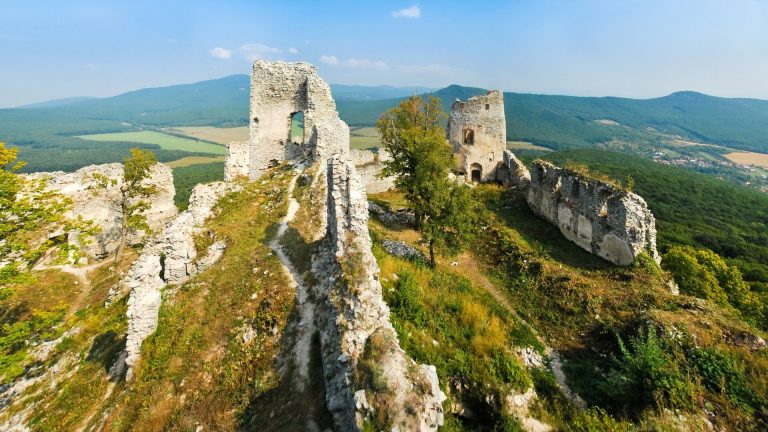
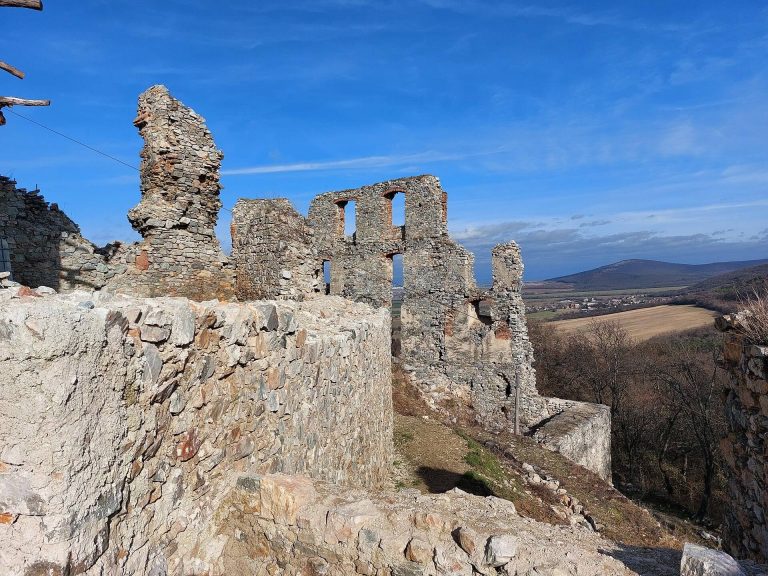
The surviving site consists of ruins within the grounds of the Saint Zoerard Zobor Specialized Hospital on Zobor Mountain, which rises to 586.9 metres above sea level. The original Benedictine complex occupied the mountain’s western slopes above Nitra and was built in the Romanesque style. Later Camaldolese construction on the same site completely destroyed the surviving remains of the Benedictine buildings, leaving fragmentary physical evidence alongside features connected with the later monastery.
Monastic buildings and church
Romanesque monastery
A column capital is identified with the ninth-century Benedictine monastery. It provides material evidence for the early monastic complex, whose buildings were constructed in Romanesque form. The later Camaldolese rebuilding altered the site so extensively that the original Benedictine structures no longer survive as an identifiable building group. The present archaeological remains are therefore read together with the evidence of the later complex and the documentary history of the abbey.
Church of Saint Joseph
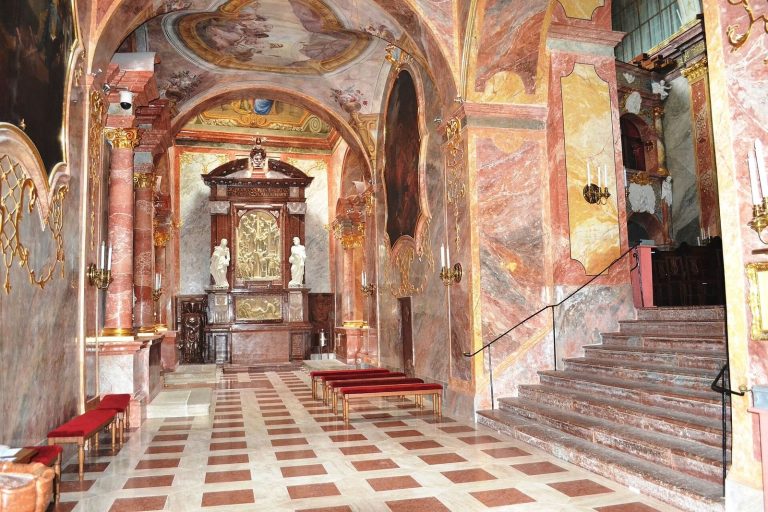
The Camaldolese church, dedicated to Saint Joseph, was erected in 1695 and completed in 1697. It had three entrances, with the principal entrance on the north side. An inscription at the entrance to the Camaldolese monastery expressed the community’s wish to protect its solitude and warned those who disturbed its peace. The church and monastery represent the post-medieval rebuilding of the abandoned Benedictine site.
Boundary and institutional evidence
Narath spring
The Narath spring formed an explicitly associated part of the abbey’s boundary. A route led from it toward Gallows Hill, while the spring itself was shared with the inhabitants of the castle. The boundary descriptions place the monastery’s lands across the mountain slope, nearby meadows, and surrounding settlements, connecting the natural feature with the abbey’s territorial organization.
Abbey seal
The former abbey had a circular seal bearing an abbreviated Latin dedication to Saint Hippolytus of Zobor. Its central image showed a settlement enclosed by a circular town wall with three towers and two crosses, with one cross positioned between each pair of towers. The seal preserves a formal image of the institution and its dedication even though the medieval buildings were destroyed.