Church of St Peter, Raunds: An Ancient Parish Church
Site at a Glance
- Rating
- 4.7
- Popularity
- Very Low
- Country
- United Kingdom
- Primary era
- Medieval
- Eras represented
- Medieval
- Civilizations
- English
- Site type
- Religious
- Remains
- Church
On this page14 sections
History
Church of St Peter is the ancient parish church of Raunds in the United Kingdom, a medieval building whose present fabric was erected mainly between the 12th and 14th centuries in the English Gothic tradition. It is thought to occupy the site of an earlier place of worship and served the historic market town in Northamptonshire.
Medieval parish church
Until the 15th century, the church was dedicated to Saint Mary. It is now dedicated to Saint Peter, reflecting a change in its religious identity during the medieval period. The building retains substantial evidence of later medieval worship, including wall paintings, carved woodwork, monuments, and the Raunds Clock, a decorated mechanical clock dating from around 1420.
Church of England administration
The church was formerly Catholic and is now a Church of England parish church. It belongs to the Province of Canterbury, the Diocese of Peterborough, the Archdeaconry of Oakham, and the Higham Deanery. In 2007, Raunds, Hargrave, Ringstead, and Stanwick were legally united as the 4 Spires Benefice, although each village retained its own church.
Restoration and continuing use
The interior was restored in 1874 and 1878 by Sir Gilbert Scott. The work included removing a west gallery and altering the chancel, the eastern part of the church surrounding the main altar. In 1893, John King-Smith, a prominent Raunds boot manufacturer, donated a three-manual organ made by Peter Conacher. The organ was most recently restored in 2006.
Church of St Peter is a Grade I listed building, the highest category of statutory protection for historic buildings in England, reserved for buildings of exceptional interest.
Remains
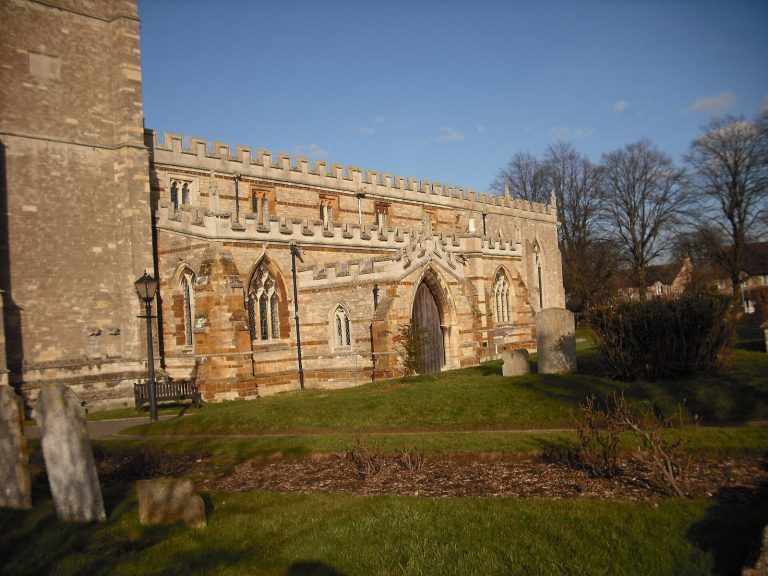
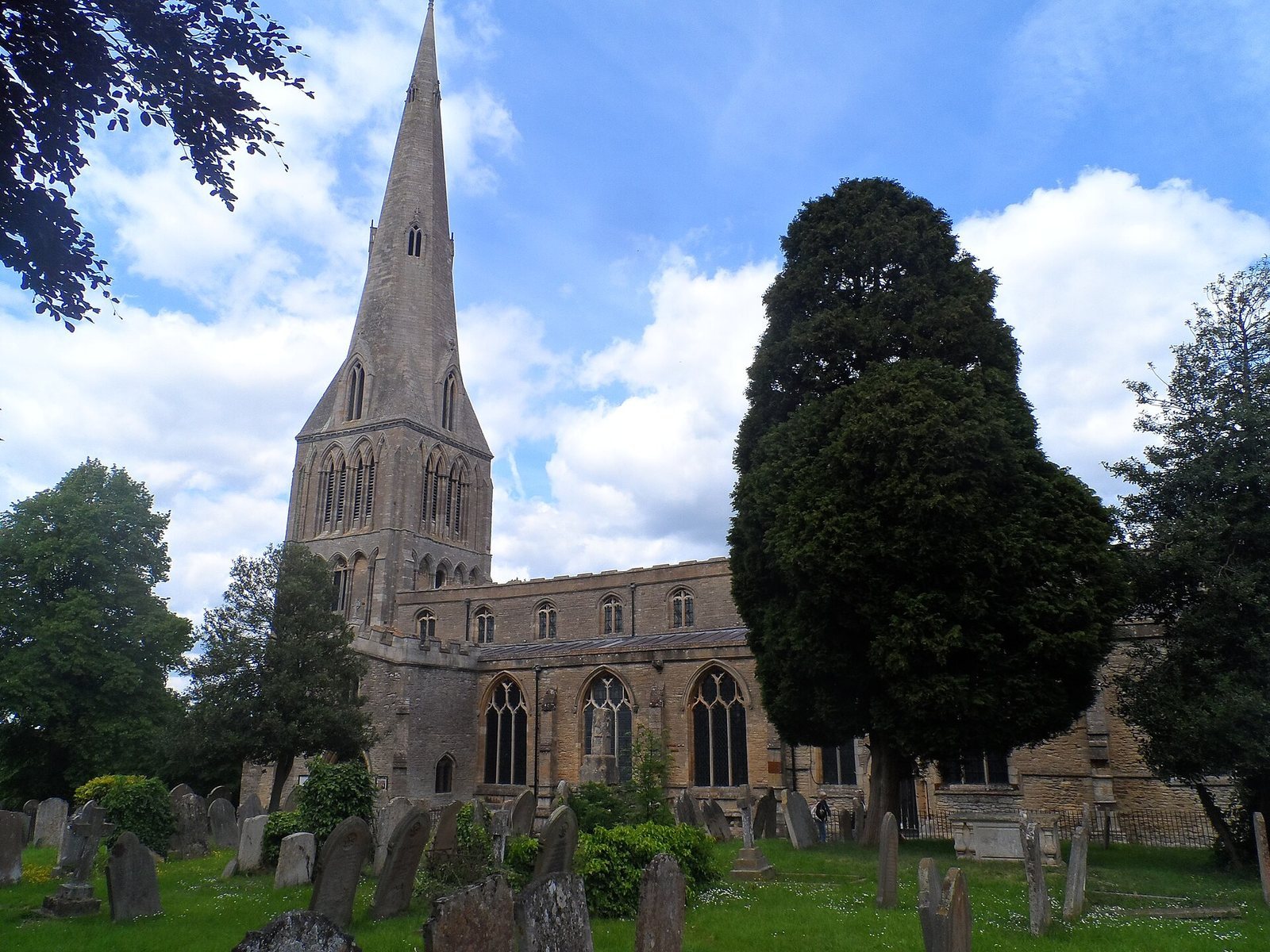
Standing in an elevated position on Church Street, the church is arranged on an east-west axis towards the chancel and Rood Screen. Its principal elements are a central nave, north and south aisles, a south aisle chapel, a south porch, and a western tower crowned by a spire. The walls are built of limestone with ashlar dressings, finely cut masonry laid in regular blocks, while the exterior, especially the tower, carries elaborate English Gothic decoration.
Nave, aisles, and chancel
The large nave is divided from the aisles by two six-bay arcades. Each arcade is surmounted by seven clerestories, upper wall sections pierced by windows above the main arcade. Large chamfered triumphal arches mark both ends of the nave. The eastern arch corresponds with the junction of the Rood Screen and chancel, while the western arch opens into the vaulted lower chamber of the tower.
The north aisle has six traceried Gothic windows and the south aisle has five corresponding windows. The south aisle chapel contains two south-facing windows and an east-facing window above the altar. A two-bay arcade separates the chapel from the triple-bayed chancel, which is closed on its north side by a wall containing three windows.
Tower, clock, and carved features
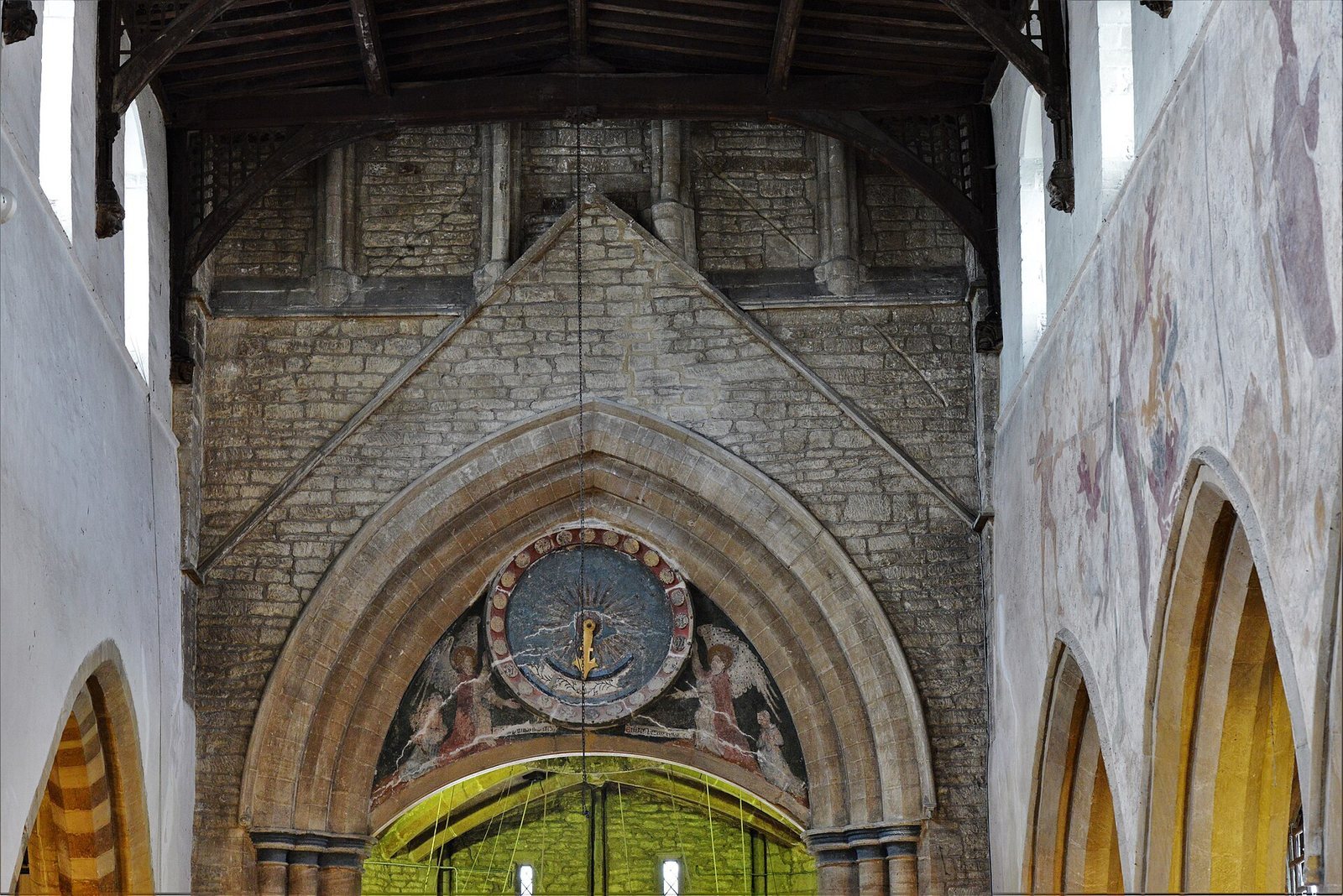
The western tower contains a vaulted lower chamber and rises to a decorated spire. It was traditionally said to reach 202 feet, but a survey in 2011 measured the spire at 176 feet, or 54 metres. Above the western triumphal arch is an early decorated mechanical clock.
The Raunds Clock
Known as the Raunds Clock, the mechanism dates from around 1420 and occupies a tympanum beneath the tower arch. Its painted face uses a 24-hour reckoning and has a single hand. Two painted angels appear to support the face, with the donors kneeling behind them. Latin wording asks for prayers for John and Sarah Catlyn.
Font and western entrance
The 13th-century circular font has a bowl carved with a ram’s head. Above the western entrance, a rare decorative motif shows a left-handed fiddler.
Wall paintings and medieval imagery
North nave paintings
The surviving Raunds Wall Paintings, largely from the 15th century, cover much of the north wall of the nave and continue in patches along the north aisle. Above the northern nave arcades, they show the Seven Deadly Sins, the traditional Christian list of moral vices, together with the Three Quick and the Three Dead, a medieval image contrasting three living people with three corpses as a reminder of death. Saint Christopher carrying the Christ Child also appears.
Rood arch paintings
The triumphal arch behind the former Rood Loft, the raised platform once associated with the screen separating nave and chancel, is painted with angels encircling the missing Great Rood. A rood is a representation of Christ on the cross, and the Great Rood was the principal crucifix with its associated figures. The arch also carries monograms of the Most Holy Name, the sacred Christian name of Jesus. Wall-painting restorer Eve Baker restored these paintings in the early 1960s.
Saint Catherine cycle
The north aisle contains the remains of a once highly complete cycle depicting the life of Saint Catherine of Alexandria, a Christian martyr and saint whose legendary life was widely represented in medieval art. Although the paintings were discovered earlier, insensitive restoration caused much of the cycle to wear away.
Monuments and later interior features
The interior preserves richly decorated 14th- and 15th-century wall paintings, carved woodwork, and stained glass, most of the glass dating from after the Reformation. A brass floor monument commemorates John Tawyer, who died in 1470, and his wife Margaret. A tomb chest is dedicated to John Wales, who served as vicar from 1447 to 1496.
The south chapel contains substantial monuments to Robert Gage, who died in 1606, and William Gage of Magilligan in Ireland, who died in 1632, together with other monuments. These memorials form part of the church’s surviving record of medieval and post-medieval worship and local commemoration.