Clare Island Abbey: A Cistercian Monastery in County Mayo, Ireland
Site at a Glance
- Rating
- 4.6
- Popularity
- Low
- Country
- Ireland
- Primary era
- Medieval
- External website
- Open
- Eras represented
- Medieval
- Civilizations
- Unclassified
- Site type
- Religious
- Remains
- Church
On this page9 sections
History
Clare Island Abbey is a ruined Cistercian monastery in Ireland, founded broadly in the twelfth or thirteenth century and dedicated to Saint Brigid. The Cistercians were a reforming Catholic monastic order known for emphasizing simplicity and austerity. The site may have had an earlier religious history, including a possible Carmelite community around 1100.
Cistercian foundation
In 1224, Clare Island Abbey became a dependent cell of Knockmoy Abbey, a Cistercian mother house near Tuam. Through Knockmoy, it belonged to the institutional affiliation of Clairvaux Abbey, one of the principal founding houses of the Cistercian order. The O’Malley family, a powerful local Gaelic family, is traditionally said to have encouraged the Cistercian foundation as a way of strengthening its regional influence.
The monastery was substantially rebuilt or renewed around 1460, probably under the patronage of Diarmuid Bacach Ó Máille. In a later phase, it served, or may have served, as a refuge for Carmelite friars. The date of its dissolution is uncertain, but it probably took place in the late sixteenth century.
The O’Malley family and later preservation
Clare Island Abbey is traditionally identified as the place where Gráinne, or Grace, O’Malley was baptised, married, and buried, although the burial attribution remains uncertain. Grace O’Malley was a sixteenth-century Irish Gaelic maritime leader and head of the O’Malley family. The abbey also became a burial place for members of that family.
The ruined abbey has been a National Monument since 1895. Conservation work undertaken between 1990 and 2000 secured the surviving building and supported its continued preservation.
Remains
Chapel and interior features
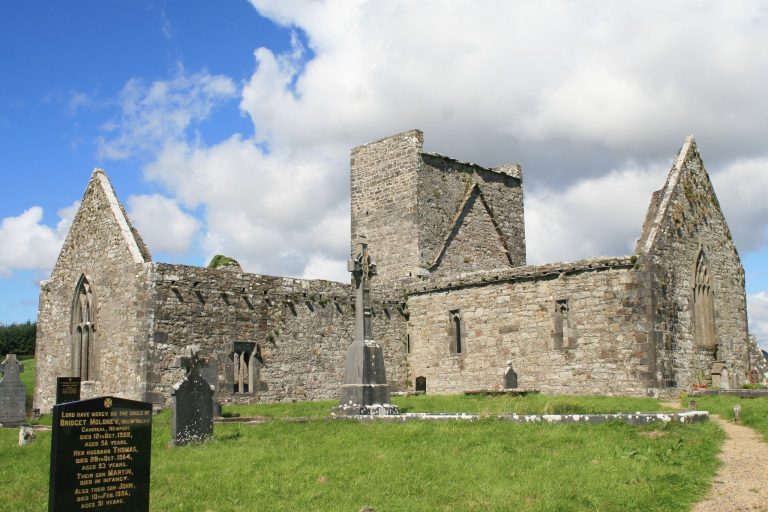
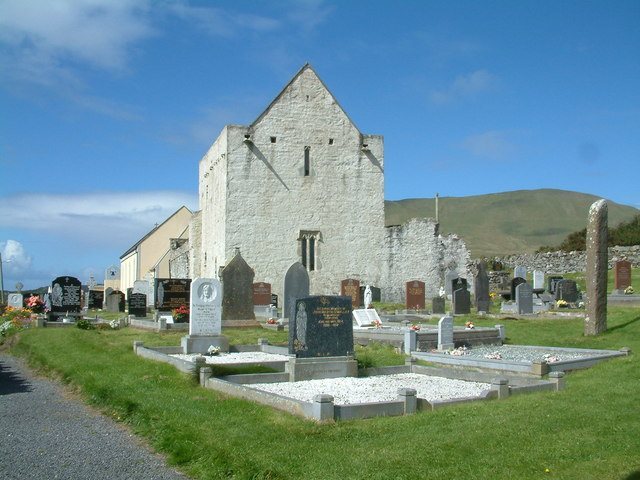
The surviving building is a ruined, single-nave chapel without aisles or transepts. Its one-bay nave is associated with the early thirteenth century, and a simple arch divides it from the higher chancel. Two pointed-arch windows light the chancel. The chapel also contains a piscina, a shallow basin for washing sacred vessels, and sedilia, seats for clergy beside the altar.
Upper chamber and carved details
A chamber above the chapel vault is reached by a staircase built into the south wall. Other surviving details include carved heads and narrow pointed windows with ogee and cusp-headed forms. An ogee arch has an S-shaped pointed profile, while a lancet is a narrow pointed-arch window.
Medieval paintings and burials
Wall and ceiling frescoes
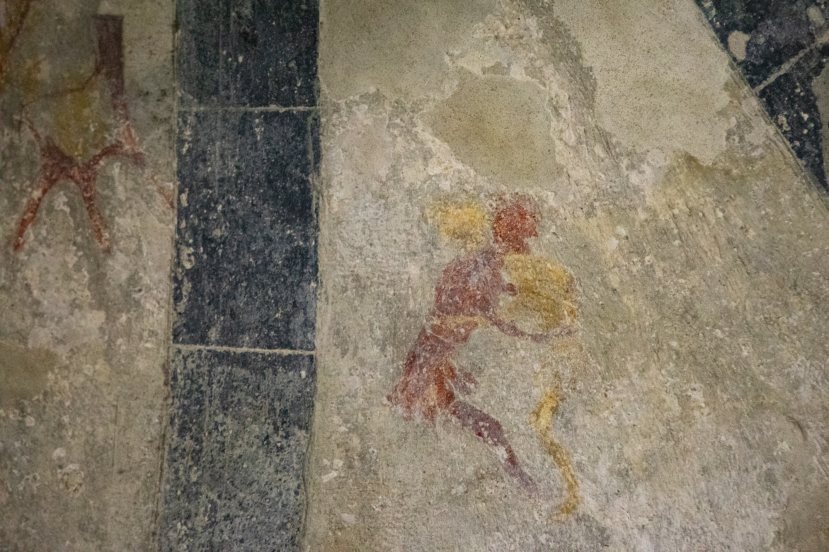
Extensive medieval frescoes cover the chapel’s walls and ceiling. Their imagery includes human, animal, and mythical figures, with scenes of cattle theft, a mail-clad knight, people on foot and horseback, musicians or a harper, and stags attacked by wolves. Dragons, griffins, a cockerel, birds, trees, hunting, and combat scenes also appear.
The paintings include strongly secular themes, an unusual form of decoration for a Cistercian foundation. Their figurative imagery contrasts with the order’s customary preference for austere interiors and its rejection of secular and figurative decoration.
O’Malley tombs and setting
A canopied tomb inside the chapel is traditionally identified as the burial place of Grace O’Malley. Further O’Malley family tombs stand in the chancel. The abbey lies in the southern part of Clare Island near the southern coast, beside its surrounding cemetery and the natural feature known as Knockmore.