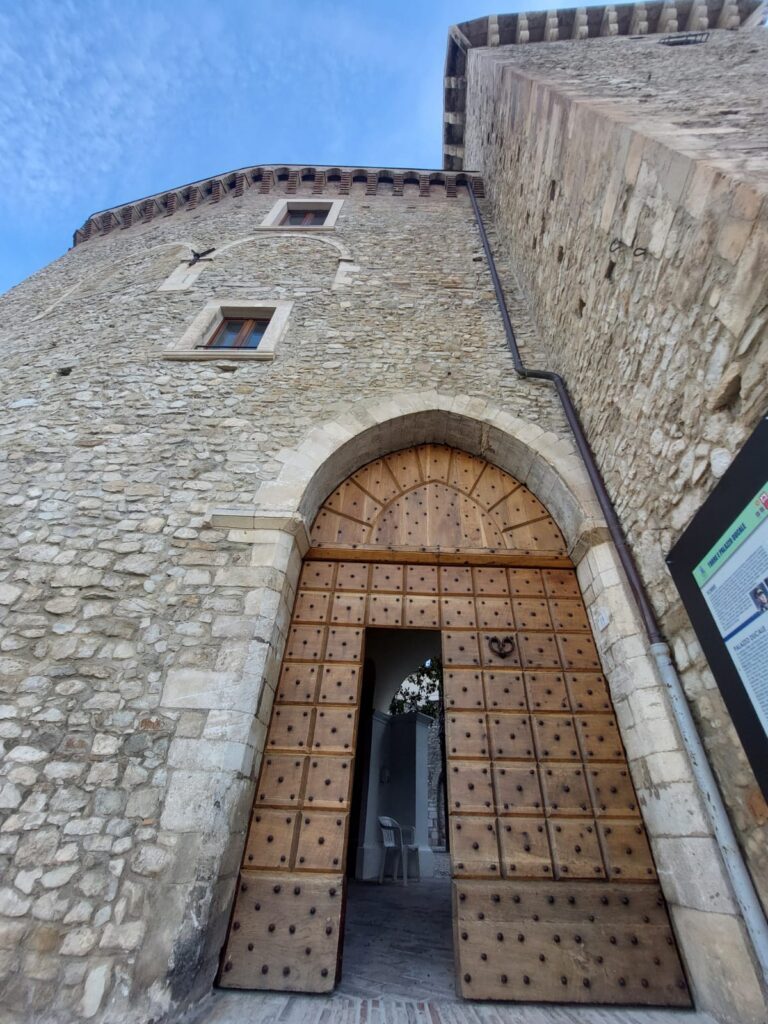
Convento del Ritiro della Santissima Annunziata del Poggio: A Franciscan Convent in Italy


Site at a Glance
- Rating
- 4.7
- Popularity
- Low
- Country
- Italy
- Primary era
- Medieval
- Eras represented
- Medieval, Modern
- Civilizations
- Kingdom of Naples
- Site type
- Religious
- Remains
- Monastery
On this page12 sections
History
The Convento del Ritiro della Santissima Annunziata del Poggio is a Franciscan convent in Italy, about 2 kilometres from Orsogna in the province of Chieti. Built and consecrated in 1448 as a medieval religious complex, it developed around a church and oratory associated with the Annunciation, the Christian event in which the Archangel Gabriel announces to Mary that she will become the mother of Jesus.
Foundation in the fifteenth century
The foundation of the retreat is linked with Saint John of Capestrano, a fifteenth-century Franciscan preacher and reformer whose work helped expand Franciscan observance in Italy. He was impressed by an oratory set in a wooded landscape on a hill near a stream. A church and an oratory were built there in 1448, and the present church corresponds to the primitive oratory.
In 1450, Ottaviano di Letto of Guardiagrele, possibly from Lettomanoppello, gave his orchards and adjoining woodland to the convent so that the property would not be divided. The donation helped secure the physical setting of the retreat, which occupies a hilltop overlooking the sea and the Maiella, the mountain massif of Abruzzo.
Later changes and wartime destruction
The convent remained a Catholic institution dedicated to the Annunciation and connected with the Archdiocese of Chieti-Vasto, a major ecclesiastical jurisdiction led by an archbishop. The cloister was closed to worship in 1864, reopened to the public in 1885, and legally reacquired in 1889.
World War II destroyed the convent. Reconstruction was completed in 1969, followed during the postwar decades by further recovery and embellishment. These works included renewal of the gravel forecourt, the construction of a monumental statue of Saint Francis, and the creation of a sacred avenue leading to a natural grotto with a statue of Our Lady of Lourdes. A small votive shrine shaped like a temple has stood at the junction of the convent road and the route from Orsogna since the 1960s. It contains a statue of Saint Francis with his arms opened in blessing. The forecourt parking area was redeveloped in 2015.
The complex is associated with the Annunziata Natural Park, whose territory includes Orsogna, Filetto, Giuliano Teatino, and Ari. The park access is at the entrance to the convent road, while the convent itself remains defined by its religious buildings, wooded setting, and long history of Franciscan use.
Remains
The surviving complex combines a small church with two rectangular convent buildings joined by a square, arcaded cloister. The buildings and covered walkways form a compact, symmetrical plan. The cloisters, corridors, dormitories, and cells are small and preserve relatively few frescoes, while the church and convent interiors retain furnishings and artworks from several periods.
The church
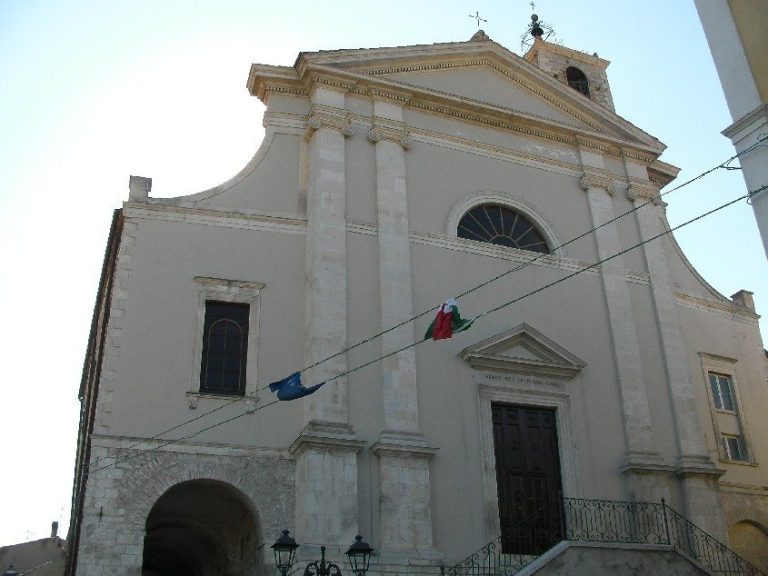
The church has a simple fifteenth-century facade of exposed brick, with a gable, an oculus, and two window openings. A small narthex, or entrance space attached to the front of a church, precedes a pointed-arch portal that opens into a single nave. Restoration in the 1960s removed the covering plaster and left the brickwork visible. Above the roof is a bell gable, a projecting wall designed to hold bells, with two bells.
Inside, the church has polychrome windows, cross-vaulted principal spaces, and a small interior that includes a walnut choir. The postwar reconstruction modernized the furnishings and replaced the earlier presbytery. The present arrangement includes a historiated stained-glass window, an organ, a suspended Crucifix, and a modern post-conciliar altar, an altar arranged according to liturgical changes associated with the Second Vatican Council. Two side niches hold statues of Saint Francis and Saint Anthony of Padua, an early Franciscan preacher and theologian.
The lateral Annunciation chapel is the convent’s primitive church. It contains an Annunciation group, a statue of the Immaculate Virgin, and wall tombs for friars who distinguished themselves in the history of the retreat. The Immaculate Virgin refers to the doctrine that Mary was conceived without original sin. An ossuary occupies a burial space between one of the convent’s entrance gates and the attached church.
Convent buildings and cloister
Arcaded cloister
The square cloister is enclosed by covered walkways on two levels of arcades and has a central well in its courtyard. It connects the two rectangular buildings and organizes access to the convent’s corridors, dormitories, and cells. One fresco cycle along the corridors of the first cloister presents scenes from the Gospels. A second cycle was painted by Father Gaetano of L’Aquila.
Refectory and residence
One rectangular building contains the refectory and the monks’ residence. Rebuilt in the nineteenth century, it has a ground-floor hall with a barrel-vaulted ceiling and a facade decorated with a clock. The refectory also has exposed-brick cross vaults and wall lunettes interrupted by windows.
The lunettes contain frescoes of Saint Bernardino preaching before the Basilica of Santa Maria di Collemaggio in L’Aquila, together with scenes from the life of Saint Francis. These include his renunciation of worldly goods and his supplication to Pope Honorius. Other images show the Last Supper, Saint Francis at prayer, Christ in Gethsemane, Franciscan saints praying, and the Madonna before the Cross. Saint Bernardino was a fifteenth-century Franciscan preacher associated with the Observant reform.
Service building
The second rectangular building contains the carriage shed and kitchen storage areas. Together with the residence and refectory, it completes the small-scale domestic and working spaces arranged around the cloister.
Paintings and devotional works
Paintings
The convent preserves a painting of the Madonna above the Holy House of Loreto by Francesco De Benedictis of Guardiagrele. The Holy House of Loreto is a major Catholic shrine associated with the house traditionally believed to have been inhabited by Mary. Other works include Nicola Ranieri’s Madonna of Sorrows, showing a heart pierced by seven swords, a small Saint Joseph with the Child, a Franciscan saint reading, and the Holy Trinity.
A sixteenth-century Crucifixion is attributed to Luca Fornaci of Chieti. Its faces and arrangement of figures resemble those in a contemporary signed painting by Fornaci in the Church of Santa Maria di Costantinopoli at Ortona. Other paintings by Ranieri show Saint Francis in ecstasy to the sound of a lute, Jesus rehabilitating Mary Magdalene, and Jesus breaking bread.
Nativity and outdoor images
A painted terracotta statue of the Infant Jesus in swaddling clothes comes from a lost Nativity scene made by Filippo Tenaglia. The Nativity scene is installed in a cell beside the right side of the church. Its earliest installation date is uncertain, but it predates 1864, when its ceramic pieces by Tenaglia were dispersed. Other pieces were made by Nicola Ranieri of Guardiagrele.
At the end of a tree-lined path leading toward the natural grotto stands a statue of Our Lady of Lourdes in a small niche. Near the main entrance is a bronze statue of Saint Francis preaching to the birds, with a wolf at his feet. Another statue of Our Lady of the Angels stands near a chapel, extending the convent’s devotional imagery into its grounds.