Monastery of Agios Ioannis Prodromos Vomvokou: An Orthodox Monastery in Greece


Site at a Glance
- Rating
- 4.9
- Popularity
- Low
- Country
- Greece
- Primary era
- Early Modern
- External website
- Open
- Eras represented
- Medieval, Early Modern
- Civilizations
- Byzantine, Ottoman
- Site type
- Religious
- Remains
- Monastery
On this page6 sections
History
The Monastery of Agios Ioannis Prodromos Vomvokou is an Orthodox monastery in Greece, with origins tentatively placed in the eleventh century. It was rebuilt around 1695 on the foundations of an earlier church and later became associated with regional religious life and the struggle for Greek independence.
Foundation and Ottoman Recognition
The monastery’s foundation date remains uncertain, although its origins are traditionally placed in the eleventh century. Its first written record dates to 1733, when Mahmud I, the Ottoman sultan who ruled from 1730 to 1754, issued a firman, or official decree, recognizing it and Varnakova Monastery as legal persons. The decree also designated their estates as waqf properties, meaning that the land was dedicated through a religious endowment to charitable or religious purposes. Ownership titles were subsequently renewed automatically in the name of each abbot, who administered the estates for the monastery.
The monastery was a favored religious foundation of Cosmas of Aetolia, an eighteenth-century Greek Orthodox missionary and teacher who preached widely in Ottoman-ruled Greece.
War, Desertion, and Later Renewal
During the Greek War of Independence, which began in 1821 as the Greek revolt against Ottoman rule, the monastery served as the headquarters of the military force involved in the siege of the fortress of Nafpaktos. François Pouqueville recorded that six monks lived there in 1817. After Greek independence, the monastery became deserted during the 1830s.
The settlement was first officially recognized in 1940 under the name Monastery of the Holy Forerunner and was attached to the community of Vomvokou. That status was abolished in 1961 and restored in 1971 under the name Monastery of Agios Ioannis, again as part of Vomvokou. Under the Kallikratis programme, Greece’s early twenty-first-century administrative reform, it forms part of the local community of Vomvokou in the Municipal Unit of Nafpaktos within the Municipality of Nafpaktia. The settlement had 11 residents in the 2011 census. Restoration during the 1990s helped renew the monastery, which is now an active female Orthodox monastery under the Holy Metropolis of Nafpaktos and Agios Vlasios, an ecclesiastical jurisdiction of the Orthodox Church of Greece.
Remains
The monastery stands on a plateau formed on the steep eastern slope of Mount Rigani. A ravine lies directly below the complex, carrying the Skas torrent toward Nafpaktos. This elevated setting defines the physical context of the surviving buildings and places the monastery above the watercourse descending toward the town.
Monastery Setting
The complex occupies the plateau on the mountain slope, with the ravine immediately below it. Its position links the monastery’s built area to the sharply descending terrain and to the route of the Skas torrent toward Nafpaktos.
Katholikon and Frescoes
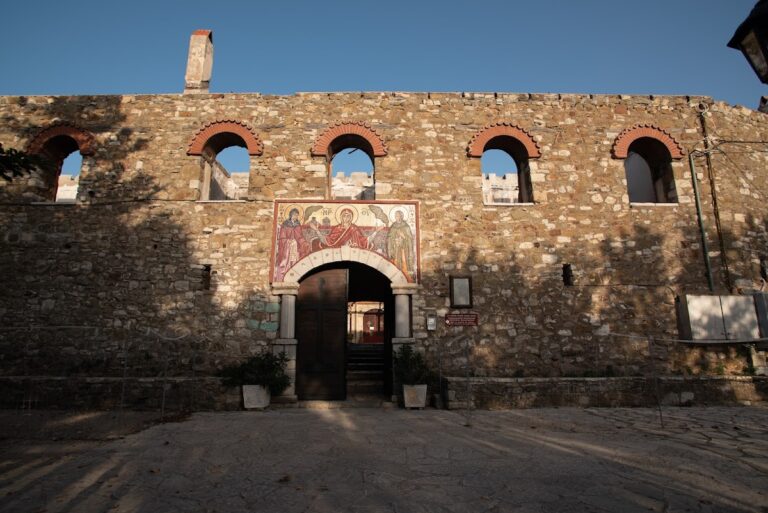
The katholikon, the principal church of an Orthodox monastery, is a domed, four-columned cruciform church. Its plan is organized around a cross-shaped layout and is surmounted by a dome. Elaborate frescoes dating from the late seventeenth century remain inside the church and possess considerable historical value.