Athenry Priory: A Medieval Dominican Foundation in Ireland
Site at a Glance
- Rating
- 4.7
- Popularity
- Very Low
- Country
- Ireland
- Primary era
- Medieval
- External website
- Open
- Eras represented
- Medieval
- Civilizations
- Irish, Norman
- Site type
- Religious
- Remains
- Monastery
On this page12 sections
History
Athenry Priory in Ireland is a ruined Dominican priory founded in Athenry in 1241 by Meyler de Bermingham, an Anglo-Norman lord associated with the town’s establishment. Its surviving architecture is Late Gothic, and the priory formed part of the Anglo-Norman settlement created in the region after the conquest of Connacht. Meyler had founded Athenry and built its castle in 1238 before giving land for the Dominican community. The Dominican Order was a Catholic mendicant order founded in the early thirteenth century that emphasized preaching, theological study, and communal religious life.
Foundation and medieval development
A provincial chapter, a formal governing meeting of a religious order’s regional province, was held at Athenry in 1242. The priory was associated with the ecclesiastical jurisdiction of Tuam and received support from both Anglo-Norman and Irish benefactors. Between 1241 and 1242, Feidlim Ua Conchobair, King of Connacht, funded the refectory, or communal dining hall. Owen Ó hEidhin, King of Uí Fiachrach Aidhne, supported the dormitory, while Conchobar Ó Cellaigh of Uí Maine paid for the chapter house, where the religious community conducted its administrative meetings. Other donations helped provide a cloister garden, infirmary, and guesthouse.
A house for scholars was added between the middle of the thirteenth century and the early fourteenth century. Contributions from local notables continued to support the priory’s expansion. The institution therefore developed beyond its original church and conventual buildings into a larger religious and educational centre within Athenry.
The priory also became a burial place for bishops of Clonfert and Kilmacduagh, members of the de Bermingham family, and other benefactor families. Meyler de Bermingham was buried there in 1252. His son William de Bermingham, who later became Archbishop of Tuam, was buried at the priory in 1312.
Fourteenth- and fifteenth-century enlargement
William Liath de Burgh left money in 1324 for the enlargement of the church and priory. The work was completed by 1345 and included additions to the northern aisle and transept. In 1408, Joanna de Ruffur left funds for a new east window and further choir windows, extending the church’s architectural development into the fifteenth century.
Fire repeatedly damaged the priory. Indulgences were granted in 1400, 1423, and 1445 to encourage restoration. An indulgence was a remission of temporal punishment associated with sin in Catholic theology. After the priory was burned in 1423, Pope Martin V and later Pope Eugene IV encouraged contributions towards its repair. In 1451, the friars also built a chapel at Carrowardahrah on land north of the river granted by Ulick Ruadh Burke.
Reformation and dissolution
During the Reformation, the priory’s future became uncertain. In 1541, its custos, Adam de Coppynger, received a promise that he and his friars could retain the house if they abandoned the Dominican habit. In 1568, Elizabeth I, queen of England and Ireland from 1558 to 1603, granted the Earl of Clanricarde permission to continue using the priory as a burial place. Her government’s religious settlement nonetheless weakened Catholic institutions across Ireland.
The priory was dissolved in 1574, and its land and buildings passed to the town of Athenry. During the same period, the sons of the Earl of Clanricarde plundered the town and monastery. William mac an Iarla Burke’s uprising also led to the priory being burned during the 1570s.
Seventeenth-century returns and displacement
Dominican friars reoccupied the priory between 1595 and 1597. They were spared when Red Hugh O’Donnell captured Athenry in 1595, during the Nine Years’ War, an Irish conflict against English rule fought from 1594 to 1603. The town was besieged in 1596 and then devastated by a major fire in 1596–97, forcing the friars to leave.
In 1622, the friars received land at Esker, about 4 kilometres southeast of Athenry. There they built a small monastery, continued admitting novices, and established a school. In 1644, the school associated with Athenry was raised to university status under the protection of the Irish Confederation, the Catholic political alliance that governed much of Ireland during the 1640s. That same year, the Dominican general chapter in Rome planned universities for the order’s five Irish provinces, including institutions proposed for Dublin, Limerick, Cashel, Coleraine, and Athenry. The Athenry university was short-lived and closed when the Cromwellians reconquered Ireland in 1652.
The Cromwellians were the forces and government associated with Oliver Cromwell’s conquest of Ireland in the 1640s and 1650s. Their conquest caused severe damage to Athenry and the priory, and several members of the religious community were killed. A number of Dominican clerics remained associated with the house during this unsettled period. Gerald Davok served as prior in 1663, William Burke served as provincial of the Dominican Order and prior, and Dominic Burke returned as prior in 1642. Dominic de Burgo, later Bishop of Elphin, professed there in 1648, while Edmund Bourke professed there in 1683.
Final abandonment and later changes
The friars returned to the former priory in 1685. After the Bishop’s Banishment Act of 1697 required bishops and clergy to leave Ireland by 1 May 1698, they were forced to abandon the site permanently. By 1698, the remaining friars had left for Esker Monastery. Thomas Burke, who had previously served as prior of San Sisto in Rome, was prior at Athenry from 1687 to 1698.
By 1722, the priory had become a ruin. During the eighteenth century, the English military demolished the cloistral buildings and adapted other parts of the complex as a barracks, around 1750. Soldiers defaced many tombs and carvings before moving to a new barracks in 1850. The priory tower collapsed sometime after 1779.
The last member of the de Bermingham family recorded as buried at Athenry was Lady Mathilda Bermingham, who died in 1788. Her Coade-stone tomb monument, made from a durable artificial stone used in eighteenth-century architectural and funerary monuments, was broken into in 2002. The ruined priory is a National Monument, an Irish protected heritage designation for a site considered of national archaeological or historical importance. In 1991, a Mass was held in the ruined nave to mark the 750th anniversary of its foundation.
Remains
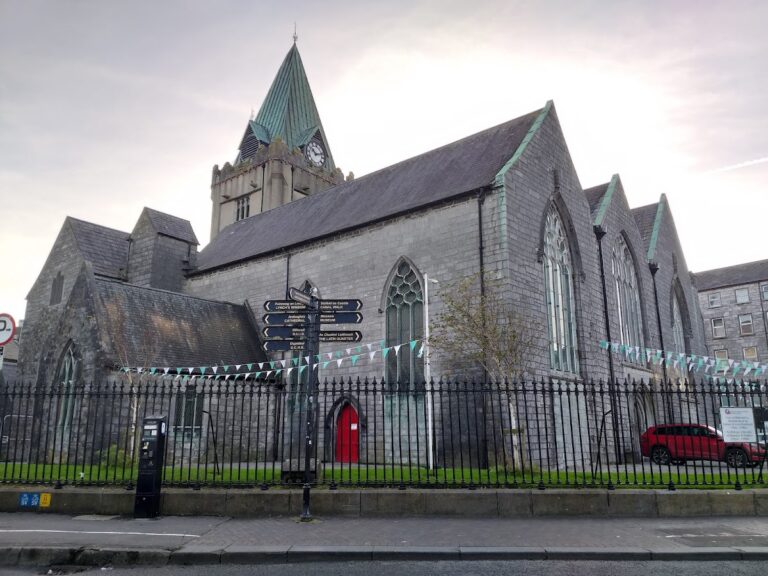
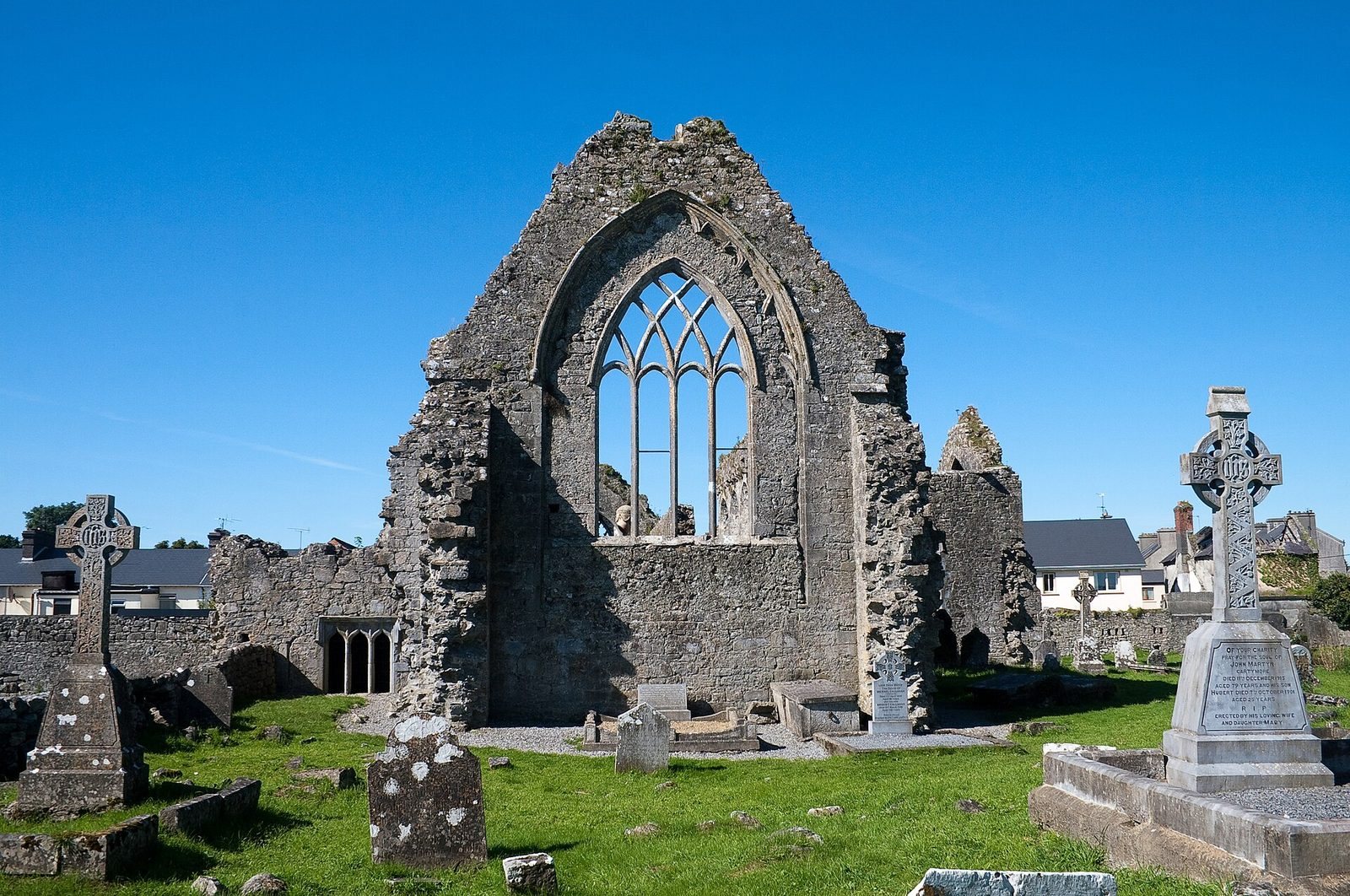
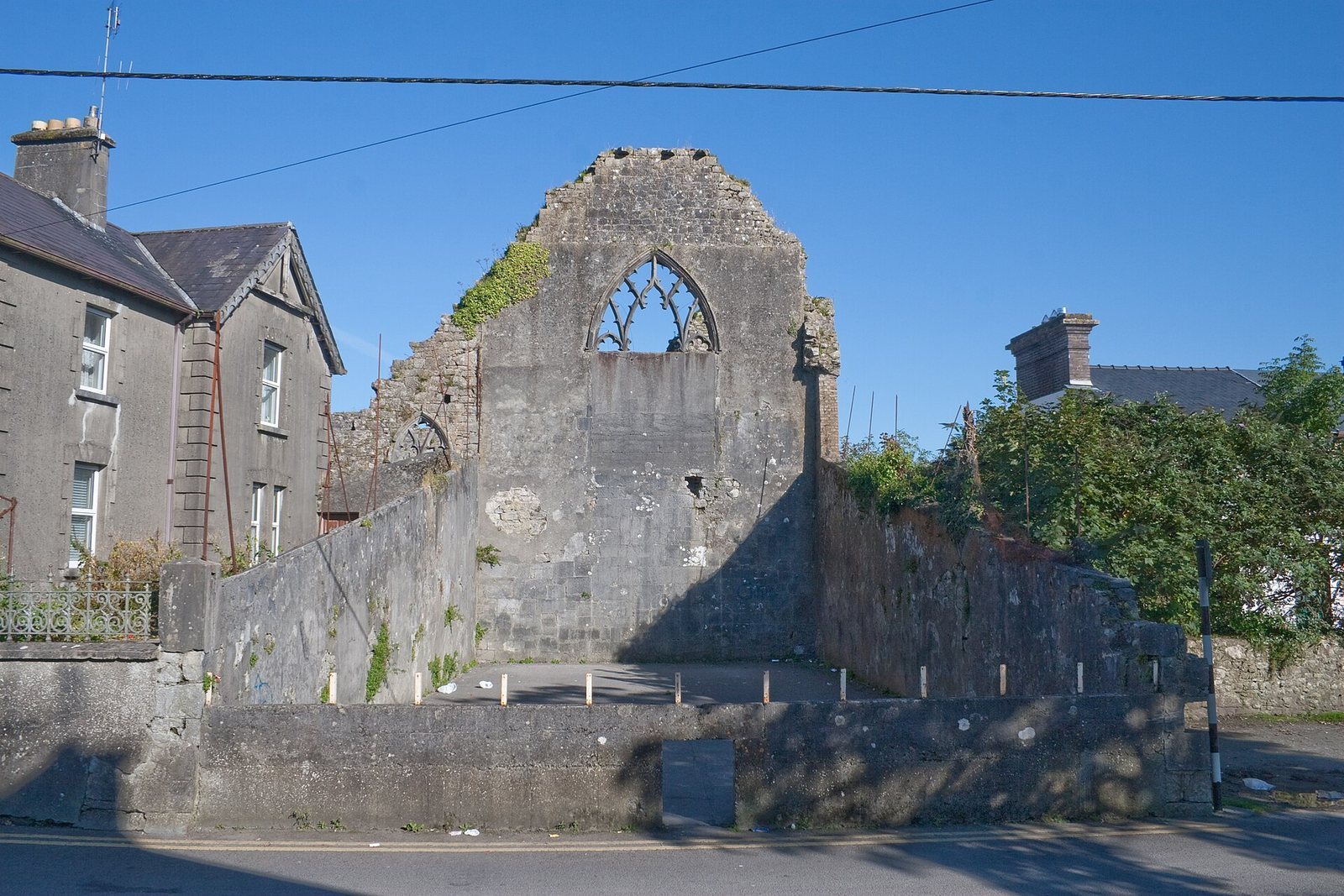
Athenry Priory stands in the eastern part of Athenry, east of the Clarinbridge River. It was first built at the edge of the town walls and was later enclosed within them. The surviving complex consists of the church’s nave, chancel, northern aisle, and northern transept, together with tombs dating from the thirteenth to the fifteenth centuries. Most of the church fabric belongs to the fourteenth century, while the tall lancet windows in the chancel probably date from the thirteenth century.
Surviving church
Nave and chancel
The nave, the main central space of the church, forms part of the surviving ruined structure. The chancel, the area around the high altar reserved for clergy, retains tall lancet windows. A lancet window is a narrow, vertically proportioned opening with a pointed arch. These windows probably preserve part of the priory’s thirteenth-century fabric, while the surrounding church remains mainly reflect the fourteenth-century enlargement completed by 1345.
Northern aisle and transept
The northern aisle, a passage alongside the nave, and the northern transept, a cross-arm of the church, belong to the later enlargement of the church. Their construction formed part of the work financed by William Liath de Burgh after his bequest of 1324. The remains are now incorporated into the ruined church complex.
Former conventual buildings
The early priory included a refectory, dormitory, chapter house, cloister garden, infirmary, guesthouse, and a house for scholars. These buildings supported communal dining, sleeping, administration, care, hospitality, and education. The cloistral buildings were demolished by the English military in the eighteenth century, while other former parts of the complex were adapted for use as a barracks until the soldiers moved elsewhere in 1850. The former tower later collapsed, sometime after 1779.
Tombs and associated remains
Tombs from the thirteenth to the fifteenth centuries remain among the priory’s physical features. They reflect its use as a burial place for bishops of Clonfert and Kilmacduagh, the de Bermingham family, and other benefactor families. The tomb of Lady Mathilda Bermingham was made from Coade stone and was broken into in 2002. The priory’s associated medieval landscape also included the chapel built at Carrowardahrah in 1451, on land north of the river granted by Ulick Ruadh Burke.