Claregalway Friary: A Medieval Franciscan House in County Galway
Site at a Glance
- Popularity
- Medium
- Country
- Ireland
- Primary era
- Medieval
- Eras represented
- Medieval
- Civilizations
- Norman
- Site type
- Religious
- Remains
- Monastery
On this page8 sections
History
Foundation and patronage
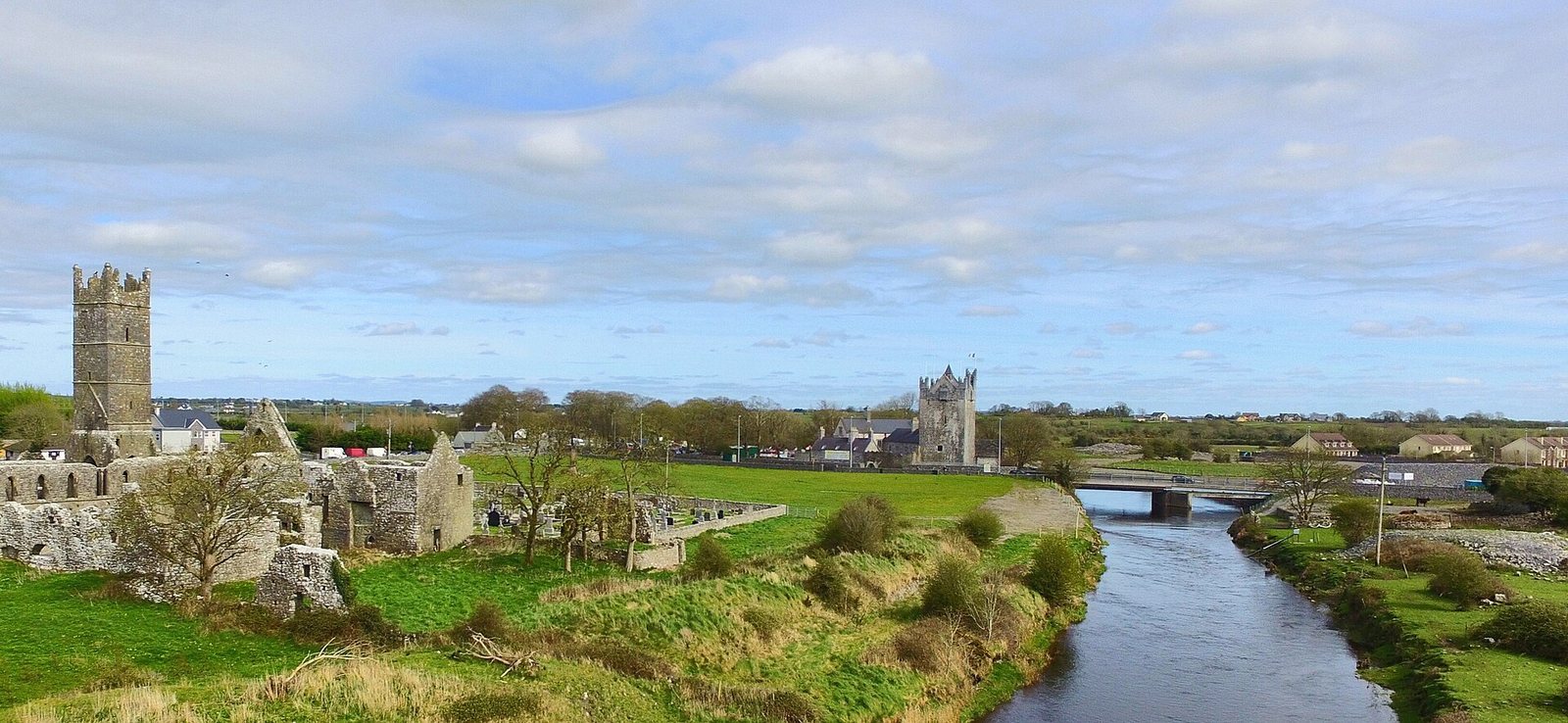
Claregalway Friary is a ruined medieval Franciscan house on the bank of the Clare River in Claregalway, County Galway, Ireland. Founded by John de Cogan I around the middle of the thirteenth century, it existed before 1250 and was the Franciscans’ second foundation in the Diocese of Tuam, a church district overseen by a bishop. The first was their Galway house, established around 1247. Claregalway was among the earliest Franciscan houses in Irish-dominated areas.
Relations between Irish and Anglo-Norman religious houses were sometimes strained. The resulting dispute within Irish Franciscan communities, known as the Conspiracy of Mellifont, lasted from 1217 to 1228. Claregalway was one of only two Franciscan houses where an Irishman could serve as Guardian, the head of a community. In 1324, a papal commission described the friary’s loyalty as suspect.
Pilgrims who came to the friary in penance received an indulgence, a grant in Catholic practice associated with the remission of temporal punishment for sin, in 1291. The house also held the Bishop of Annaghdown’s pontificals, the insignia and ceremonial objects of his office. In 1296, the archdeacon of Tuam was accused of taking them. The de Cogan family patronized the friary until 1327. John Magnus de Cogan, also called John de Cogan III, claimed in 1326 to be its founder, perhaps because he had supported or enlarged it. The following year, he granted the buildings and surrounding land to the Franciscans in return for an annual rose for himself and his descendants on the Nativity of John the Baptist, a Christian feast marking the saint’s birth.
The friary underwent renovation in the fifteenth century. Two senior churchmen were buried there: Muiris Ó Fithcheallaigh, an Irish Franciscan theologian and Archbishop of Tuam who lived circa 1460–1513, and Tomás Ó Maolalaidh, Bishop of Clonmacnoise circa 1509–1514 and Archbishop of Tuam from 1514 to 1536.
Reformation and political upheaval
The community flourished until the mid-sixteenth-century Reformation, a religious movement that challenged Catholic authority in parts of Europe and led to the establishment of Protestant churches. In Ireland, the movement disrupted Catholic institutions, while political and economic pressures made the friary harder to maintain. At a Reformation-era assessment, its holdings included six cottages with gardens, 24 acres of farmland, a watermill, and the right to use a common meadow for 24 cows.
On 11 July 1538, troops under Lord Leonard Gray looted and ransacked the friary while marching toward Galway. Queen Elizabeth I granted the monastery to Sir Richard de Burgo in 1570. Around 1589, Sir Richard Bingham, the English governor in Ireland, turned the buildings into a barracks and expelled the Franciscans. They later regained permission to occupy parts of the friary, but were expelled again. During King James’s reign, the property passed to the Earl of Clanrickarde. The Franciscans returned in 1641, though the buildings were in poor repair and the community lacked the means to renovate them.
Decline and preservation
The friary continued to house a community in the eighteenth century. In 1731, Edward Synge, Archbishop of Tuam, noted that at least three friars lived there. The following year, County High Sheriff Stratford Eyre reported that the monks lived close to the friary. The community numbered about 220 in 1766 and about 150 in 1782. In 1791, French diplomat Coquebert de Montbret described the friars as living among the ruins.
By 1838, only two friars remained. They left in November 1847 to join the larger Franciscan community in Galway. Friars from Galway continued to visit on feast days to celebrate Mass and hear confession, a practice that had ended by 1860. In 1892, Lord Clanmorris gave the property to the Commissioner of Public Works under the Ancient Monuments Act 1882. Claregalway Friary is a National Monument of Ireland.
Remains
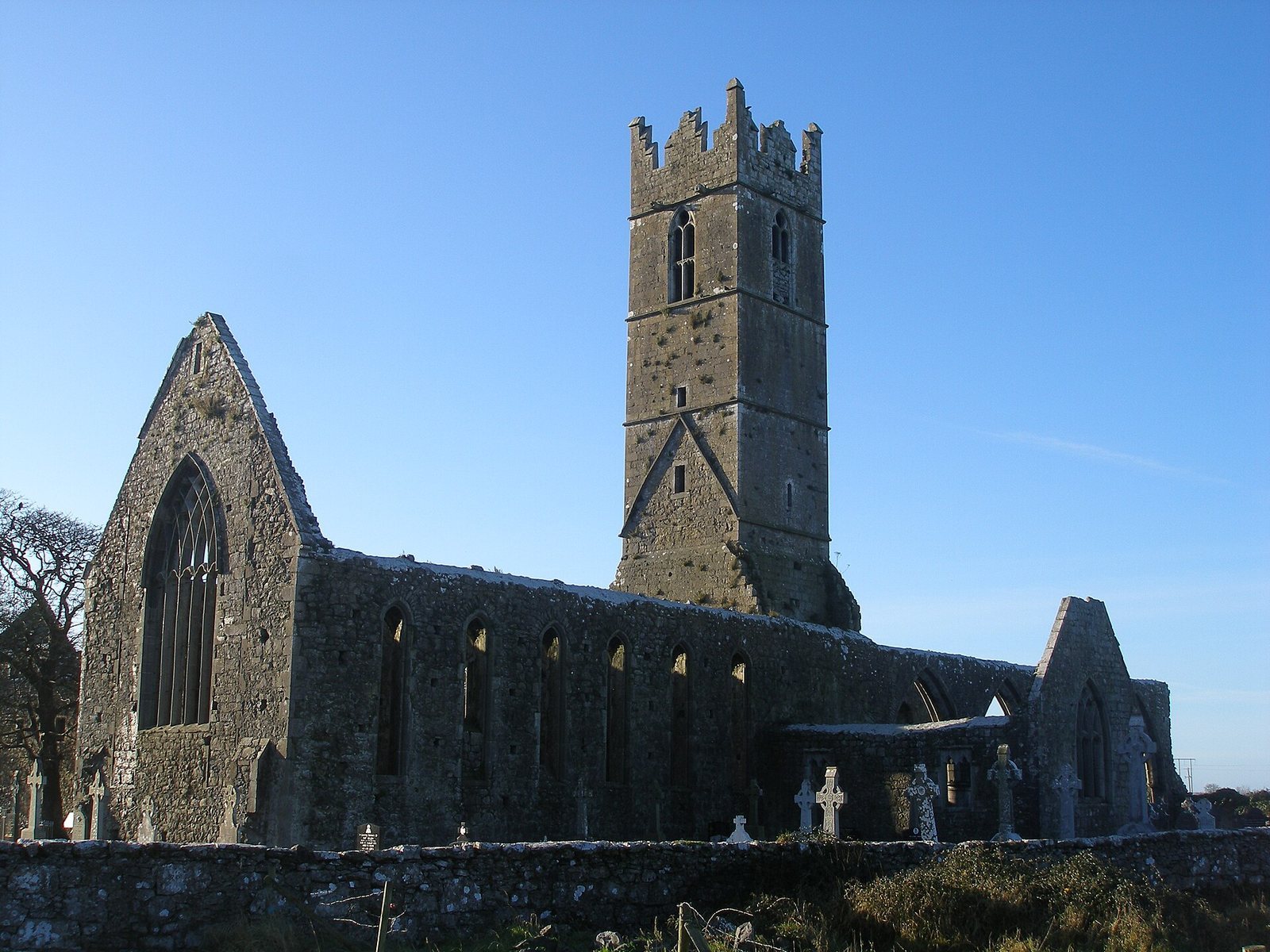
The ruined friary stands beside the Clare River. Much of its surviving fabric dates to the thirteenth century, with later alterations. The buildings are an important early example of Franciscan architecture in Ireland, arranged around an east-facing church and a cloister to its south.
Church
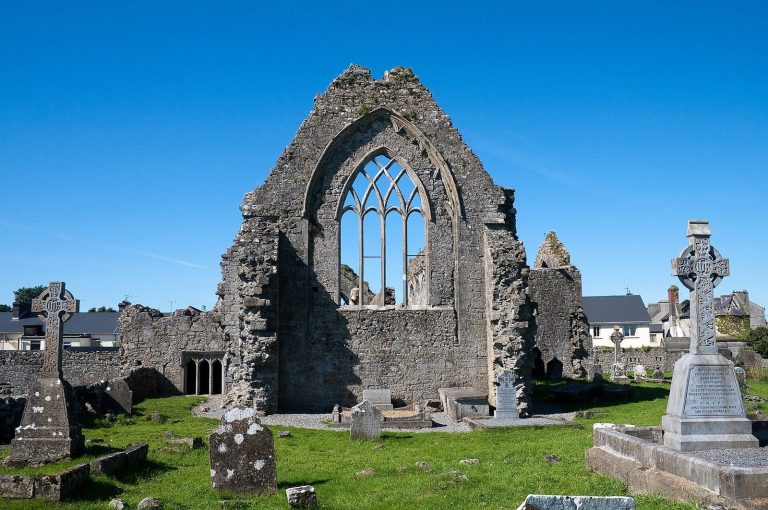
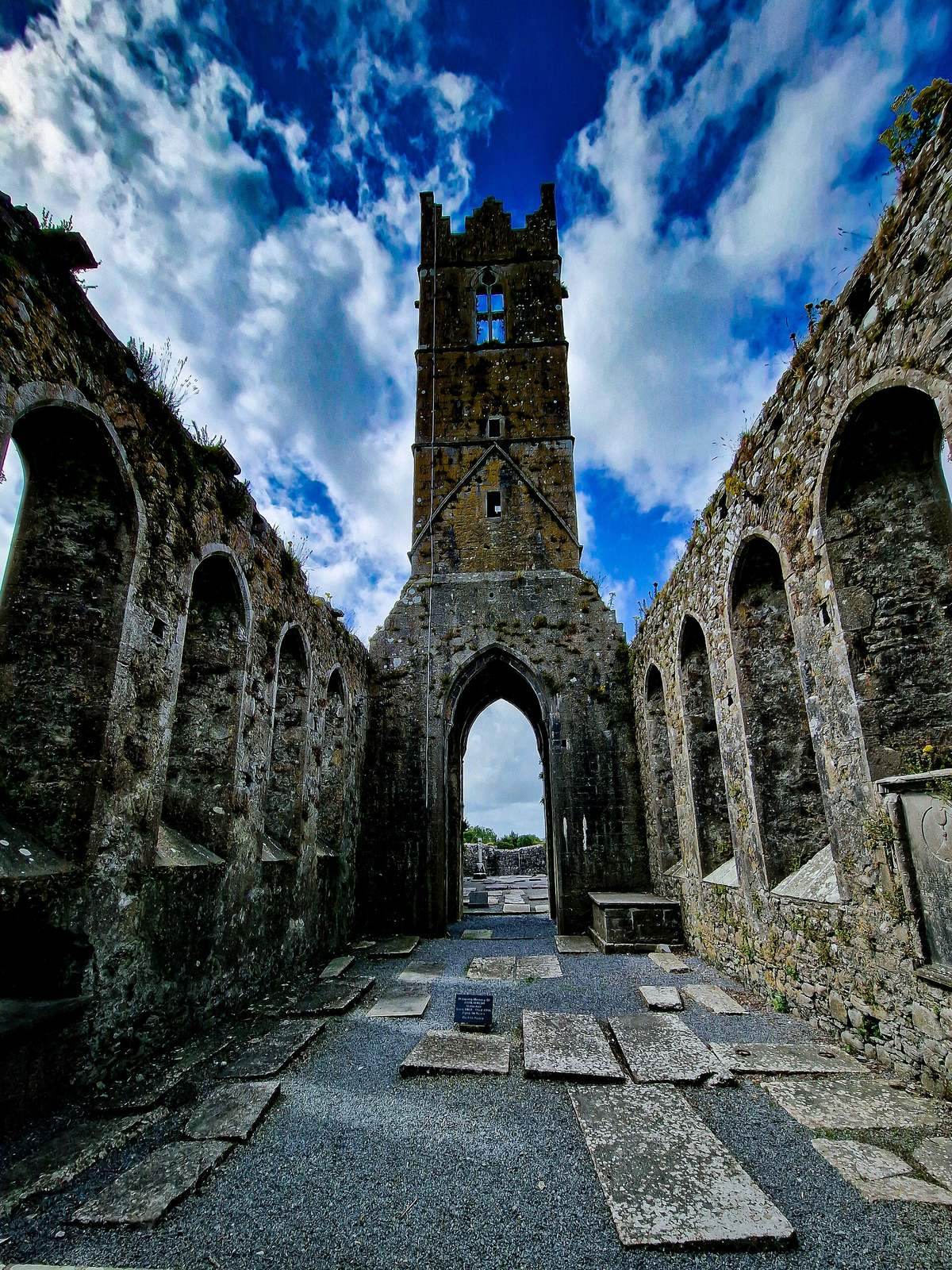
The church has a cruciform plan, with a nave, chancel and north transept. Arcades divide the nave from a north aisle, which has four pointed-arch bays supported by cylindrical pillars with simply moulded capitals. The chancel’s east end originally had five or possibly seven narrow, pointed lancet windows; a larger window replaced them in the fifteenth century. Tall, narrow windows from the thirteenth century remain along its north and south sides. Inside the chancel are a three-seat stone bench and a carved tomb recess. An altar remnant is fixed to the north side of the nave.
Bell tower and carved details
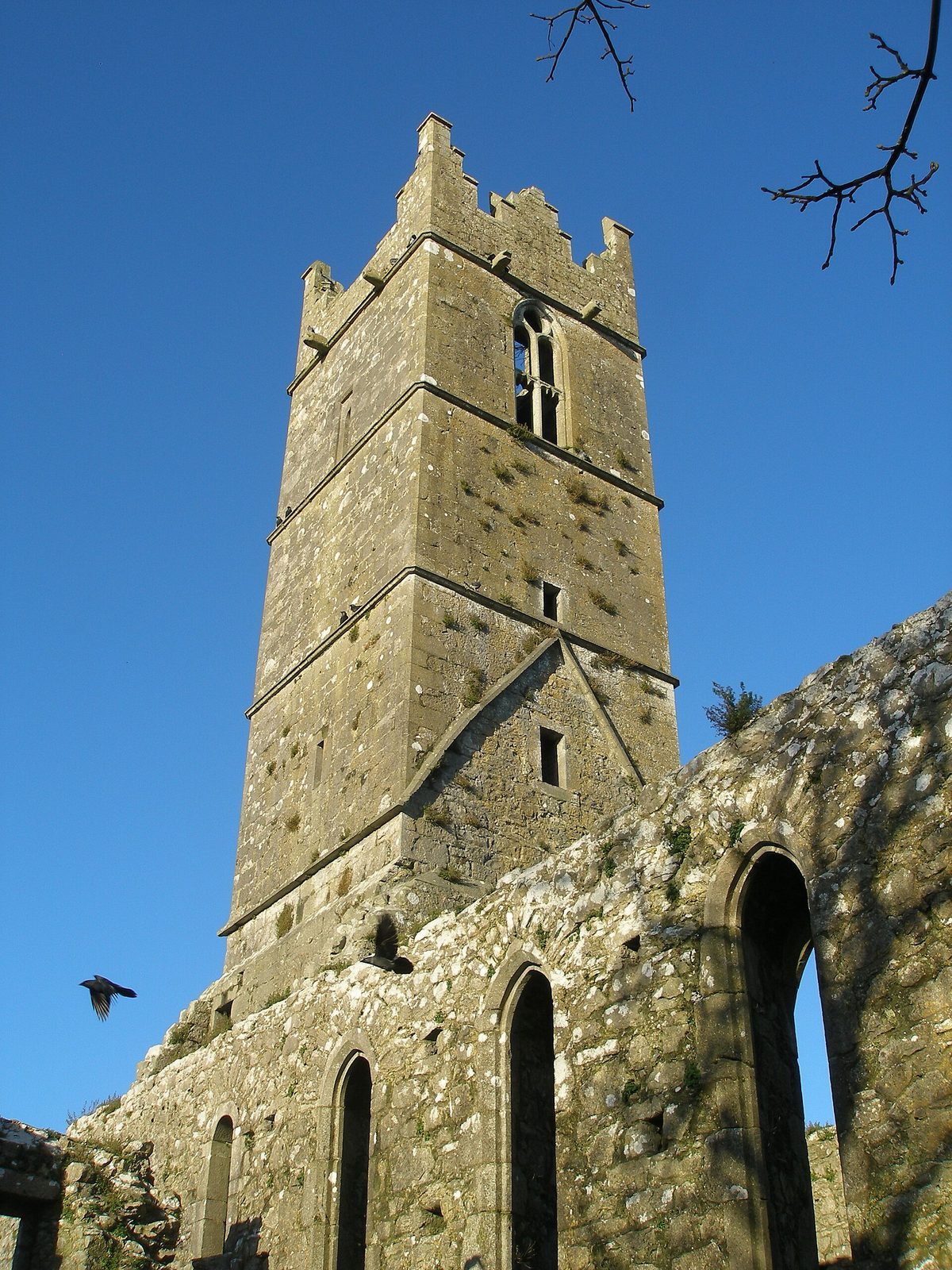
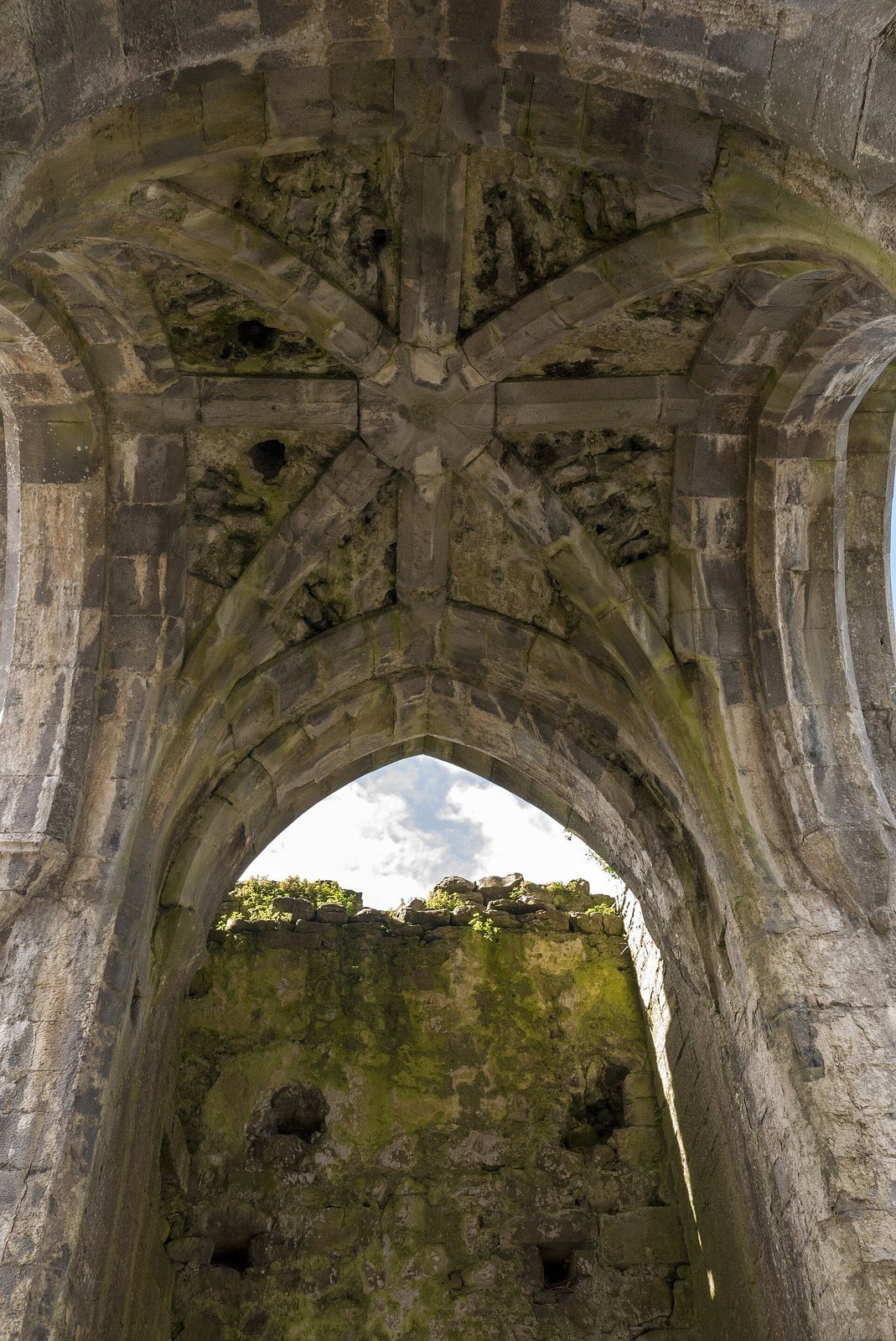
The fifteenth-century bell tower rises 24 metres and is among Ireland’s better-preserved examples of its type. Three horizontal bands divide its storeys, while projecting waterspouts mark the upper level. Animal-head carvings decorate the arches beneath the tower, and small animal heads and other motifs ornament its projecting supports. In the passage between nave and chancel, the ribs of a vaulted ceiling meet at a carved boss shaped like a monkey’s head. Bricks projecting above eye level on the tower’s west side, facing the nave, may have supported statues of saints.
Cloister and living quarters
South of the church are remains of the cloister and associated living quarters. The cloister enclosed a square area that served as a garden; two-storey buildings once bordered its other sides.