San Donnino a Villamagna: A Romanesque Parish Church in Italy
Site at a Glance
- Rating
- 4.8
- Popularity
- Very Low
- Country
- Italy
- Primary era
- Medieval
- Eras represented
- Medieval, Early Modern, Modern
- Civilizations
- Grand Duchy of Tuscany, Holy Roman Empire, Italian, Republic of Florence
- Site type
- Religious
- Remains
- Church
On this page14 sections
History
San Donnino a Villamagna is a Roman Catholic church in Italy, founded and consecrated in the eighth century and later rebuilt in the Romanesque period. Dedicated to San Donnino, the Italian name for Saint Donninus, it stands within Villamagna, in the commune of Bagno a Ripoli, and belongs to the Archdiocese of Florence.
Medieval parish centre
The first surviving documentary reference dates to 27 February 1067, when the court and castle of Villamagna were donated to the monastery of San Pier Maggiore. By the eleventh century, the church had taken the Romanesque form associated with its present structure.
During the thirteenth century, San Donnino functioned as a pieve, a parish church with pastoral authority over dependent churches in a surrounding district. Its finances were modest, and it was assessed at only 13 lire in 1276. A chapter of priests nevertheless operated there and administered five dependent churches: Santa Maria at Rignalla, San Romolo of Villamagna, Santa Maria at Remoluzzo, San Michele at Compiobbi, transferred from the pieve of Remole, and the Oratory of Blessed Gherardo.
The church was renewed during the fourteenth century. In 1394, the painter Mariotto di Nardo received the commission for a polyptych, an altarpiece made from several panels. An altar dedicated to Saint Michael was added in the fifteenth century, while frescoes were also placed in the church during that period.
Later changes and restoration
Patronage remained in the hands of the parishioners. In 1640, they commissioned the Chapel of the Confraternity of San Donnino and carried out restoration work focused mainly on the façade. The confraternity chapel was recorded as profaned in 1786.
A new organ was acquired in 1842. In 1871, white plaster covered two frescoes of Saint Stephen and Saint Gherardo on the pillars of the last arch on the right side of the nave. The pillars were uncovered and consolidated in 1891.
An earthquake damaged the church in 1895. In 1930, engineer Attilio Rampoldi directed a restoration intended to return the building to its Romanesque forms. Further consolidation followed the Second World War under the direction of architect Guido Morozzi.
The church’s historical furnishings include works connected with the confraternity dedicated to San Donnino. A painting by Francesco Granacci was probably commissioned by the confraternity and may have been executed around 1530–1535. San Donnino was also the original home of Rosso Fiorentino’s 1522 Villamagna Altarpiece.
Remains
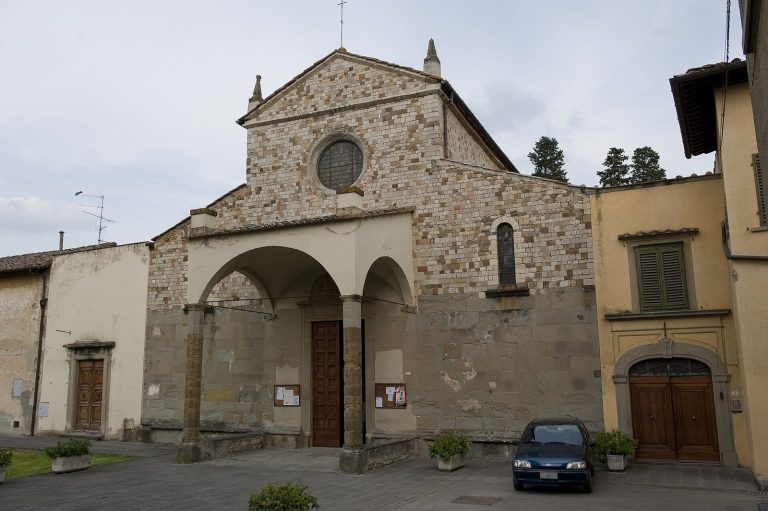
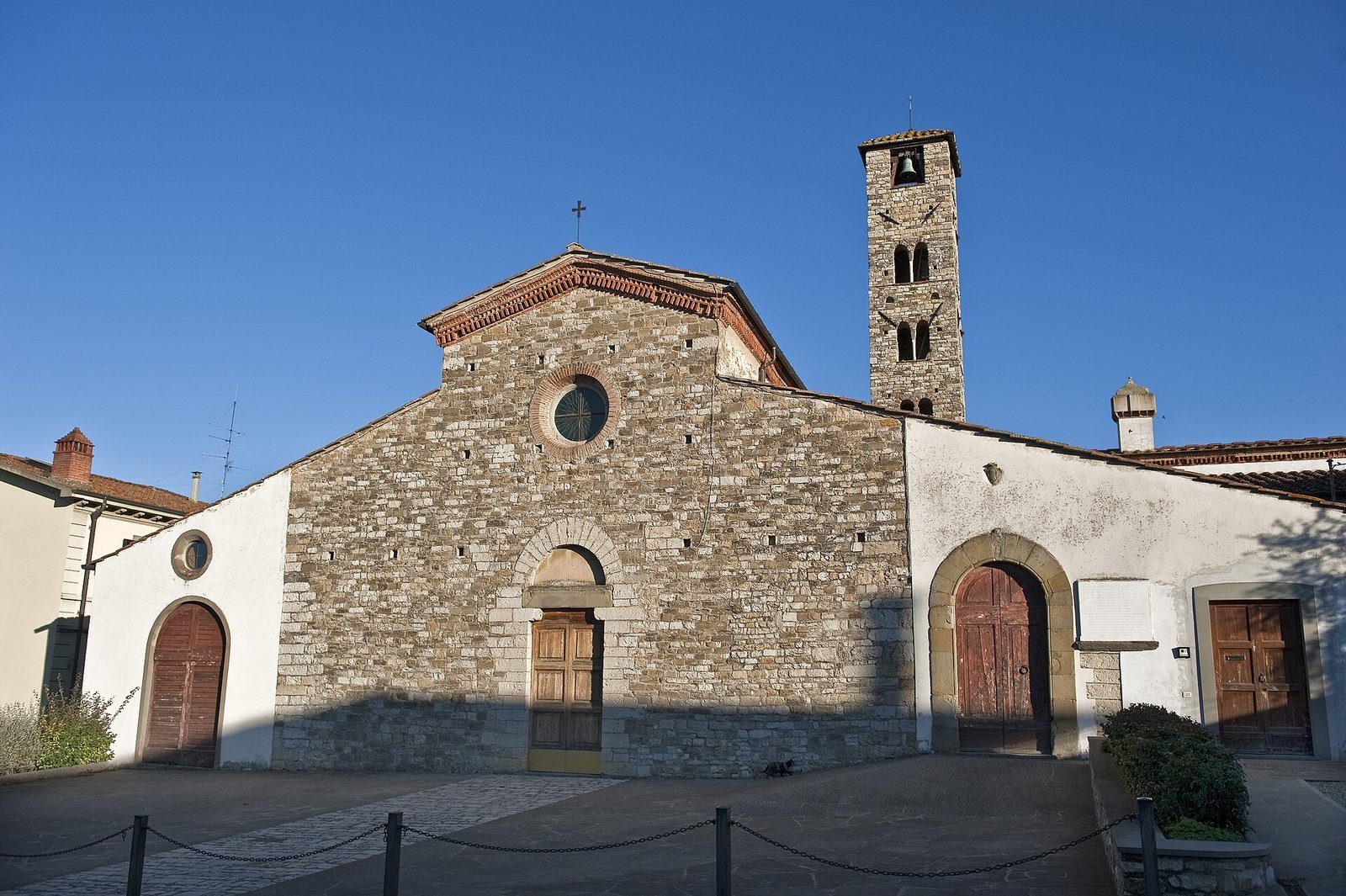
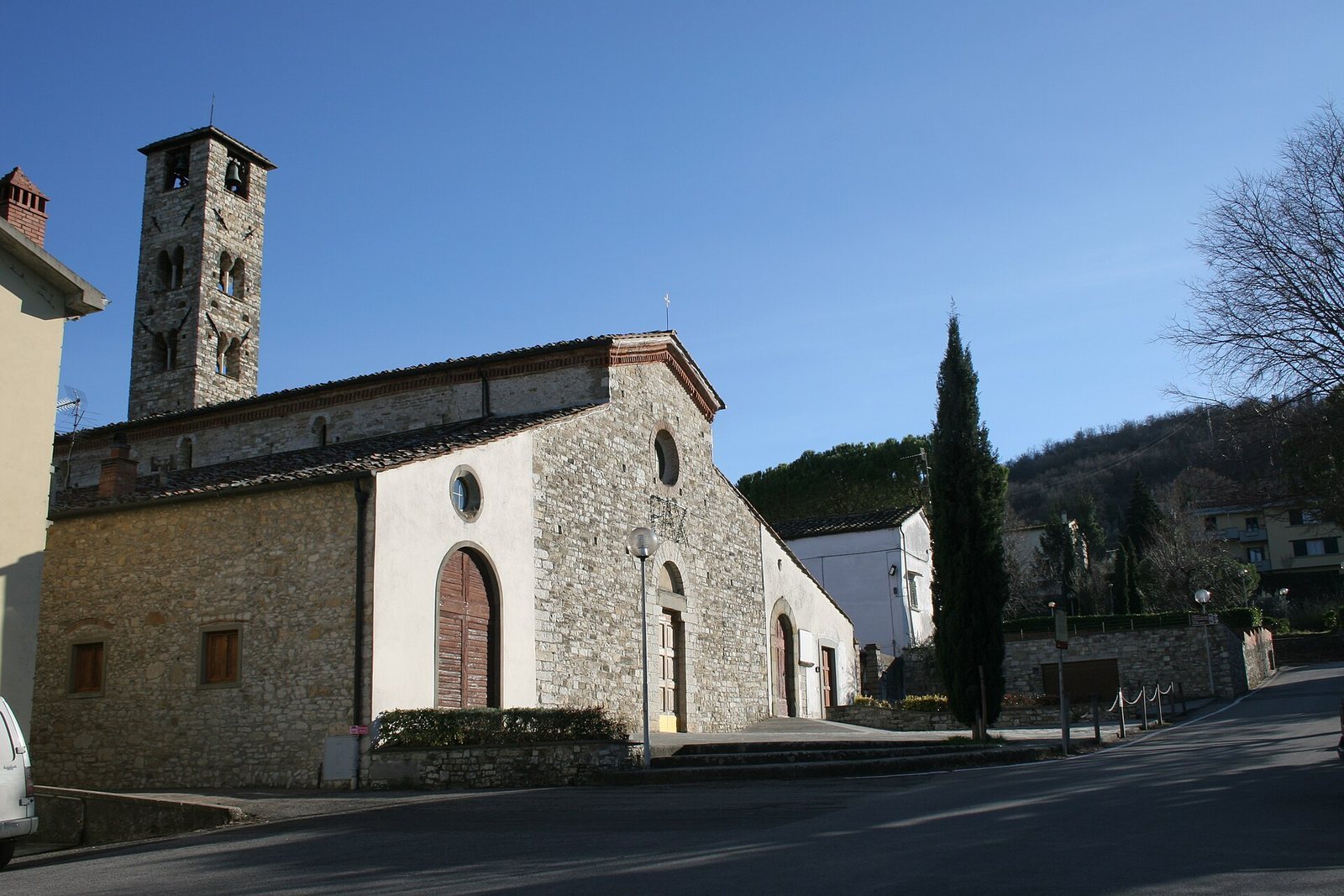
San Donnino stands at the centre of the extensive parish complex of Villamagna. It is a small church with three aisles, a semicircular apse, and a bell tower. The building is datable to the eleventh century and uses roughly cut Alberese limestone blocks laid in regular courses. Abundant bedding joints, now filled with cement, remain visible in the exterior masonry.
Exterior and bell tower
Façade
The stepped façade reflects the division of the interior into three aisles. A terracotta cornice crowns the front and links it visually to the rectory complex on the south side. The central portal and the oculus above it belong to the twentieth-century restoration.
Apse
The apse forms a prominent rounded volume at the eastern end of the church. Its wall contains a window that may have replaced an earlier single-light opening. Two pilasters frame it and support a cornice made of projecting limestone arches. Between the apse and the roof ridge, a double-splayed single-light window has been blocked.
Bell tower
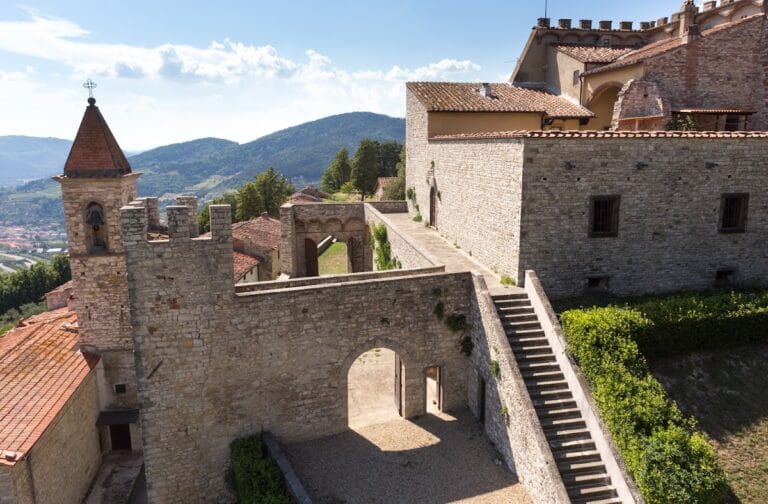
The square bell tower rises on the right side of the church and is divided into six levels. Its uppermost level was built after the Second World War. The shaft contains a single-light window with a two-colour archivolt, the band of masonry following the curve of an arch. The upper levels have broad two-light windows divided by marble columns with deep projecting impost blocks.
Adjoining buildings cover both side elevations, while the clerestory, the upper part of the nave with windows above the aisle roofs, remains visible. It is pierced by a series of single-light windows.
Interior and artworks
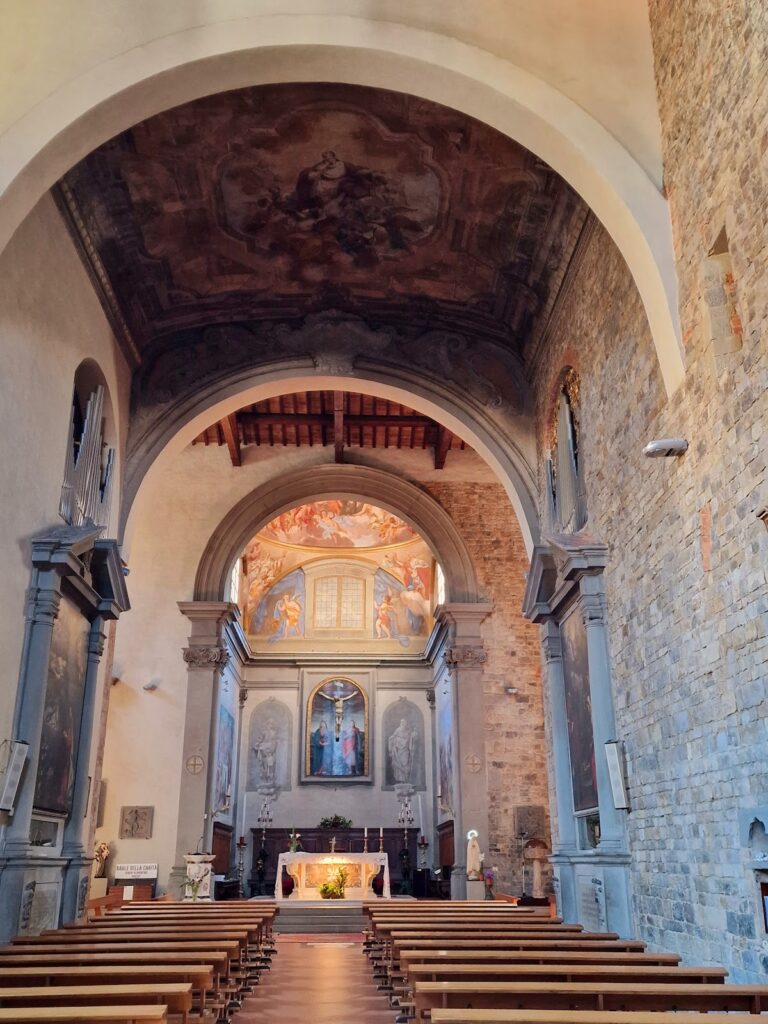
Inside, six round arches separate the three aisles. They rest on four-sided pillars, and the fourth and fifth bays on the right are decorated with fifteenth-century frescoes. The final bay on that side contains the base of the bell tower, reached through a portal with an archivolt formed by alternating stone and terracotta rings.
Right aisle
The right aisle contains an early-sixteenth-century panel of the Enthroned Madonna and Child with Two Saints by an unknown Florentine painter. A late-seventeenth-century canvas shows Saint Dominic and Saint Catherine in adoration, while a bas-relief of the Madonna and Child is attributed to Lazzaro Cavalcanti, known as Il Buggiano. Approximately midway along the aisle stands Mariotto di Nardo’s 1394 triptych, an altarpiece with three main panels.
Right presbytery and organ area
At the head of the right aisle is an organ made by the Agati firm. The same area preserves frescoes attributed to the Maestro di Signa, an anonymous name for an unidentified painter or workshop. They include traces of a small cycle showing the Crucifixion with Mary Magdalene and Saint Donnino, together with a monochrome altar frontal depicting the Madonna and Saints.
Presbytery
In the presbytery, the sanctuary area around the high altar, an ark beneath the altar contains the body of Blessed Gherardo da Villamagna, a medieval religious figure associated with Villamagna and venerated as a blessed. A processional Crucifix stands above the high altar.
Left aisle
At the head of the left aisle is Francesco Granacci’s canvas of the Madonna and Child with Saints Donnino and Gherardo. About halfway along the aisle, an altar in a Renaissance frame holds David Ghirlandaio’s Enthroned Madonna and Child with Saints John the Baptist, Nicholas, Donnino, and Sebastian.
Frescoes attributed to the Maestro di Signa decorate the same altar. Their subjects are the Nativity, Christ in Pity, God the Father, and the Evangelists.
Baptismal area
Above the baptismal font is a panel from the mid-fourteenth century attributed to Jacopo di Cione. It depicts Saint John the Baptist, Saint Anthony Abbot, and Saint Francis of Assisi receiving the stigmata.