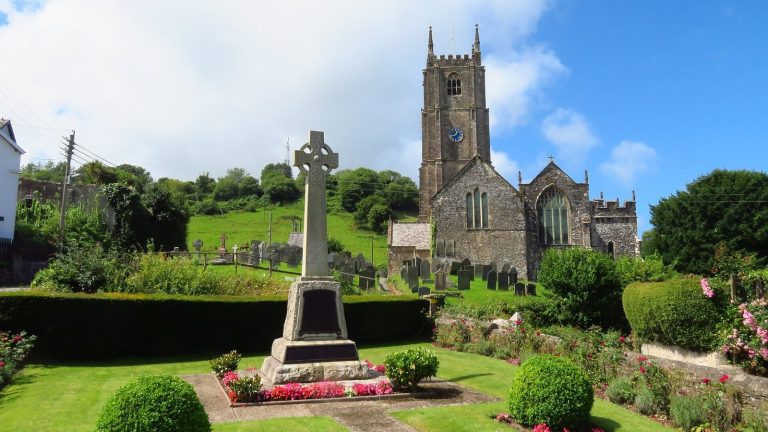
Church of St George, Georgeham: An Anglican Parish Church in Devon
Site at a Glance
- Rating
- 4.9
- Popularity
- Very Low
- Country
- United Kingdom
- Primary era
- Medieval
- External website
- Open
- Eras represented
- Medieval, Early Modern, Modern
- Civilizations
- British, English
- Site type
- Religious
- Remains
- Church
On this page18 sections
History
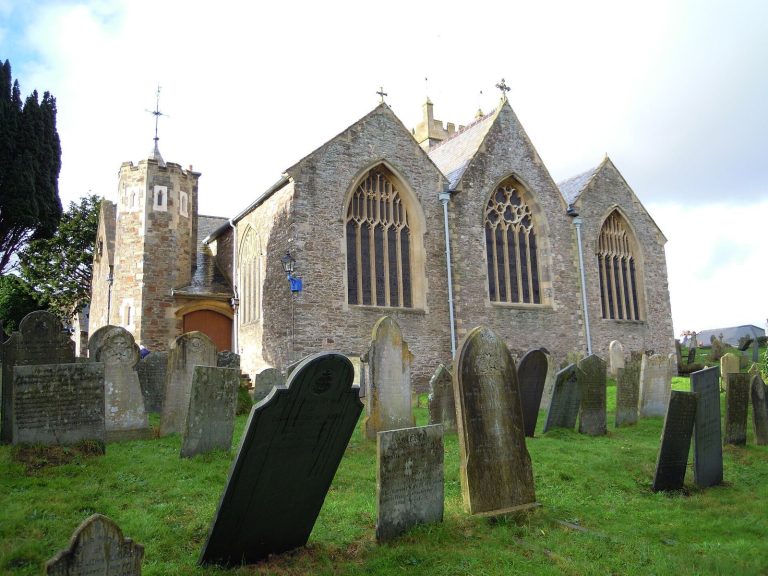
Church of St George is the Anglican parish church of Georgeham in the United Kingdom, a medieval church associated with the Diocese of Exeter, the Church of England’s administrative territory covering Devon. The church is described as dating from the thirteenth century, and its dedication is to Saint George, the Christian martyr whose cult became especially prominent in medieval Europe. The first recorded dedication to Saint George dates from 1356.
Medieval origins
The first recorded church at Georgeham dates from 1231, when Robert de Edington was described as the “persona,” meaning parson, and patron of Hamme. An earlier Saxon or Norman church may have stood on the site, although this possibility is not supported by firm evidence. The early history of the present church is reflected in surviving thirteenth-century features, including a font, a Crucifixion carving, a piscina, and a knight’s effigy.
Sir Mauger St Aubyn III, who fought in Wales in 1283, died in 1294 and was buried in the church. Local tradition portrays him as a man of giant-like stature who threw a heavy stone into Georgeham from a great distance. His wife, Isabel Pickwell, died after 1308 and was also buried in the church. Her monument no longer survives and was probably moved during one of the later Georgian or Victorian restorations.
Georgian and Victorian changes
A major restoration in 1762 reshaped the interior in a Classical or Romanesque manner, and most of the windows were altered. Boxed seating was installed in 1767, along with raised galleries on the west wall for the gentry. These changes were later reversed or modified during a further restoration directed by James Fowler in 1876. Fowler was a nineteenth-century English church architect known for restoring Anglican churches.
The 1876 work replaced the box pews, removed the elevated gallery, enlarged the vestry, and rebuilt parts of the chancel. The wooden screen was restored in 1912. The church has been a Grade I listed building since 25 February 1965. This is the highest level of statutory protection in England, reserved for buildings judged to have exceptional historical or architectural interest.
Families, worship, and remembrance
Memorials inside the church preserve associations with the Newcourt, Harris, and Chichester families. William Chichester served as rector from 1750 to 1770, and a memorial commemorates him, his wife Mary, and their daughter Ann Chichester, who died in 1780. The church also remembers Archibald Cleveland, who took part in the Charge of the Light Brigade in October 1854 and was killed at the Battle of Inkerman in November of the same year. Both were major engagements of the Crimean War, fought between Britain and Russia and their allies.
Henry Tinker of Croyde drowned in 1916 while trying to rescue a woman in difficulties off Croyde Beach. He was awarded the Royal Humane Society Medal after his death, and a plaque in the church commemorates the act. The organ was installed in 1881 in memory of Frances, who died in 1880. She was the daughter of the Reverend William Spurway and the widow of the Reverend Francis Hole, who served as rector from 1831 until his death in 1866. The organ was restored in 1999, when its hand pump was converted to electric operation.
The tower clock was installed in 1921 as a memorial to parishioners who died on active service during the First World War. Its dial and hands were regilded in 2014, and an electric winding mechanism was fitted during a commemoration of the war’s centenary. The churchyard is also the burial place of Henry Williamson, author of Tarka the Otter, and the American author and adventurer Negley Farson.
Parish life in the twentieth century
A tapestry map of Georgeham Parish was unveiled in 1995. The Women’s Institute initiated the project to commemorate the seventy-fifth anniversary of the Institute’s foundation in Devon. About 85 artists and embroiderers from Georgeham and Croyde, together with 70 children from Georgeham Primary School, contributed to its production. The completed map was displayed at the Barbican in London in 1996.
Remains
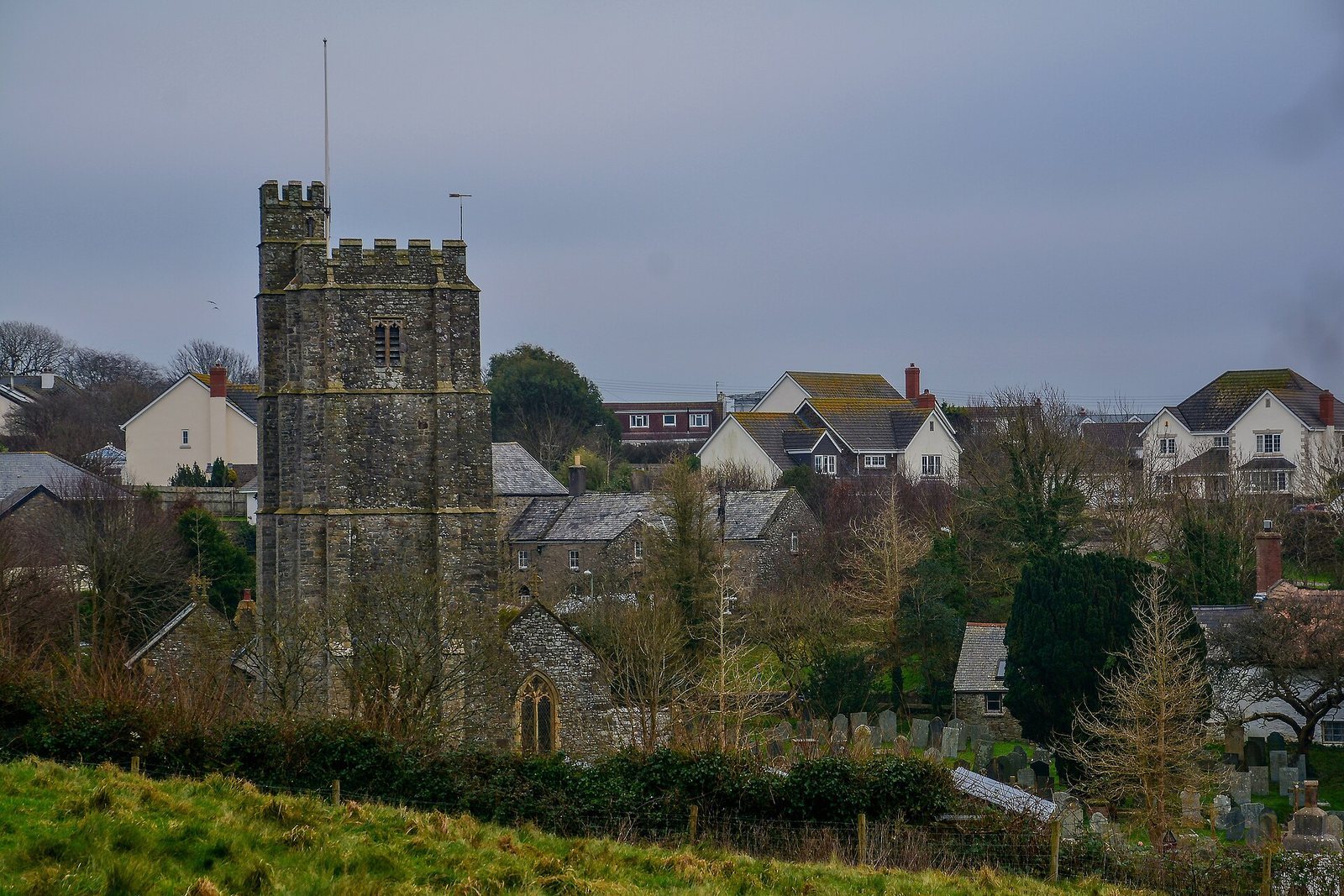
Church of St George is built mainly of random stone rubble. Large stone blocks strengthen the tower, while carefully cut stone surrounds the openings and forms the building’s quoins, or corner stones. The surviving fabric brings together medieval masonry, later alterations, carved church furnishings, memorials, and stained glass. The oldest surviving part is the fourteenth-century tower, while the nave, side aisle, chancel, chapel, porch, and interior fittings represent several subsequent phases.
Tower, nave, and aisle
Fourteenth-century tower
The tower has three stages, set-back buttresses, and an embattled parapet, a roofline with alternating raised sections and openings. A stair turret on its north side contains four slit windows. Traces on the tower’s east face show that the nave was once higher than the present building. The tower’s eight bells comprise five cast in 1748, one cast in 1765, and two made in 1926.
Nave and south aisle
The arcade, a series of arches supported by piers, separates the nave from the side aisle and is probably fifteenth-century. Its bays contain Pevsner “B” type piers with leaf capitals on the main shafts. The nave and south aisle retain unceiled waggon roofs, whose broad curved or polygonal interiors contain carved bosses at the intersections. The south porch has a wall sundial dated 1773 and may itself belong to that year.
Medieval features and Pickwell Chapel
Early carvings and font
A stone font stands to the right of the altar. In the chancel, a small Crucifixion carving dates from around 1300. The heads of Christ, John, and Mary have been mutilated, while weeping angels appear at either end of the cross. These early features belong to the medieval history of the building and remain part of its interior fabric.
Pickwell Chapel
The Pickwell Chapel contains a small piscina, a wall basin used for washing sacred vessels during the liturgy, and the prone stone effigy of a knight. The effigy dates from around 1294 and is identified as Sir Mauger St Aubyn III. It depicts him as approximately 6 feet, or 1.83 metres, tall, cross-legged, with two dogs at his feet. He carries a sword and shield, and supporting angels appear around the figure.
Chancel and later interior
Chancel windows and piscina
Near the altar, the north wall of the chancel contains a small fourteenth-century quatrefoil window, an opening with four lobes. It was discovered concealed during the Victorian restoration, repositioned in the chancel, and glazed with an angel holding a scroll bearing the words “Sanctus Sanctus Sanctus.” The chancel also contains a trefoil-headed piscina, whose opening has three lobes. Most of the church’s other stained glass dates from the nineteenth and twentieth centuries.
Screen, altar, and pulpit
The wooden screen between the nave and Pickwell Chapel dates from the 1762 restoration. Its Corinthian pilasters are flat, wall-attached supports with capitals based on the classical Corinthian order, and it is topped by a broken segmental pediment. Above the altar, the Last Supper reredos, an ornamental panel placed behind an altar, dates from the 1876 restoration. The same work introduced a Caen-stone pulpit, made from pale limestone quarried in Normandy, with carvings of John the Baptist in the wilderness, the Sermon on the Mount, and Saint Paul in Athens.
Murals on both sides of the altar depict Saints Francis and George, the Archangel, and the Virgin Mary. They were painted by Margaret Kemp-Welch, who lived in the village during the 1920s and 1930s. The parish tapestry map hangs on the south wall of the nave and required more than 3,000 hours of stitching.
Monuments and memorial objects
Family monuments
The Newcourt family monument is the oldest wall memorial in the church, dating from 1645. It commemorates Tobie Newcourt, his son William, and William’s four sons, John, William, Tobie, and another John. Two female heads represent the wives of Tobie Newcourt and his son. In the Pickwell Chapel, the Harris family monument dates from 1776. Honour Harris erected it to her parents, Dorothy and John Harris, and to three children who died in infancy. A cameo carving of Honour Harris was added after her death. John Harris had served as a Member of Parliament for Barnstaple.
Chichester and Cleveland memorials
A Chichester family memorial is fixed to the wall to the right of the altar. It commemorates William Chichester, his wife Mary, and their daughter Ann. The Pickwell Chapel also holds the large Bible commemorating Archibald Cleveland. On the north wall of the nave, a plaque remembers Henry Tinker. It displays the Royal Humane Society Medal, with a central copper insignia that can rotate to show both faces of the disc.