Archbishop’s Chapel, Ravenna: An Early Christian Episcopal Oratory


Site at a Glance
- Rating
- 4.8
- Popularity
- Medium
- Country
- Italy
- Primary era
- Medieval
- External website
- Open
- Eras represented
- Classical, Medieval, Modern
- Civilizations
- Ostrogothic
- Site type
- Religious
- Remains
- Chapel
On this page13 sections
History
The Archbishop’s Chapel in Ravenna, Italy, is an early Christian private oratory built at the turn of the sixth century during the reign of Theoderic, the Ostrogothic king of Italy. Construction is generally placed in the late fifth or early sixth century and is associated with Bishop Peter II. The chapel was attached to the episcopal residence and served the Catholic, or Trinitarian, bishops of Ravenna while Arian Christianity was dominant among the Goths.
The Episcopal Foundation
Ravenna’s episcopal complex began to take shape at the turn of the fourth and fifth centuries under Bishop Ursus. It included the Ursiana Basilica, now the cathedral, together with a baptistery and the bishops’ residence. The bishops of Ravenna acquired the rank of archbishop from 546 onward, strengthening the institutional importance of the complex.
The chapel was originally dedicated to Christ the Saviour. It later received the dedication of Saint Andrew, one of the Twelve Apostles, after relics associated with him were brought from Constantinople to Ravenna in the mid-sixth century. The alternative names Archiepiscopal Chapel and Chapel of Saint Andrew reflect this history. Although the chapel is sometimes linked with Peter Chrysologus, a fifth-century archbishop of Ravenna, its construction is attributed to the later Bishop Peter II. The mosaics belong to the original building campaign or were made shortly afterward.
Confessional Meaning
The oratory was built during Theoderic’s reign, when Arian Christianity, which understood Christ’s relationship to God the Father differently from Catholic Christianity, held a dominant position among the Goths. Its decorative program repeatedly emphasizes Christ’s divine nature and therefore expresses Catholic orthodoxy in a setting shaped by confessional tension. The chapel is described as the only surviving early Christian private oratory and as the only Catholic architectural work built during Theoderic’s reign.
Expansion and Later History
The wider episcopal complex expanded before the eleventh century, when the area had become an important center of municipal power. Archbishop Torreggiani commissioned a major enlargement in 1645, and additional rooms were built or altered during the following decades and over the next two centuries. The present complex incorporates a nineteenth-century facade and includes the archiepiscopal palace, a museum, a library, and an archive containing approximately 13,000 parchments.
The chapel’s entrance was altered during a restoration in 1914. It is now used as a museum. In 1996, the chapel was inscribed as part of the UNESCO World Heritage property Early Christian Monuments of Ravenna, under cultural criteria (i), (ii), (iii), and (iv).
Remains
The chapel occupies the first floor of the bishops’ palace. It is a very small room of approximately 220 square feet, laid out as a Greek cross, with four arms of equal form and an eastern arm ending in an apse, the usually semicircular termination of a Christian sanctuary. A small rectangular narthex, or entrance vestibule, stands before the chapel. The lower walls are faced with marble slabs, while the upper surfaces retain parts of a richly colored mosaic scheme, alongside areas replaced by tempera paintings.
Entrance and Vestibule
Narthex
The narthex has a barrel-vaulted ceiling covered with polychrome mosaics. Floral designs are interwoven with 99 multicolored birds, including forms representing local fauna. Twenty Latin hexameters appear on its walls. The entrance was later enriched with a lunette, a semicircular field above a doorway, containing a mosaic.
Christ the Warrior
The entrance lunette presents a young, beardless Christ as a warrior or victorious emperor. He wears Roman armor, carries a cross and a book, and bears a cross-shaped halo. His feet rest upon a lion and a serpent, imagery that represents the defeat of evil and draws on Psalm 90:12-13. The book carries the inscription Ego sum via, veritas et vita, meaning “I am the way, the truth, and the life.”
Cross-Shaped Interior
Apse and Central Vault
The apse has a hemispherical vault painted in tempera with a starry sky and a Latin cross at its center. The central cross-vault contains four angels in white garments, shown raising their hands to lift a Chi Rho monogram. The Chi Rho is an early Christian sign formed from the first two Greek letters of “Christ.” Between the angels appear the symbols of the four Evangelists, each shown with a copy of the Gospels.
Arches and Medallions
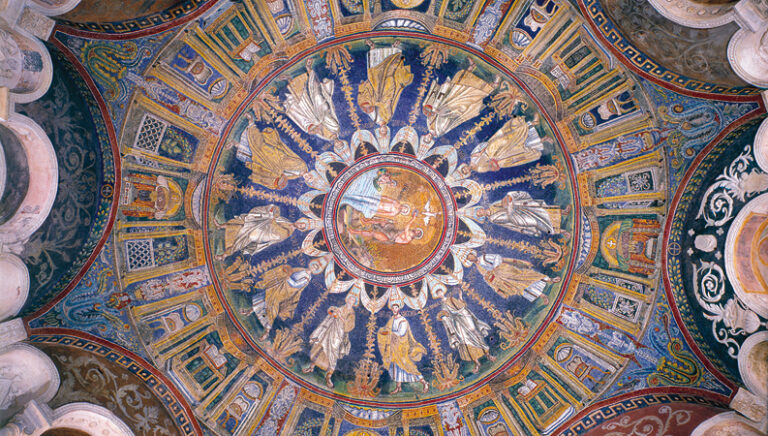
Further Chi Rho monograms occupy the central parts of the arcade arches. Three Apostles flank the monogram on each eastern and western arch, while three martyrs appear on each southern and northern arch. The compartments of the vault contain medallions depicting Christ, the twelve Apostles, and other saints. Their faces are distinguished by strong individuality, giving the surviving figures a marked sense of personal character.
Painted Replacements
Side lunettes contain frescoes by the Ravenna painter Luca Longhi, including scenes of the Resurrection and the Entombment of Christ. Fresco is a method of painting onto wet plaster. The lower portion of the Christ the Warrior mosaic and other original mosaic sections were repainted or replaced with tempera, including works by Luca Longhi from the sixteenth century.
Objects and Surviving Complex
A silver cross associated with Archbishop Agnellus is kept in the chapel. Its surface carries 40 repoussé medallions, made by hammering designs from the reverse of the metal. Four medallions date from the sixth century, while the remainder were made in the sixteenth century. Beyond the chapel, the surviving episcopal complex includes the massive Salustra Tower, while much of the original episcopal palace has not survived.