Baptistry of Neon: Ravenna’s Early Christian Baptistry


Site at a Glance
- Rating
- 4.8
- Popularity
- Medium
- Country
- Italy
- Primary era
- Classical
- External website
- Open
- Eras represented
- Classical, Medieval, Early Modern
- Civilizations
- Roman
- Site type
- Religious
- Remains
- Baptistery
On this page10 sections
History
The Baptistry of Neon is an early Christian baptistry in Ravenna, Italy, begun during the late fourth or early fifth century as part of the cathedral complex associated with Bishop Ursus’s basilica. It is the oldest surviving building in Ravenna by date of commencement. Designed for the Christian rite of baptism, its octagonal form expressed the theological idea that an eighth day, representing resurrection and eternal life, followed the seven days of creation.
Foundation and episcopal expansion
Bishop Ursus initiated the baptistry as part of the cathedral complex. His successor, Bishop Neon, continued the work in the second half of the fifth century, undertaking major structural interventions and overseeing the extensive mosaic and stucco decoration. The dome was constructed around 458, and the building acquired its present name from Neon’s role in completing and embellishing it.
The baptistry was built partly over the foundations of Roman baths, whose bricks were reused in its construction. The belief that it specifically occupied the bath complex’s calidarium, or heated room, has no secure historical basis. The original building belonged to a larger basilica complex that was demolished in 1734 for the present cathedral. A ring-shaped passage around the choir and other connections may once have linked the baptistry to the basilica, although this proposed arrangement has not been confirmed archaeologically.
Late antique religious setting
The name “Orthodox Baptistry” distinguished the building from Ravenna’s later Arian Baptistry, erected under the Ostrogothic king Theodoric about fifty years afterward. In this context, “Orthodox” referred to Christians regarded as following the accepted doctrine, while Arianism was a theological position that denied the full equality of the Son with the Father and was rejected by Nicene and later Catholic tradition.
Over time, subsidence and the accumulation of ground around the building buried much of its lower fabric. The original interior floor lay approximately three metres below the present ground level, changing the apparent proportions of the structure. The upper wall zone may have been enlarged during the tenth century or later to raise the building’s profile after the lower part had become buried. Another proposed date for this rebuilding is the second half of the fifteenth century.
Restoration and heritage status
The interior decoration has undergone substantial alteration and restoration. Between 1897 and 1906, some original fifth-century stucco reliefs were mistakenly removed as later additions. Reconstructed versions now stand alongside surviving fragments. The central figures in the dome mosaic were substantially remodelled in the eighteenth century by Felice Kibel, a Roman artist active in Ravenna, and parts were supplemented during nineteenth-century restoration.
The Baptistry of Neon forms part of the UNESCO World Heritage property Early Christian Monuments of Ravenna, inscribed in 1996 with seven other monuments in the city. The ICOMOS evaluation described it as the finest and most complete surviving example of an early Christian baptistry and emphasized the continuing Greco-Roman fluidity of its representations of the human figure.
Remains
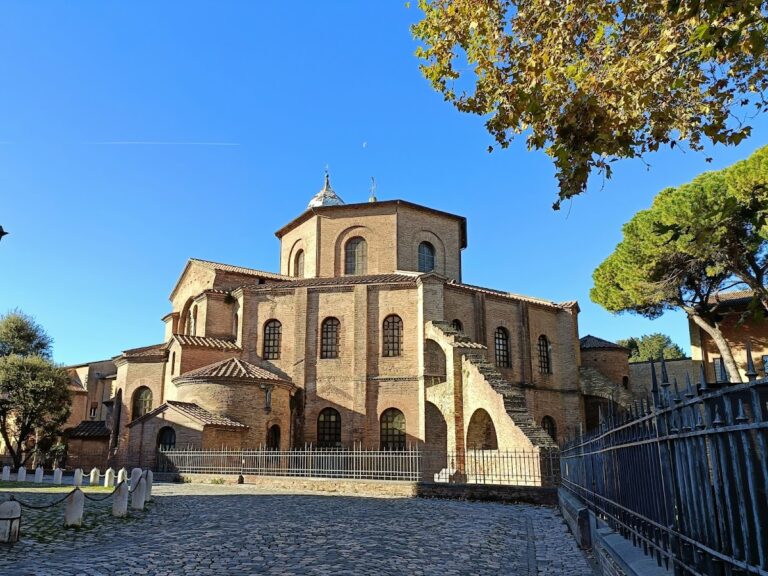
The surviving building is an octagonal brick structure organized around a central baptismal space. Four low apses, or projecting niches, give the exterior a more nearly square outline. A plain brick facing, one window on each side, and paired blind arches in the upper register create the exterior’s principal features. A flat, eight-sided tiled roof conceals the low, approximately hemispherical internal dome.
Exterior and dome construction
The internal dome is made from interlocking hollow terracotta tubes, known as tubi fittili, probably selected to reduce its weight in comparison with heavier pumice blocks. Its masonry and supporting arches are structurally distinct from the outer brick shell and rest on the interior arches and columns. Small openings above the windows may have held oil lamps, perhaps for baptismal ceremonies conducted at night. The large windows have also prompted a hypothesis that the baptistry could have been used in daylight during the fifth century, an interpretation rejected by the historian Ivanovici.
The northwest exterior contains a marble relief of a mounted rider. It is probably a surviving fragment of a sarcophagus from the second quarter of the third century, reused in the baptistry. The only present entrance is the western doorway, whose stone frame dates from the sixteenth century. The roof formerly carried a bronze cross from the seventh century. That cross was replaced by a simple cross in 1963.
Interior architecture and wall decoration
The interior consists of an octagonal central space surrounded by eight columns and arches, with four apsidal or arched niches expanding the plan. In the middle wall zone, an arcade of eight larger arches is each divided into three smaller arches. A window occupies the central opening of each group, while the two lateral sections contain stuccoed architectural frames.
The lower walls and blind arcades contain opus sectile panels, made by arranging differently coloured stones in geometric patterns. Red porphyry, basalt, green porphyry, and African marble appear in the surviving decoration. The original lower-wall revetment and flooring are largely concealed beneath the raised ground level. Nineteenth-century excavations and reconstructions suggested that the lower walls may once have been faced with light-coloured marble.
Eight columns with carved capitals, four blind arches on small columns, and four Latin inscriptions on the decorated bands around the arches form part of the lower zone. Mosaic vine scrolls and human figures accompany the inscriptions. Three texts refer to biblical passages including Psalm 22, Psalm 31, and Matthew 14:22–23. Other texts paraphrase passages from the Gospels of Matthew and John, including the account of Christ washing his disciples’ feet.
Prophets and baptismal imagery
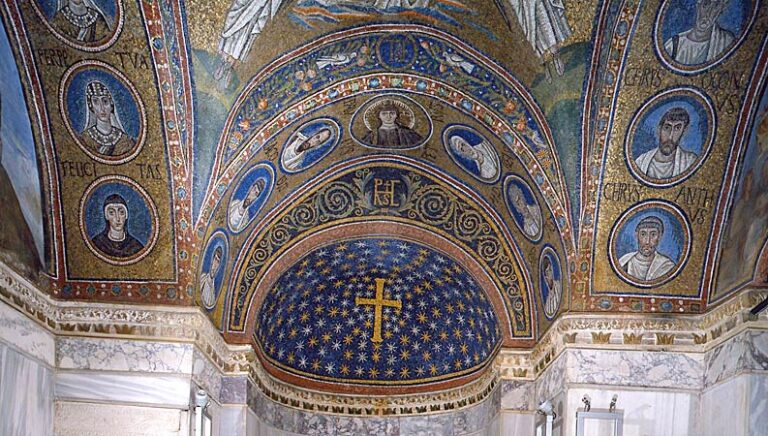
Above the lower arcade, eight standing male figures appear within gold oval medallions edged with flame-like borders. They wear white tunics or draped mantles called pallia, and hold scrolls or books. Since they lack identifying attributes, they are generally interpreted as prophets. Gold vine scrolls and acanthus leaves spread across a blue background around them.
The upper wall zone contains sixteen stucco reliefs of prophets set in imitation niches, including four major and twelve minor prophets. The figures were originally polychrome and are strongly modelled, although stucco is less durable than marble or stone. Smaller reliefs show pairs of animals. Four figurative scenes portray Christ trampling animals, the Traditio legis, Jonah and the whale, and Daniel in the lions’ den. The Traditio legis represents Christ symbolically delivering religious authority or teaching to the apostles, especially Peter. These scenes have been connected with the baptismal liturgy and the instruction of baptismal candidates, although their precise interpretation remains debated.
Vines, peacocks, vessels, baskets, and other animal imagery add further early Christian motifs above and below the arches. Some original fifth-century stucco reliefs representing these designs were removed during the restoration of 1897 to 1906. Surviving fragments are now accompanied mainly by reconstructions.
Dome mosaic
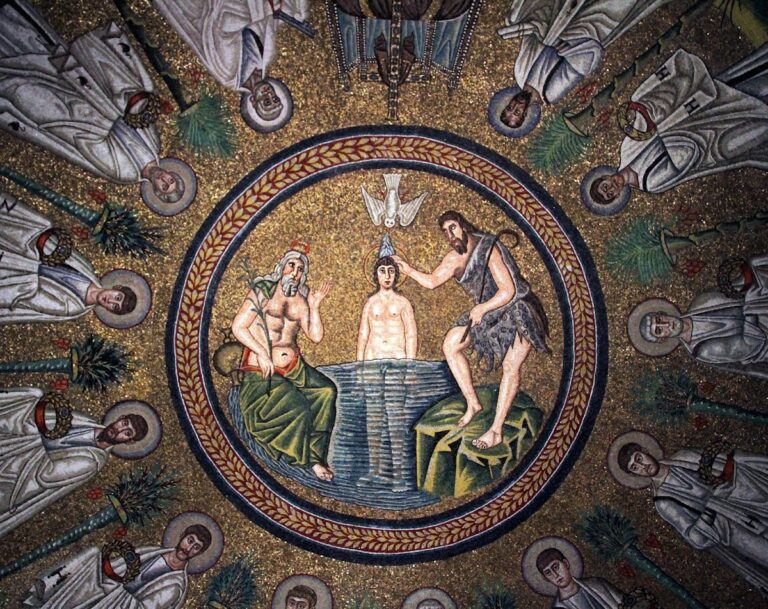
The dome mosaic is arranged in three concentric zones. At the centre, a gold-ground medallion presents Christ’s baptism in the Jordan. Christ stands immersed to the waist while John the Baptist pours water over his head from a shallow vessel. Beside them appears a personification of the Jordan beneath the inscription IORDANN, and a dove representing the Holy Spirit is placed above Christ. This central scene is one of the oldest surviving mosaic representations of Christ’s baptism.
Several strongly outlined central elements, including the faces of Christ and John, the dove, and the jeweled cross, were altered or remade in the eighteenth century. Christ may originally have been beardless. John may have placed his hand on Christ’s head rather than pouring water from a vessel, and his cross may originally have been a shepherd’s staff.
The middle zone shows the twelve apostles advancing in two processions against a blue background and meeting at Saint Peter and Saint Paul. They wear alternating gold tunics and white pallia with dark ornamental bands, carry crowns intended for Christ, and are separated by decorative candelabra. White draperies hanging from the upper ring form a flower-corolla shape when viewed from below.
The outer zone presents eight architectural scenes resembling theatrical stage sets, with alternating concave and convex forms. Four central niches contain open Gospel books, including one inscribed EVANGELIVM SECVN MARCUM. The other four contain empty prepared thrones, called hetimasiai, which are associated with Christ’s presence and expected return. Together with the empty seats beside the architectural settings, the imagery evokes the Heavenly Jerusalem, Christ’s judgment, and the place prepared for the righteous.
Baptismal font
At the centre stands an octagonal marble baptismal basin that apparently dates from the thirteenth century and was rebuilt in the sixteenth century from older components, including reused Greek marble and porphyry. Its basin and columns are joined by metal clamps, while inscriptions on the structure probably date from the sixteenth century.
Archaeological evidence indicates that the original font was circular, approximately 3.1 metres in diameter, and set below floor level. It was probably clad in marble and approached by two opposing flights of steps. The present font incorporates a fifth-century marble ambo, or raised platform from which the priest conducted the baptismal rite. A cross and a dove associated with the font symbolize the Holy Spirit. The separate metal cross once fixed to the roof is now kept inside one of the niches, together with an altar.