Augustinian Church: A Gothic Court Church in Vienna


Site at a Glance
- Rating
- 4.7
- Popularity
- Medium
- Country
- Austria
- Primary era
- Medieval
- External website
- Open
- Eras represented
- Medieval, Early Modern, Modern
- Civilizations
- Habsburg, Holy Roman Empire
- Site type
- Religious
- Remains
- Church
On this page15 sections
History
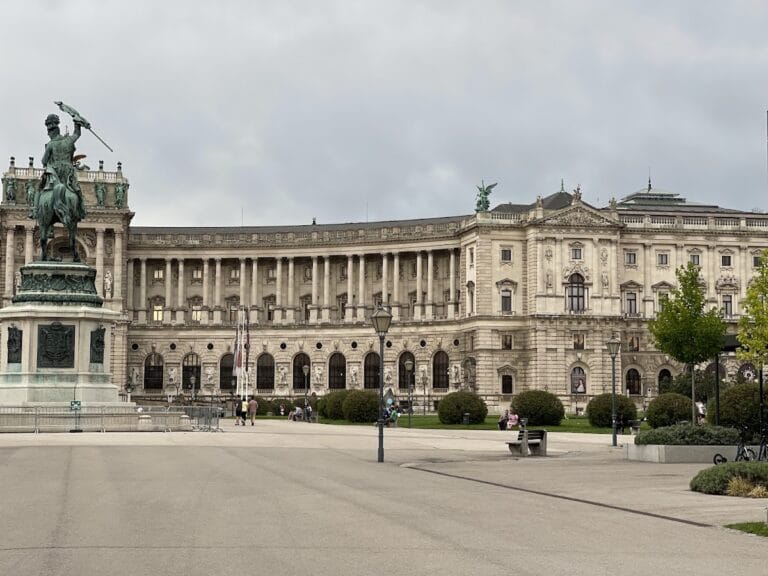
Augustinian Church is a Gothic church in Vienna, Austria, founded by Habsburg Duke Frederick the Handsome for the Augustinian Hermits in 1327. Built under Dietrich Landtner of Pirna between 1330 and 1339, it was consecrated on 1 November 1349. The church later became part of the Hofburg, Vienna’s former imperial palace complex, when the Albertina wing was constructed around it. Its unusual orientation was retained: the choir points south-southeast, while the principal entrance faces north-northwest toward Josephsplatz.
The Augustinian foundation
The monastery initially belonged to the Bavarian Province of the Augustinian Hermits, a Roman Catholic mendicant order following the Rule of St. Augustine. Founded in 1299, the province encompassed Bavaria, Bohemia, Moravia, Austria, Silesia, and Poland. Many houses were abandoned during the Reformation, but the Vienna foundation remained occupied. The order was later restored during the Counter-Reformation, the Catholic revival that followed the spread of Protestant movements.
In 1630, Emperor Ferdinand II established the Discalced Augustinians at the monastery. This stricter reform branch of the Augustinian tradition took responsibility for the foundation during a period of renewed Catholic institutional activity. In 1634, the church became the imperial court parish church, a position it held until 1918. The monastery then functioned as the court monastery, its clergy providing pastoral care for members of the imperial household and taking part in major religious ceremonies.
Imperial court church
Between 1750 and 1780, the monastery housed as many as 90 Augustinians. The church became a setting for ceremonies involving the Habsburg court, including several prominent marriages. Maria Theresa married Francis Stephen of Lorraine there in 1736. Proxy ceremonies, in which a representative stood in place of one of the couple, joined Maria Antonia, later Marie Antoinette, to Louis XVI in 1770 and Marie Louise to Napoleon Bonaparte in 1810. Emperor Franz Joseph I and Elisabeth of Bavaria were married at the church in 1854.
Other recorded weddings included the marriage of Leopold I and Margaret Theresa in 1666, that of Maria Leopoldina and Dom Pedro of Portugal in 1817, and the marriage of Crown Prince Rudolf and Stephanie of Belgium in 1881. In 1683, the Polish king Jan III Sobieski attended a thanksgiving Te Deum, a Christian hymn of praise, at the church after the victory over Ottoman forces at Vienna. A plaque inside commemorates the event.
The church also held a ceremonial role in the leadership of the Archdiocese of Vienna. Newly appointed archbishops were vested there, and tradition required the new archbishop to process from St. Augustin to St. Stephen’s Cathedral for the installation ceremony.
Reforms, damage, and renewed religious life
The Josephine reforms, the church policies of Emperor Joseph II that reorganized religious institutions and suppressed many monasteries, made St. Augustin a parish church in 1783. The Hofburg monastery was dissolved in 1836. Diocesan priests connected with the Frintaneum, a clerical institution, continued to administer the court parish until 1918, after which the church and parish passed to diocesan clergy.
A fire in the court library spread to the church roof in 1848 and caused the tower to collapse. The tower was rebuilt in 1852. The Augustinian Hermit monasteries were almost entirely suppressed during the Josephine reforms, but Augustinians expelled from the Sudeten lands after the Second World War formed a new Vienna vicariate of the German Augustinian Province and resettled the Hofburg monastery in 1951.
Bombing in 1945 severely damaged the church, which was restored by 1950. Further renewal took place between 1996 and 1999. The present Vienna Vicariate of the Augustinians of Maria Trost includes St. Augustin and the monastery of Maria Trost in Zwiesel, founded in 1962. The Vienna community administers the parishes of St. Augustin and Aspersdorf.
Burials and sacred music
The church’s crypt was used for Augustinians and members of the court nobility. A proposal made in the early nineteenth century to transfer the Habsburg burial place from the Capuchin Crypt to St. Augustin was not carried out. Noble families, including the Lambergs, also used the church for burials. Nikodemus della Scala, Prince-Bishop of Freising, who died in Vienna, was buried before the Cross Altar in 1443. His tomb monument no longer survives. The crypt also contains the burial place of the preacher Abraham a Santa Clara.
St. Augustin has maintained a long sacred-music tradition. Franz Schubert conducted his Mass in F major there, while Anton Bruckner wrote his Mass in F minor for the church and conducted its first performance there. The repertoire includes approximately 120 masses, and high liturgies have featured works by Mozart, Haydn, and Schubert.
Remains
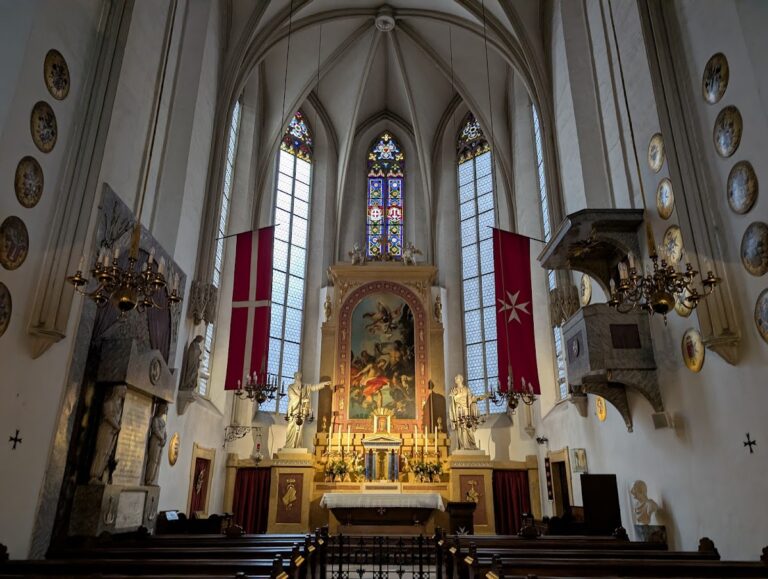
Augustinian Church is an approximately 80 to 85 metre-long, 20 metre-wide, three-aisled Gothic hall church integrated into the Albertina wing of the Hofburg. The nave measures 43 metres in length and 20 metres in height. The high choir is 40 metres long, 10 metres wide, and 24 metres high. The church’s exterior is relatively inconspicuous because surrounding buildings enclose it, while the interior contains a series of richly furnished chapels, monuments, altars, and organs.
Church interior and Gothic Revival features
The original Gothic nave was remodelled in an early Baroque manner during the seventeenth century, when side chapels and altars were added. In 1784 and 1785, court architect Johann Ferdinand Hetzendorf von Hohenberg restored the interior in a Gothicizing form, reintroducing medieval Gothic features, and removed 18 side altars installed between 1630 and 1780. His pulpit is an early Central European example of Gothic Revival. Made of white-and-gold wood, it has a foliated Gothic capital, blind tracery, and a canopy topped by a dove and a statue identified as St. Paul.
The former main facade had buttresses, a central window, and a portal. A wing of the court library, now the Austrian National Library, concealed it between 1767 and 1769. The area before the original portal became the entrance vestibule. The square tower stands on the north side, and the current main entrance is approached from Josephsplatz.
High choir and altars
The high choir ends in a seven-tenths apse, a polygonal sanctuary end forming roughly seven-tenths of a circle, around the high altar. Andreas Halbig designed the altar between 1857 and 1870 for the Votive Church. Made from polychromed sandstone, it was rejected for that building by Heinrich Ferstel and transferred to St. Augustin in 1873 and 1874. Its centre presents Christ the King as ruler of the world, surrounded by angels and the patron saints of Emperor Franz Joseph I. Its forms refer to fifteenth-century High Gothic and Brabantine Gothic design.
A new altar facing the congregation and an ambo, a raised stand for proclaiming readings, made of Carrara marble were installed in 2003. A side altar dedicated to Blessed Emperor Karl I followed in 2004.
Furnishings and saints
The richly ornamented benches in the eastern nave bays date from around 1730 and were made by Johann Baptist Straub. Their decoration includes biblical scenes, and they originally belonged to the former second Schwarzspanier Church in Alservorstadt. Other benches have inlaid panels bearing the emblems of Emperor Charles VI. They came from the Hofburg Chamber or Joseph Chapel after alterations under Joseph I and Maria Theresa, and from the former Jakoberkloster.
Statues of principal Augustinian saints line the nave walls. On the eastern side near the Bach Organ, St. Augustine is shown with a flaming heart. St. Ambrose stands on the western wall with a beehive and quill as his attributes.
Funerary monuments and chapels
Marie Christine memorial
The memorial to Archduchess Marie Christine of Saxony-Teschen was made by Antonio Canova between 1798 and 1805. This major work of Neoclassical funerary art takes the form of a pyramid inspired by the Pyramid of Cestius. A doorway opens into the realm of the dead beneath the dedication Uxori optimae Albertus. A procession of allegorical figures approaches it, including Virtue with an urn, Caritas supporting an old man, a sleeping lion, an angel, a putto with a palm branch, and a genius holding the archduchess’s portrait.
Georg Chapel
The Georg Chapel lies south of the choir. In the fourteenth century it was associated with the short-lived Order of St. George, a Habsburg court order founded by Duke Otto the Merry. Afterward, the chapel became a funerary space. Its monuments include those of Gerard van Swieten, Wirich Philipp Count Daun, and Leopold Count Daun. It also contains an empty ceremonial sarcophagus for Emperor Leopold II, made by Balthasar Ferdinand Moll.
Loreto Chapel
The Loreto Chapel was consecrated in 1724. It was once richly decorated with silver, much of which was melted down during the Napoleonic Wars. Its surviving iron grille dates from the eighteenth century.
Habsburg Heart Crypt
Behind the Loreto Chapel, separated from it by an iron door, lies the semicircular Habsburg Heart Crypt. This separate burial place contains the hearts of 54 members of the Habsburg family in metal, mostly silver, urns. Some hearts were transferred from earlier generations. The oldest belong to Emperor Matthias and his wife Anna of Tyrol, while the last recorded deposit was the heart of Archduke Franz Karl on 8 March 1878. For 39 individuals, the body, heart, and internal organs were placed in three different Viennese churches.
The crypt beneath the nave is a separate space from the Habsburg Heart Crypt. It served Augustinians and court nobility, while a Schwarzenberg family burial vault lies beneath the Chapel of St. Nicholas of Tolentino.
Organs and parish spaces
The church contains a sacristy, the Georg Chapel, and the Loreto Chapel. Its principal organ stands on the north wall. The Rieger workshop built the present instrument in 1976, retaining a historical case from around 1785 with an angel group by Johann Baptist Straub. The case had earlier housed an organ built by Johann Hencke for the Schwarzspanier Church and installed at St. Augustin late in the eighteenth century. The current organ has 48 stops on four manuals and pedal. Its electronic combination system was modernized in 2002 and renewed in 2019, when the organ was cleaned and received an additional 32-foot labial pedal stop.
The smaller Vienna Bach Organ stands on the eastern wall at the end of the nave. The Reil brothers’ workshop in the Netherlands built it in 1985 for a festival marking 300 years since Johann Sebastian Bach’s birth. Constructed in a historical manner, it has 25 stops on two manuals and pedal, with mechanical action.
The parish of St. Augustin also includes the Maltese Church, St. Ursula, St. Anne’s Church, the Capuchin Church, the Hofburg Chapel, and the Elisabeth Chapel at Center St. Elisabeth.