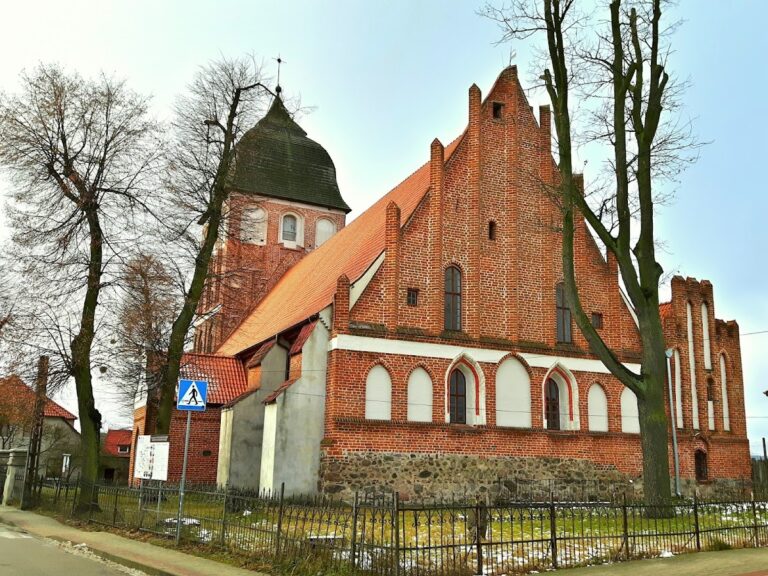
Immaculate Conception and Adalbert of Prague Church in Nidzica: A Historic Parish Church


Site at a Glance
- Rating
- 4.5
- Popularity
- Low
- Country
- Poland
- Primary era
- Medieval
- External website
- Open
- Eras represented
- Medieval, Early Modern, Modern
- Civilizations
- Teutonic Order
- Site type
- Religious
- Remains
- Church
On this page9 sections
History
The Immaculate Conception and Adalbert of Prague church is a historic parish church in Nidzica, Poland, with foundations dating from the fourteenth century and an architectural history that developed from Gothic beginnings through Neo-Renaissance alterations. Its first known record appears on 7 December 1381, when Nidzica’s town foundation document mentioned both the church and its parish priest. Pastoral care was then provided by a priest appointed by the Teutonic Order, a medieval Catholic military-religious order that ruled territories in the eastern Baltic, and by a deacon employed by the town authorities.
From Catholic foundation to Lutheran parish
The first church was Catholic. When the Reformation, the sixteenth-century movement that led many northern and central European churches to adopt Protestant worship, reached East Prussia in 1525, the building became the Lutheran parish church of Neidenburg. It served the town and the surrounding villages. The church’s appearance before the sixteenth century is not known. A visitation in 1561 mentioned a choir and several benches, while a description from 1684 identified a two-aisled building with a tower on its north side.
Fire and warfare repeatedly altered the building. The church burned together with the market in 1414 and was destroyed again in 1664. Another fire damaged it in 1804. After reconstruction in 1812, French forces used the church as a field bakery while traveling toward Moscow. Further renovations, reconstructions, and alterations took place in 1579, 1689, 1725, and 1817 to 1819. Russian military forces damaged the building in 1914, and work carried out from 1920 to 1924 retained only the masonry core of the older Teutonic church.
Postwar transfer and Catholic dedication
After the Second World War, the former Lutheran congregation in Neidenburg was nearly dissolved as the established population fled or was expelled. The Catholic population grew with the arrival of new settlers. On 5 August 1948, Catholics and Protestants exchanged churches: the smaller Catholic parish church was assigned to the Protestant congregation, while this larger former Lutheran parish church became Roman Catholic. From that year, it has belonged to the Archdiocese of Warmia and the Nidzica deanery.
Following the exchange, the church was dedicated to the Immaculate Conception of the Virgin Mary and additionally to Adalbert of Prague, a tenth-century bishop and Christian missionary who was martyred in the Baltic region and is venerated as a Catholic saint. The Roman Catholic parish later established two further churches in Nidzica, dedicated to Divine Mercy and Blessed Boleslawa Lament.
In the early 1950s, a bell formerly used by the Neidenburg Protestant parish church was found in the bell cemetery in Hamburg, a wartime collection site for bells removed from churches. It had been surrendered for armaments production in 1942 but survived the war. The bell weighs 180 kilograms, measures 65 centimetres across at its lower edge, and has the strike note C-sharp. The church is a legally registered historic monument of Nidzica, entered in the heritage register under number 964 on 29 July 1968.
Remains
Exterior form and tower
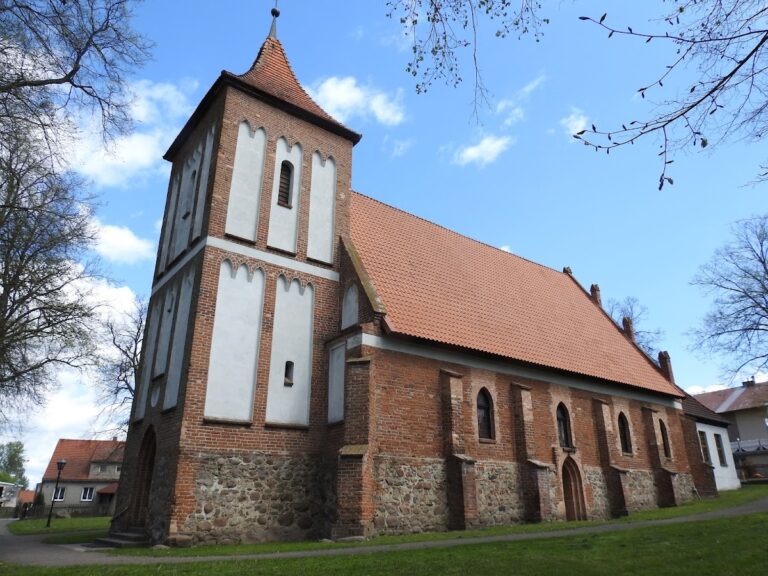
The church stands in the western part of Nidzica’s old town, within the former defensive walls, where it formed an important component of the town’s fortified setting. The present building is a rectangular hall church built mainly of brick, with some sections resting on or made from fieldstone. Its exterior walls are plastered. A square tower adjoins the eastern elevation. The tower retains a Gothic form up to its third story, while its gables were added in the Neo-Renaissance style. A hipped, tent-like roof covers the tower, and clocks are set into both gables. Its uppermost story was added in 1903.
Interior arrangement
Galleries and ceiling
Side galleries run along the length of the side elevations. Two rows of windows occur only in the western wall. The interior has a flat wooden ceiling arranged in recessed ornamental panels, a coffered design associated with Renaissance-style decoration. During work in the 1990s, plaster was removed from the lower portions of the interior walls, exposing brickwork and recalling the building’s earlier Gothic character. The interior was then given new multicolored painted decoration, including medallion portraits of fifteen Polish saints and blessed figures, together with Saint John Bosco, above the galleries.
Chancel and altars
The chancel contains paintings of the Annunciation and the Resurrection on either side of the main altar. An image of Saint Adalbert stands on the left. The present main altar bears an image of the Immaculate Conception of the Virgin Mary, with figures of Saint Adalbert and Saint John the Baptist on either side and a Crucifixion Group above. Two small side altars stand at the same level as the main altar. The altar on the left is dedicated to the Sacred Heart of Jesus, while the altar on the right is dedicated to Our Lady of Perpetual Help.
Organ and earlier furnishings
Repeated fires and wartime damage left little of the older furnishings. An organ was already in the church before 1728, and Georg Caspari of Königsberg extensively repaired it in 1735. From 1820, the main altar contained an oil painting of the Crucifixion of Christ by Knorr of Königsberg. The present status of that painting is not stated.