Qtaish Mosque: An Ottoman Mosque in Sidon, Lebanon


Site at a Glance
- Rating
- 4.4
- Popularity
- Very Low
- Country
- Lebanon
- Primary era
- Early Modern
- Eras represented
- Early Modern
- Civilizations
- Ottoman
- Site type
- Religious
- Remains
- Mosque
On this page10 sections
History
Qtaish Mosque is an Ottoman mosque in Sidon, Lebanon, founded at the expense of Sheikh Ali ibn Muhammad ibn Qtaish in 1592, although 1580 is also given. Located in Sidon’s old city, it became associated with religious learning, charitable endowments, and the city’s scholarly life.
Foundation and Early History
Sheikh Ali ibn Muhammad ibn Qtaish was regarded as one of Sidon’s notable men and supported learning and scholars. The mosque’s extensive waqf, a permanent charitable endowment whose revenue supports a religious or public institution, included the mosque garden, which was planted with lemon trees. The endowment helped make Qtaish Mosque one of the wealthiest mosques in Sidon and Lebanon.
When the traveler Abd al-Ghani al-Nabulsi visited around 1700, he described Qtaish Mosque as a new, well-lit building with a water pool and a small marble fountain supplied by fresh water. He also observed that it was smaller than nearby Al-Kikhia Mosque.
Repairs and Religious Associations
The building underwent several repairs. In 1867, descendants of Sheikh Ali Qtaish undertook a major renovation and commemorated the work with verses inscribed above the exterior door. The Islamic Endowments Directorate of Sidon carried out another restoration in 1964.
Qtaish Mosque became linked to a local tradition about the scholar Yusuf al-Asir and his departure from Sidon. The story says that people who had attended his lessons at Al-Kikhia Mosque moved to Qtaish Mosque to hear another preacher discuss roosters, including their qualities, breeds, and uses. Disturbed by this change, Yusuf al-Asir reportedly left Sidon, declaring that a city like this did not seek knowledge.
The mosque was also associated with the scholar Ali Uthman Jaradi during the early military escalation of the Syrian uprising, a conflict in which Hezbollah intervened in support of the Syrian government. Jaradi preached against the Syrian government and its allies and urged people not to support them. His Friday sermons drew large congregations and prompted a popular response in Sidon.
Worshippers traditionally gathered at the entrance after the dawn prayer for group dhikr, a devotional practice of remembering and praising God through repeated recitations led by an imam. The gathering included repeated declarations of God’s unity and ended with another collective declaration of faith.
Remains
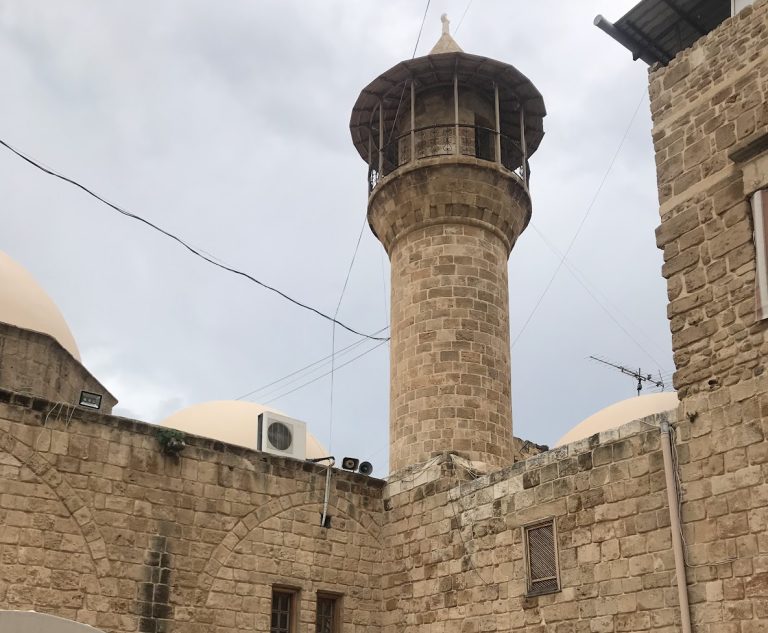
Qtaish Mosque follows an Ottoman layout consisting of a sanctuary, a courtyard, a room, and a garden, with a single minaret. The sanctuary lies beside the two-part courtyard, while the garden forms part of the mosque’s endowed property.
Sanctuary and Courtyard
Sanctuary
The sanctuary covers no more than 50 square metres and is surmounted by a dome. Six mosaic panels decorate the dome’s interior, and two further panels flank the main entrance. These mosaics form the principal decorative elements described within the prayer space and entrance area.
Courtyard
The courtyard is divided into two sections. The section adjoining the sanctuary has a roof supported by two antique columns with ornamental details and projecting features. Their form is traditionally taken to indicate that the columns were brought from ancient archaeological sites.
The second section is spacious and larger than the combined area of the sanctuary and the adjoining covered section. It is traditionally said to have contained a pool filled with juice during celebrations of the Prophet Muhammad’s birthday, known as Mawlid.
Teaching Space and Founder’s Tomb
Teaching Room
A room within the mosque served as a meeting place for scholars and as a center for Quranic instruction. Sheikh Musa Nasr, who died in 1969, was the last person to teach there, giving Quran lessons without charge.
Founder’s Tomb
Sheikh Ali Qtaish was buried on the southern side of the mosque. His tomb is a simple stone structure topped by a gravestone inscribed with a Quranic verse.