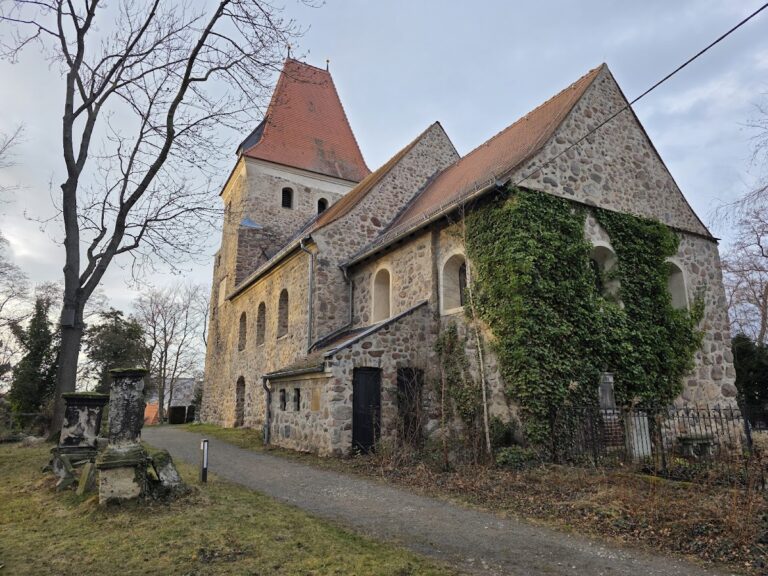
Christuskirche (Eutritzsch): A Medieval Evangelical Church in Leipzig


Site at a Glance
- Rating
- 3.8
- Popularity
- Very Low
- Country
- Germany
- Primary era
- Medieval
- External website
- Open
- Eras represented
- Medieval, Modern
- Civilizations
- German, Holy Roman Empire
- Site type
- Religious
- Remains
- Church
On this page13 sections
History
Christuskirche (Eutritzsch) is an evangelical church in Leipzig, Germany, and the oldest surviving building in the Eutritzsch district. More than 700 years old, it is protected as a historic monument. Its oldest surviving element is the Romanesque lower part of the tower, probably built before 1381, while the main church took its present late Gothic form between 1489 and 1503.
Romanesque Origins
The lower section of the tower preserves the earliest phase of the church. Its Romanesque construction places the beginnings of the surviving building in the medieval period, before the extensive rebuilding that reshaped the congregation’s church at the end of the fifteenth century.
Late Gothic Rebuilding
Between 1489 and 1503, the nave was rebuilt as a late Gothic hall church under the direction of Benedict Eisenberg, a master builder and stonemason associated with church construction and remodeling in Leipzig. The date 1503 on the eastern keystone marks the completion of this transformation, rather than the foundation of the entire church. The congregation commemorated the five-hundredth anniversary of the rebuilding in 2003.
Eisenberg’s mason’s mark, the letters “BE,” appears at the crown of the rib vault in the tower entrance hall. It identifies his supervision of the work and connects Christuskirche with his involvement in the late Gothic remodeling of Leipzig’s St. Nicholas Church.
Later Changes and Congregational Life
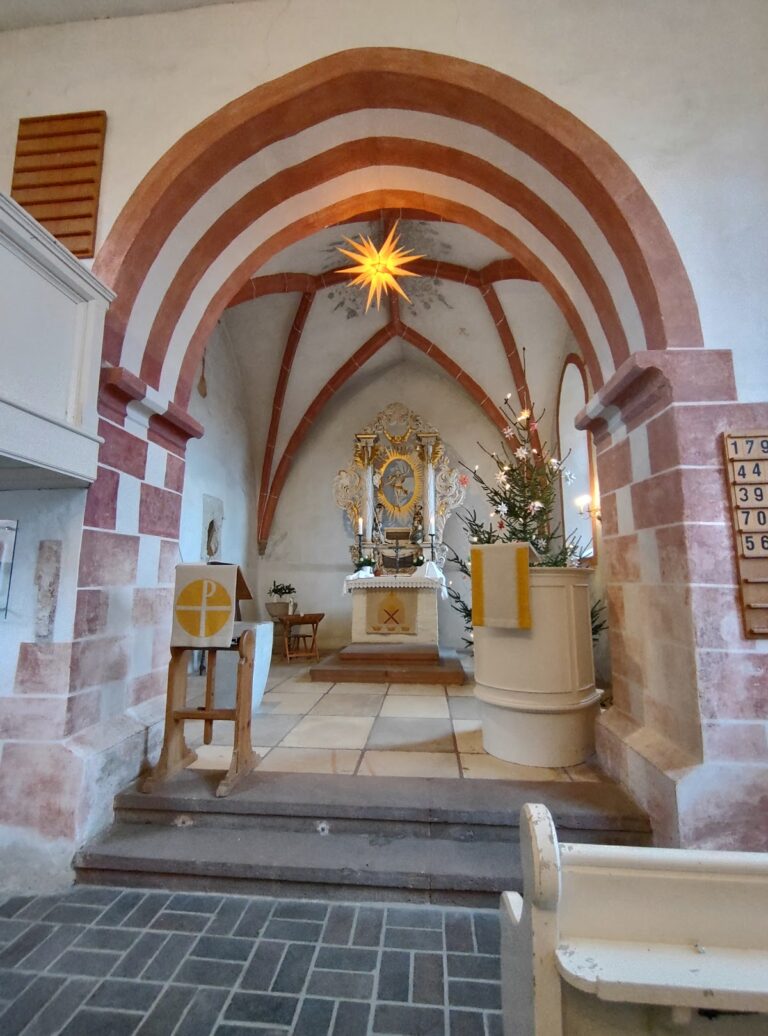
The church now brings together Romanesque, Gothic, Renaissance, Baroque, and Historicist elements. Historicism was an architectural approach of the nineteenth and early twentieth centuries that revived and combined earlier styles. The interior is arranged to approximate the appearance of the church around 1500, although former side galleries and altars have not survived.
Since 2021, the Christuskirche congregation has belonged to a sister-church association, a cooperative arrangement among neighboring congregations. The association includes congregations in Leipzig-Gohlis, Podelwitz-Wiederitzsch, Leipzig’s northeastern district, Plaußig-Hohenheida, and Taucha-Dewitz-Sehlis. The pastor in 2021 was Peter Amberg.
Remains
Church Structure
The late Gothic church is organized as a hall church, in which the nave and side spaces are approximately the same height, creating a unified interior volume. Its choir closes on three sides, forming a polygonal eastern end, and the ceiling has a rhombic net vault whose intersecting ribs create diamond-shaped compartments. Exterior buttresses support the masonry against the outward pressure of the vault. The square tower has a steep hipped roof, which slopes on all sides, while pointed-arch windows and Gothic tracery, ornamental stone framework within the windows, survive on the north side.
Altar and Organ
Marian Altar
The Marian altar, an altar dedicated to Mary, the mother of Jesus, dates from 1480. It originated in the church at Machern and was transferred to Eutritzsch in 1960. Extensive restoration in 2002 prepared the altar for its present place within the church’s historic interior.
Organ
The present organ was built by the Eule organ company of Bautzen as Opus 584. It has two manuals, a pedal, and 18 stops arranged in the pattern 6-7-5. The instrument was ceremonially inaugurated on the First Sunday of Advent in 1991. It is the fifth organ installed at the church since the Baroque period. Earlier instruments included a 1736 organ by Zacharias Hildebrandt, renewed by Johann Gottlob Mende in 1847 and remodeled by Gottfried Hildebrand after a lightning strike in 1888. A replacement installed by Schmidt and Berger in 1909 was irreparably damaged by unauthorized persons.
Bells and Memorials
Bronze Bells
As of February 2021, the church had a four-bell bronze peal. The oldest bell, cast by an unknown founder in 1480, sounds a′ +2, weighs approximately 584 kilograms, and has a lower diameter of 983 millimeters. A second bell, cast by G. A. Jauck in 1834, sounds e′ +2, weighs about 1,105 kilograms, and measures 1,242 millimeters across its lower diameter. Two further bells were cast by the Schilling bell-founding family in 1964. One sounds c′ +5 and weighs approximately 1,743 kilograms, with a diameter of 1,448 millimeters; the other sounds f′ +3, weighs about 684 kilograms, and measures 1,060 millimeters in diameter.
Churchyard and Grave Slab
The churchyard occupies the site of the former cemetery and contains historical gravestones. Inside the church is the grave slab of Pastor George Jenichen, who served in Eutritzsch from 1667 and died in 1718 during his fifty-third year in office.
First World War Memorial
A memorial cross erected on the southeast side of the church in 1920 commemorates members of the Eutritzsch congregation who fell in the First World War.