Sidna Omar Mosque: A Mamluk-Era Mosque in Jerusalem


Site at a Glance
- Rating
- 4.7
- Popularity
- Very Low
- Country
- Israel
- Primary era
- Medieval
- Eras represented
- Medieval
- Civilizations
- Mamluk
- Site type
- Religious
- Remains
- Mosque
On this page7 sections
History
Sidna Omar Mosque is a Mamluk-era mosque in Jerusalem, Israel, built under the Mamluk sultanate, which ruled Jerusalem during the late medieval period and supported extensive mosque and minaret construction. Located in the Jewish Quarter of the Old City, it was formerly affiliated with Sunni Islam and is also known as the Great Umar Mosque and, among Muslims, as the Mosque of the Jews. It was one of two mosques in the quarter.
Early traditions and Mamluk establishment
The mosque is traditionally associated with Umar ibn al-Khattab, the second caliph of the early Islamic community. One tradition places its origins in the period of the Rashidun Caliphate, the early Islamic government associated with the first four caliphs after Muhammad, while another attributes repairs to the Umayyad period during the reign of Abd al-Malik ibn Marwan. The building itself is identified with the Mamluk period, and its establishment is generally placed in the late fourteenth century.
The earliest known reference comes from the historian Mujir al-Din, who recorded that the mosque was renovated in 1397. The work was supported by collected funds and by land donated for the building’s maintenance. The Italian rabbi Obadiah Bartenura gave a different account, stating that a Jewish convert to Islam had built the mosque and that the convert’s mother endowed her house in a synagogue courtyard for its construction.
Relations with the neighboring synagogue
Sidna Omar Mosque was built beside the Ramban Synagogue, allowing the mosque, its minaret, and the synagogue to coexist in the Jewish Quarter. After part of the neighboring synagogue collapsed during a severe storm in 1474, conflict between Muslims and Jews reportedly resulted in the synagogue’s destruction. Sultan Qaytbay, a fifteenth-century Mamluk ruler, intervened in the dispute, after which the synagogue was rebuilt.
Worship and closure
The mosque remained open for worshippers from the Mamluk period through the 1967 Six-Day War, the Arab-Israeli conflict during which Israel captured East Jerusalem and the Old City. The minaret was damaged by sniper fire during the war and restored in 1974.
Restrictions on worship began in 1972, when Muslims were prohibited from performing the dawn prayer on the grounds that worshippers disturbed nearby settlers. Evening prayers were prohibited in 1982, leaving only noon and afternoon prayers permitted. The mosque was completely closed in 2000, when both prayer and the call to prayer were prohibited. It is administered by the Jerusalem Waqf, a religious endowment that supports religious or public institutions, and remains closed.
Further renovations were carried out in 2019 at the expense of the Jordanian government. A reopening planned for December of that year did not take place.
Remains
Building and minaret
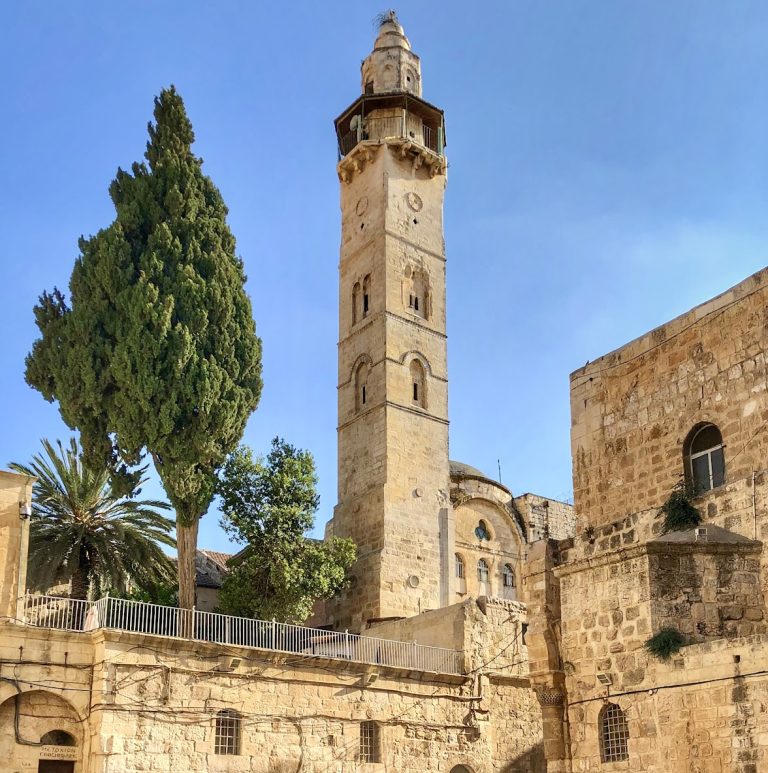
The mosque stands in the Jewish Quarter beside the Hurva and Ramban Synagogues. Its surviving form follows Mamluk architectural style and includes a single minaret. The minaret rises approximately 15 metres through two stories and ends in a balcony for the muezzin, the person who traditionally announces the Muslim call to prayer. Its upper section is narrower than its base, an arrangement intended to help stabilize the structure.
Interior columns
Columns inside the mosque led to an association with the Crusader Church of St Martin in the late nineteenth century. Architectural historian Michael Hamilton Burgoyne rejected the connection as tenuous because the columns were reused in a secondary context, rather than necessarily belonging to the church originally.