St. Mary’s Church Herzberg (Elster): A Late Gothic Parish Church

Site at a Glance
- Rating
- 4.8
- Popularity
- Very Low
- Country
- Germany
- Primary era
- Medieval
- External website
- Open
- Eras represented
- Medieval, Early Modern, Modern
- Civilizations
- German, Holy Roman Empire
- Site type
- Religious
- Remains
- Church
On this page10 sections
History
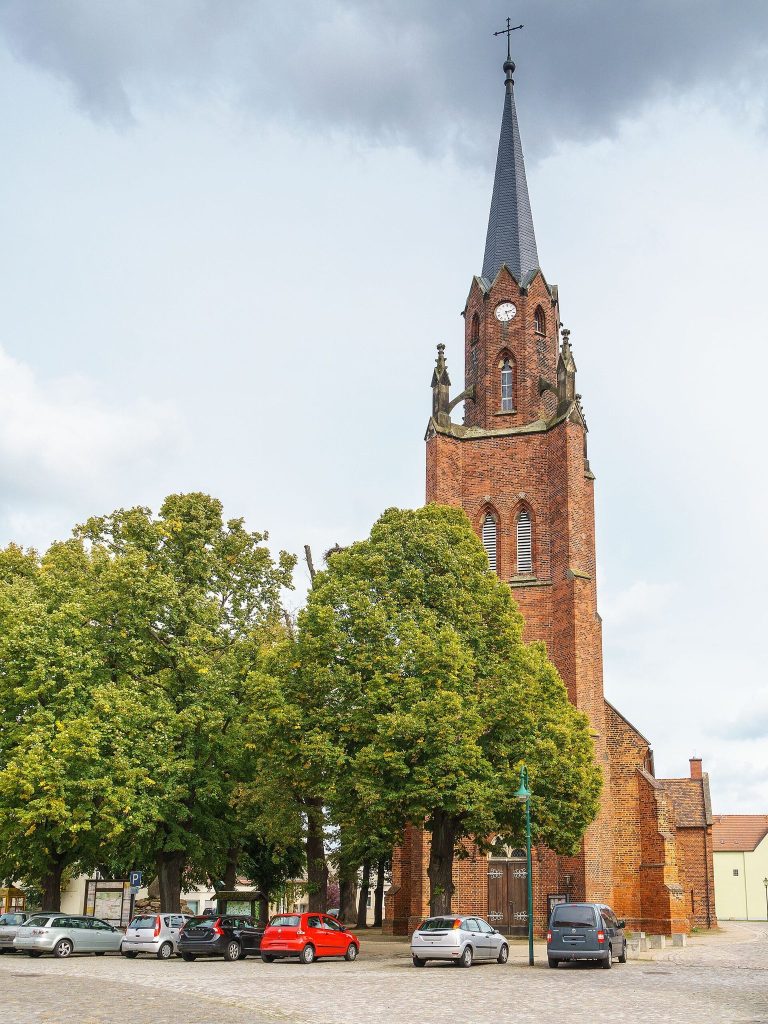
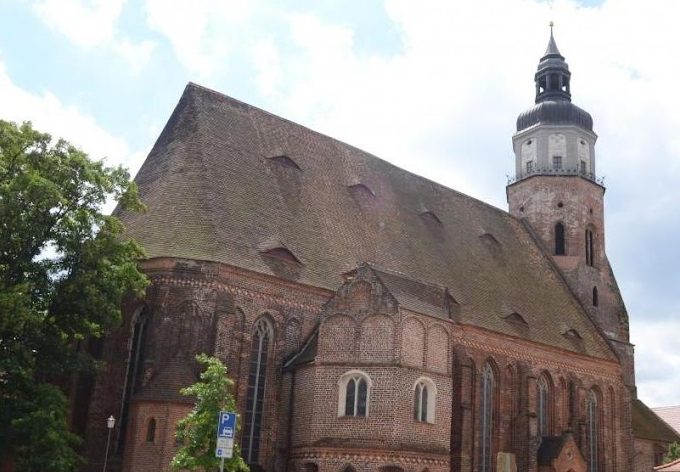
St. Mary’s Church Herzberg (Elster) is an Evangelical parish church in Germany, built as a Late Gothic brick church around 1350 on the foundations of an older brick church. It stands on the town’s market square and was first dedicated to St. Nicholas, a Christian bishop and saint traditionally associated with charity and gift-giving. By the fifteenth century, its dedication had been transferred to the Virgin Mary, the mother of Jesus in Christian belief.
Medieval construction
The building was erected in two stages from east to west. The three eastern bays, including their three eastern choir ends, were completed by the middle of the fourteenth century. The three western bays followed by the end of the fifteenth century. A bay is a structural compartment defined by repeated arches, vaults, or supports, and the sequence of bays reflects the church’s gradual completion.
The west tower burned in 1483 and collapsed soon afterward. It was rebuilt in 1562, then developed into its present form during the seventeenth and eighteenth centuries. The collapse also destroyed the final bay of the main nave. That section was restored in 1709 and 1710, when it received decoration in a provincial Baroque style, characterized by dynamic forms and elaborate decoration.
Reformation and later restoration
Martin Luther took part in school and church visitations in Herzberg in 1522 and 1533. Luther was the central German reformer whose teaching initiated the Protestant Reformation. The church still holds full-length late-sixteenth-century portraits of Luther and Philipp Melanchthon, a leading theologian and educational reformer associated with him.
A major reorganization took place in 1809. The baptismal font was moved from the middle of the church toward the altar, without a surrounding railing. Seats were numbered, chairs and galleries were painted white, and a new organ with a supporting gallery was installed. The instrument had come from the French Reformed Church in Halle and was dedicated in the renovated church on Reformation Day, which commemorates the Protestant Reformation.
From 1862 to 1868, the church underwent a comprehensive restoration. New Neo-Gothic entrance halls were added at the side portals, and window tracery was designed from drawings by Friedrich August Stüler and Councillor of Works Ritter. Two small stair towers were built for the gallery stairways. During the nineteenth century, Karl Friedrich Schinkel and Ferdinand von Quast advocated preserving the vault paintings and recommended a comparatively restrained restoration. Despite this approach, the eastern vaults of the northern aisle and parts of the Hell scene in the Last Judgment were painted over.
St. Mary’s Church is listed in the Brandenburg monument database as monument object number 09135160.
Remains
The surviving church is a three-aisled, six-bay hall church with a broad central nave, narrower side aisles, and gently curved eastern ends. A hall church has a nave and side aisles of broadly similar height rather than a distinctly raised central nave. The brick building measures 42.5 metres from east to west and has a present north-south extent of 22 metres. It is 14.5 metres high, while the roof ridge reaches 30.9 metres.
Medieval vault paintings
The vault paintings are a distinctive feature of the interior and survive in exceptionally high artistic quality. They were painted using the a secco technique, in which pigments are applied to dry plaster, and reflect the influence of Bohemian painting of the late fourteenth century. Works dating from around 1415 are fully preserved in the ornamental fields of the southern aisle and almost completely preserved in the figural scenes of the principal bays. Their brightly coloured figures appear either floating or seated on cushions.
Paintings in the two main-nave and aisle bays beside the transverse arches were created after 1430. Their compact, painterly compositions show figures standing on ground formed by the vault ribs, the projecting structural elements that frame and support a ribbed vault. The final main-nave bay has a later decorative character because it was rebuilt after the tower collapse and painted in the provincial Baroque style in 1709 and 1710.
Altar and liturgical furnishings
Altar
The 1765 altar presents the Agony in the Garden of Gethsemane in low relief. Gethsemane is the garden in Jerusalem associated with Jesus’ prayer before his arrest. Moses and John the Baptist stand on the side consoles as proclaimers of Christ. The altar originally had an iron chancel screen at the edge of the altar steps, bearing the inscription “1769 J. G. Dobe.” Since 1864, the altar grilles that once separated the choir from the nave have stood in the entrance hall of the west tower.
Pulpit
The late-Renaissance pulpit stands against the southern pillar at the centre of the church. It rests on a statue of Paul, while the Lord and the four Evangelists with their symbols appear on the parapet. Additional apostles are represented as herms, sculpted human figures that form pillars or supports. The painted door wing shows Christ holding the globe and blessing with his right hand, with a full-length figure of Peter below.
Baptismal font
The baptismal font is a fluted vessel carved from serpentine, a typically green ornamental stone used for carved objects. Its inscription reads “ANNO MDCXXIIII,” corresponding to 1624.
Organ, tower, and bells
The surviving organ was built in 1896 by Wilhelm Rühlmann of Zörbig. It stands in a Neo-Gothic case, a revival of medieval Gothic forms, and was financed through a foundation established by Medical Councillor Franz. The instrument is a cone-chest organ, using cone valves to admit air to its pipes, with 47 stops on three manuals and pedals operated by pneumatic action. Its couplers are II/I, III/I including a super-octave coupler, III/II, I/P, II/P, and III/P.
The tower contains a ring-shaped viewing platform 36.3 metres above ground. The lantern base begins at 49 metres, the golden finial ball reaches 59.4 metres, and the golden heart-shaped cross reaches 64.27 metres. Four bells cast in the fourteenth and fifteenth centuries remain associated with the church. Their strike-note sequence is E-flat, G-flat, A, and F, forming a bell peal regarded as one of the most valuable in eastern Germany.