Église Saint-Blaise de Sindelsberg: A Medieval Parish Church in France


Site at a Glance
- Rating
- 4.7
- Popularity
- Very Low
- Country
- France
- Primary era
- Medieval
- External website
- Open
- Eras represented
- Medieval, Early Modern
- Civilizations
- Holy Roman Empire
- Site type
- Religious
- Remains
- Church
On this page12 sections
History
Église Saint-Blaise de Sindelsberg, also known as the Sindelsberg Chapel, is a Catholic parish church in Marmoutier, France. Built in the twelfth century in the Romanesque period, it formed part of the Benedictine nunnery of Sindelsberg, founded in 1115 by Marmoutier Abbey. The church has remained dedicated to Saint Blaise, a Christian bishop and martyr traditionally associated with protection against throat ailments.
The nunnery and the fourteenth-century rebuilding
The church was largely rebuilt in the early fourteenth century and consecrated in 1332. The eastern part of the present building belongs mainly to this phase. The nunnery later declined and was dissolved in 1488 by Robert of Bavaria, the medieval Bishop of Strasbourg. Its property, including the church, was incorporated into Marmoutier Abbey, which became responsible for maintaining the sanctuary.
Damage, rebuilding, and commemoration
The German Peasants’ War, a widespread rural uprising in the German-speaking lands in 1525, caused severe damage to the church. The nave was subsequently rebuilt around 1580 under Gisbert Agricola, the abbot of Marmoutier. The resulting nave was shorter than its predecessor. Agricola died in 1586, and a cenotaph, a commemorative monument that does not contain the person’s remains, was erected in the church in recognition of the benefits he had provided.
The façade was restored in 1872, a date recorded on the gable. By the end of the nineteenth century, Émile Audiguier, curator of the Saverne Museum, had called attention to the poor condition of the interior and to the need to protect Agricola’s funerary monument. The chancel and the monument were registered as historic monuments in 1935.
Restoration and religious continuity
Restoration began with work on the roof in 1968 and continued with interior repairs in 1969. The interior campaign, begun in September of that year, revealed wall paintings in the chancel and apse. Their discovery brought new attention to the artistic history of the medieval and early modern building.
The church’s dedication to Saint Blaise continued a medieval tradition, probably extending back to its foundation. An annual pilgrimage took place on 3 February and included the Blasiusegen, or blessing of the throat. This practice continued at least until the late 1960s. An earlier custom of blessing bread and salt in the church on the same day had already ended.
Remains
Eastern building
Chancel and apse
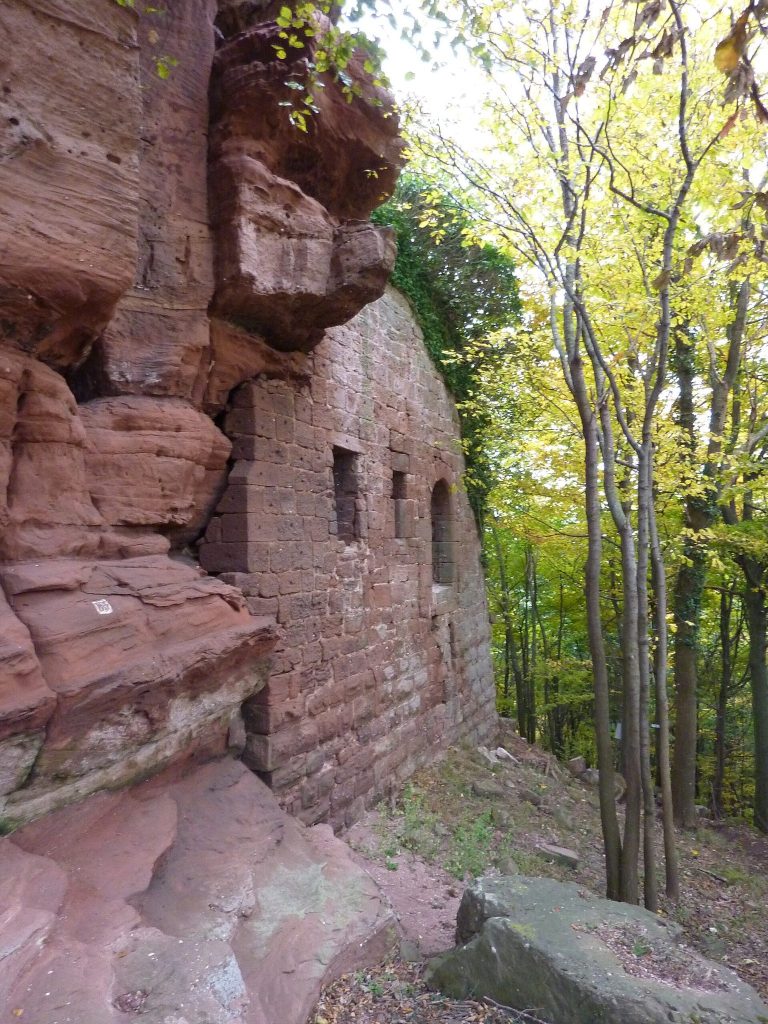
The oldest surviving part of the church is its eastern end, comprising a chancel and a shallow pentagonal apse. Both are covered by rib vaults and probably date chiefly from the rebuilding connected with the 1332 consecration. The apse contains four windows and the nave two, while two dormer windows provide additional light. The windows have lost their mullions and tracery, and some are partly blocked. The unrendered exterior wall also shows former openings that were later sealed.
Tower
A three-storey tower rises above the chancel and is capped by a saddleback roof. Its position forms part of the eastern composition of the church, which preserves the principal structural evidence of the fourteenth-century rebuilding.
Interior decoration and furnishings
Wall paintings
The surviving paintings are concentrated in the apse, although the interior was probably once extensively frescoed. Their existence was known in the nineteenth century, and the paintings were uncovered during the restoration of September 1969. Their style places them between the rebuilding of the nave around 1580 and the construction of the gallery in 1619.
The northern half-panel of the apse shows a saintly abbot dressed in green, probably Saint Benedict. A corresponding southern figure may represent Saint Blaise or Saint Scholastica, although the condition of the painting prevents a secure identification. Architectural decoration frames the windows in the northwest and southwest panels. Fluted columns with Corinthian capitals support rolled, leather-like ornaments arranged in volutes beneath the pointed arch.
The eastern panel contains a large Crucifixion. Above it, God the Father holds the body of Jesus on his knees, while angels carrying the Arma Christi, objects associated with Christ’s Passion, occupy the northern and southern compartments of the vault. Another vault image represents a variant of the Throne of Grace, in which God the Father holds the crucified or dead Christ. The composition also draws on the Pietà tradition, which became popular in Flemish art from the late sixteenth century. A comparable scene appears on a triptych in the Hofkirche at Neumarkt, and both works may have relied on the same unidentified model, probably derived through intermediate works from Michelangelo’s Pietà. A tetramorph, the symbolic combination of the four Evangelists, appears on the chancel vault beneath beige whitewash.
Later furnishings
Most of the furnishings date from the eighteenth century, including the altars, pulpit, and gallery. The funerary monument of Gisbert Agricola, and possibly the statues of the Virgin and Child and the Pietà, are earlier. The dates of the statues remain uncertain.
Gisbert Agricola’s cenotaph
Agricola’s cenotaph is set into the northern wall of the nave. Made from yellow-and-grey variegated sandstone, it consists of a semicircular niche, now blocked, that probably once held a statue of the abbot. Two pilasters frame the niche and support an entablature surmounted by a cross, although the cross may be a later element.
The monument’s sculptures were originally polychromed and later covered with red-and-white whitewash. The base and pilasters carry the symbols of the four Evangelists. Two angels on the entablature hold a torch and a garland, and a lion’s head forms another sculptural detail. Latin inscriptions on the base and entablature commemorate Agricola.