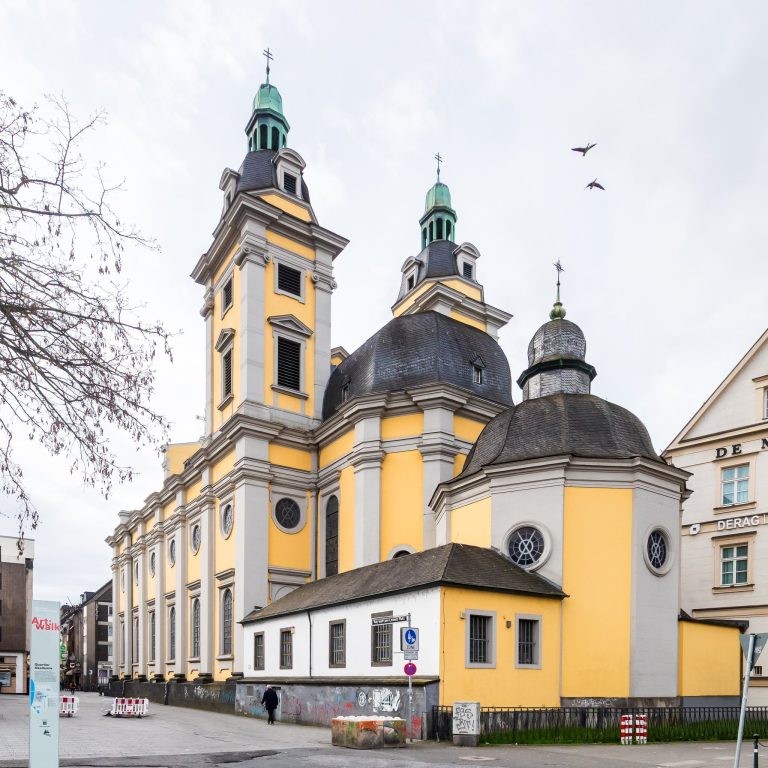
St. Nikolaus: A Romanesque Church in Düsseldorf, Germany


Site at a Glance
- Rating
- 4.6
- Popularity
- Very Low
- Country
- Germany
- Primary era
- Medieval
- External website
- Open
- Eras represented
- Medieval, Modern
- Civilizations
- German, Holy Roman Empire
- Site type
- Religious
- Remains
- Church
On this page9 sections
History
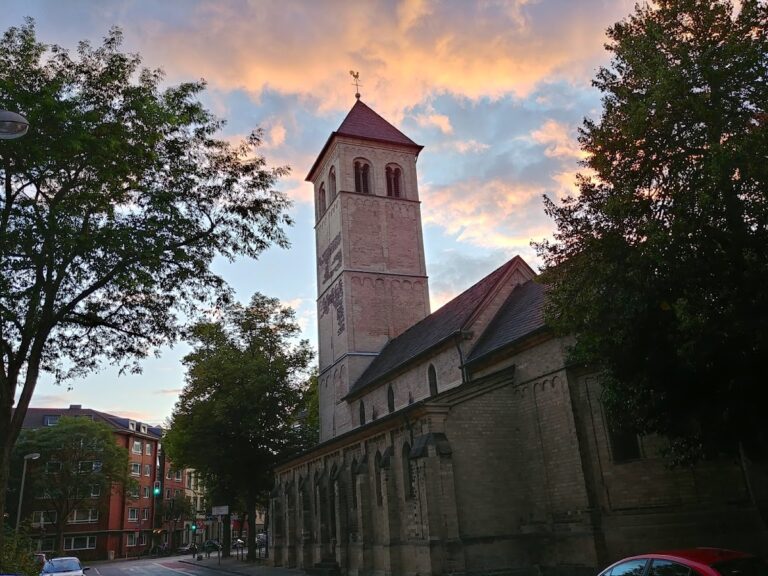
St. Nikolaus is a Roman Catholic church in Düsseldorf, Germany, built in the eleventh century in the late Romanesque style and counted among Düsseldorf’s three oldest churches. Dedicated to Nicholas of Myra, the fourth-century Christian bishop traditionally associated with generosity and later regarded as the patron saint of sailors, it stands near the Rhine in Himmelgeist.
Early church and medieval development
The first church at Himmelgeist was recorded in 904 as a filial church of the Kaiserswerth collegiate foundation, a medieval ecclesiastical institution based in what is now a Düsseldorf district. That building served as the predecessor of the present church. The eleventh-century structure initially had neither a tower nor a choir. During the twelfth century, a choir and main apse were added, and a tower was built in the thirteenth century.
The church continued to develop during the later Middle Ages. Two sacrament houses, built-in architectural enclosures for reserving the Eucharist, were inserted into the choir area in the fourteenth and fifteenth centuries. By the early twentieth century, three historic bells remained in use, including one cast in 1454 and two made in 1730.
Alterations and nineteenth-century restoration
A lightning strike on 14 June 1741 led to restoration of the tower. The interior was restored by August Rincklake in 1867, while the sacristy was enlarged during the nineteenth century. These interventions formed part of the building’s later development while its medieval core remained in use.
War damage and twentieth-century renewal
Shelling during the Second World War heavily damaged the church and tower. The tower spire, which had already been torn open on its Rhine-facing side, fell during a hurricane on 28 December 1945. Reconstruction and restoration continued after the war, including renewal of the spire and weathered masonry, and extended into 1967–68.
Extensive restoration followed in 1974. Work undertaken during the major restoration campaign of the early 1970s uncovered surviving traces of painted decoration, allowing the interior’s original color scheme to be restored. The nineteenth-century sacristy was enlarged again in 1972 in a style intended to harmonize with the church. High Rhine water entered the building in 1995.
Parish history and ecclesiastical status
Until 2025, St. Nikolaus served as the parish church of the parish of the same name. At the turn of 2025–26, that parish and seven other Catholic parishes were dissolved and replaced by the newly established parish of St. Nikolaus Düsseldorf. St. Gertrud in Eller became the new parish church because it is the largest church in the enlarged parish. St. Nikolaus belongs to the Roman Catholic Church and the Archdiocese of Cologne and is protected as an immovable heritage monument in North Rhine-Westphalia.
Remains
Romanesque basilica and medieval additions
St. Nikolaus is a three-aisled Romanesque pillar basilica, a church with a central nave and lower side aisles supported by substantial pillars. Its medieval structure has three apses and stands near the Rhine. The twelfth-century choir has a ribless cross-vault resting on Romanesque three-quarter columns. Two sacrament houses are built into the southern wall of the choir area.
The tower was inserted into the existing church rather than placed in front of it. Its eastern wall cuts through the arches of the third arcade, preserving visible evidence of how the later structure was integrated into the earlier building. The bell chamber has openings with early pointed arches. At the same time as the tower, the main nave received an Early Gothic rib vault, while the side aisles have groin vaults. The Romanesque clerestory windows have been bricked up.
Windows and interior furnishings
The stained-glass windows date from 1967–68 and were made by the Cologne glass painter Franz Pauli. The almost uncolored ornamental windows in the main nave admit light. Quatrefoil windows in the side aisles show the Beatitudes from the Sermon on the Mount, the baptism of Jesus in the Jordan, and works of mercy. The three apse windows depict the Lamb in the Heavenly Jerusalem from the Apocalypse at the center, Christ the Good Shepherd on the left, and Christ’s Resurrection on the right.
Olaf Höhnen made the Aachen-blue-stone altar in 1967, replacing an oversized Neo-Romanesque altar. He also created the 1974 portal, whose theme is the Church’s mission, filled with the Holy Spirit, into the world. His other works in the sanctuary include the triumphal cross above the altar, the tabernacle, and the consoles beneath the tabernacle and for the sanctuary lamp. The furnishings also include a Gothic baptismal font, a Baroque Madonna and crucifix, and a late nineteenth-century Pietà, Stations of the Cross, and statue of Saint Nicholas.
Organ
Johannes Klais of Bonn built the organ in 1938 as opus 915, the builder’s catalog number for the instrument. It is a cone-chest organ, a type in which cone valves admit air to the pipes, with 17 stops on two manuals and pedal. Its key and stop actions are electric. The builder’s workshop restored it in 1998, and Orgelbau Seifert of Kevelaer thoroughly renovated it in 2022. Its couplers are II/I, I/P, II/P, and Sub II/I.