Church of St Peter Ad Vincula: The Parish Church of Combe Martin


Site at a Glance
- Rating
- 4.6
- Popularity
- Very Low
- Country
- United Kingdom
- Primary era
- Medieval
- External website
- Open
- Eras represented
- Medieval, Early Modern, Modern
- Civilizations
- British, English
- Site type
- Religious
- Remains
- Church
On this page15 sections
History
Church of St Peter Ad Vincula is the Church of England parish church of Combe Martin in the United Kingdom, in North Devon, and belongs to the Diocese of Exeter. Construction of the present building began in the thirteenth century in the Early English phase of English Gothic architecture, while its unusually large scale is associated with the period when silver was mined locally. The church may occupy the site of an earlier Saxon church.
Medieval foundation and expansion
The dedication, St Peter ad Vincula, means “St Peter in Chains” and refers to the biblical imprisonment of St Peter. It derives from the ancient Basilica of San Pietro in Vincoli in Rome. Only 15 churches in England share this dedication.
Thirteenth-century fabric survives in the south transept and on the south sides of the chancel and nave. The building was enlarged substantially in the fifteenth century, when the north aisle, north chancel chapel, north porch, and west tower were added. A north transept followed in the late fifteenth or early sixteenth century. The former chantry chapel, established for prayers and masses for particular donors or benefactors, is now known as the Lady Chapel.
Later changes and restoration
The south porch was rebuilt in 1725, and the church’s medieval roofs were ceiled during the same year. Restoration took place in 1858 and 1881. The rood screen was restored in 1912, followed by new choir stalls in 1913 and new altar rails in 1914. In 2009, the medieval screen and its paintings were conserved.
A new organ was installed in 1905 in memory of the Reverend Humphry William Toms, who served as rector from 1842 until 1904. The church became a Grade I listed building in 1965. The architectural historian Nikolaus Pevsner, known for his surveys of English architecture, described it as “One of the best in the neighbourhood.”
Memorials and local associations
James Norman, the church sexton, was buried in the churchyard near the lychgate. His life inspired the character Reuben Dale in Marie Corelli’s The Mighty Atom, published in 1896 and written during her stay at the nearby Pack o’ Cards inn.
A cross-shaped war memorial in the Garden of Remembrance, attached to the churchyard, was designed by W. C. Willis and unveiled in 1921. It commemorates villagers who died in both World Wars.
Remains
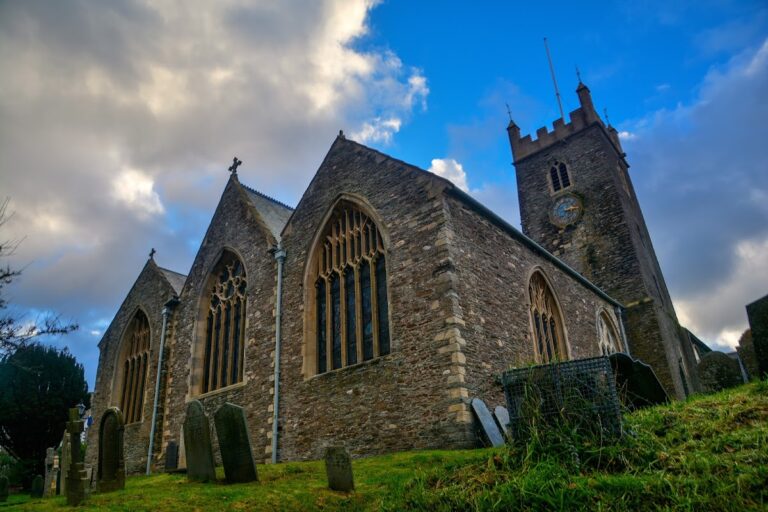
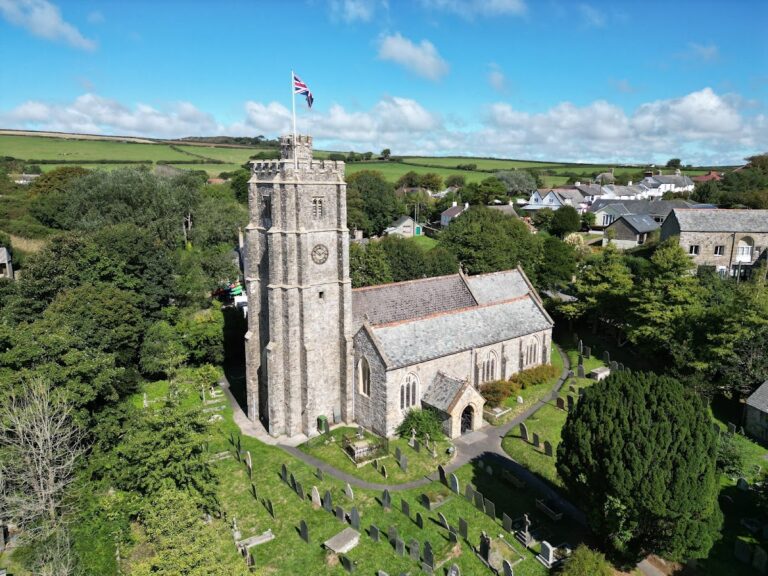
Church of St Peter Ad Vincula is a large stone parish church built principally of rubble with ashlar dressings, while the south porch has a dressed-stone façade. Slate roofs cover the building. Their gable ends have copings and apex crosses, and the west tower, vestry, north transept, and north porch have embattled parapets. The surviving fabric combines thirteenth-century Early English work with later Perpendicular additions, a style marked by strong vertical lines and elaborate panel tracery.
West tower and exterior features
West tower
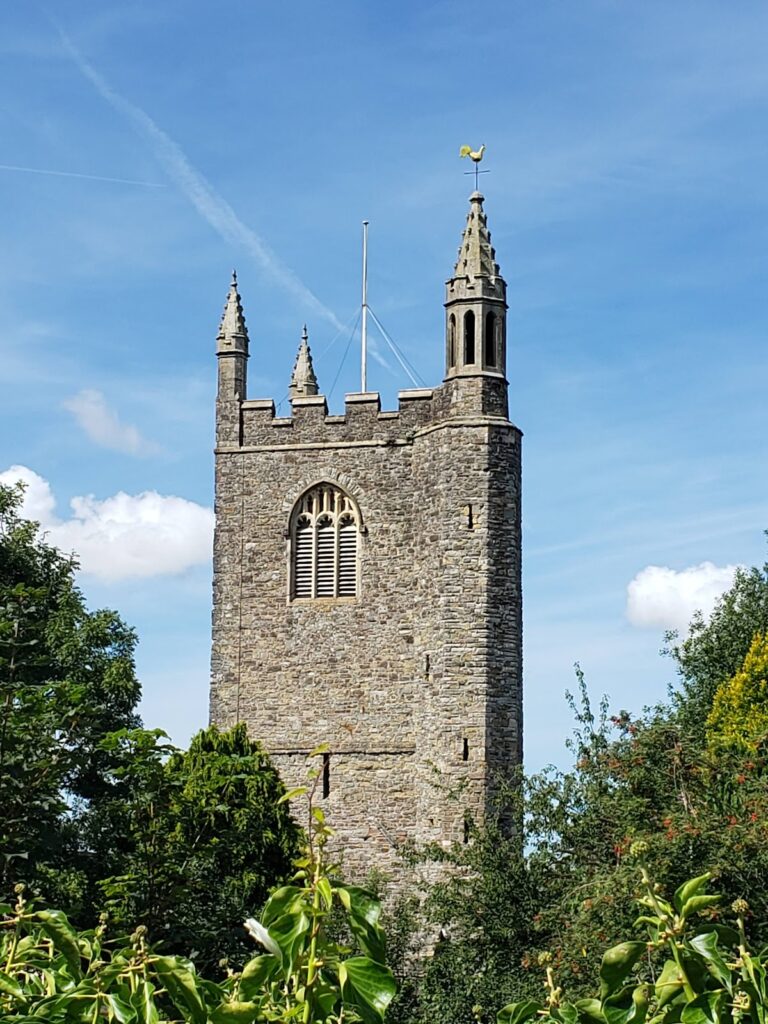
The west tower rises 99 feet and is divided into four stages. It has embattled parapets, setback buttresses, two tiers of gargoyles, and tall, slender crocketed pinnacles. Trefoil-headed niches in the north and south buttresses contain weathered statues. Each face has a large three-light Perpendicular bell-opening, while a cusped niche contains a carved figure of Christ.
The tower houses a clock and eight bells. The bells were recast by Taylor of Oxford in 1827 and by Mears and Stainbank of London in 1922. The churchyard retains its lychgate and the attached Garden of Remembrance, where the cross-shaped war memorial stands.
Roofs and north transept
Devon cradle or wagon roofs extend throughout the church and were ceiled in 1725. The north transept roof has stars at the centres of its panels, together with two Green Man carvings. A Green Man is a foliage-associated carved human face or head used as a decorative motif in medieval and later church architecture.
Chancel screens and chapels
Rood screen
The fifteenth-century rood screen has nine and a half bays and is carved in the Perpendicular style. A rood screen is a decorated partition separating the chancel from the nave and traditionally supporting or framing a representation of the Crucifixion. The chancel bays contain three panels each, while the chancel chapel bays contain four. All but three panels retain Tudor-painted figures of Christ and the Apostles.
Three different artists appear to have painted the figures, as additional silver-mining wealth provided funds for the work. Female saints occupy the side formerly assigned to women. These paintings are the only preserved examples of their kind in North Devon. The rood figures of Jesus, Mary, and John the Apostle were carved by Colin Shewring in 1962, based on an image in a medieval Book of Hours.
Chancel chapel and parclose screen
Twin arches connect the chancel with the chancel chapel. On their western side are two canopied niches on slender shafts, with original painted scrolling foliage carved below and behind them. The parclose screen dates from about 1333, when the chantry chapel, now the Lady Chapel, was added. A parclose screen is a partition enclosing a chapel or another area within a church.
The chancel chapel contains a sixteenth-century oak Peter’s Pence chest and damaged sixteenth-century pew ends. Peter’s Pence was a charitable payment associated with support for the papacy. The vestry plank door is probably fifteenth-century and retains its original sanctuary ring and lock.
Font, glass, and memorials
Baptismal font
The baptismal font dates from 1427. Its Perpendicular octagonal bowl is lined with lead and decorated on each face with blind-traceried panels that retain traces of their original paint. The short circular stem has four narrow outer columns. Evidence of medieval wall painting survives beside the font.
Stained glass
The stained glass includes a three-panel window by Archibald John Davies depicting the calling of St Andrew and St Peter. The central section of the western chancel lancet retains medieval glass showing seraphim and wheels.
Monuments and brasses
A monument on the south chancel wall commemorates Richard Harding, who died in 1831, and his family. The north aisle contains a monument to George Ley, who died in 1716 and built the nearby Pack o’ Cards, supposedly after winning a large sum in a card game.
A marble wall monument in the chancel chapel commemorates Judith Ivatt, who died in 1634. She was the wife of Thomas Ivatt, described as “his Majesty’s principal searcher in the port of London,” a senior customs official responsible for inspecting goods and checking compliance with port regulations. A monumental brass on the south side commemorates William Hancock, who died in 1587, with his coat of arms above the inscription.