San Giorgio alla Costa: A Historic Catholic Church in Florence


Site at a Glance
- Rating
- 4
- Popularity
- Very Low
- Country
- Italy
- Primary era
- Early Modern
- External website
- Open
- Eras represented
- Medieval, Early Modern
- Civilizations
- Grand Duchy of Tuscany, Republic of Florence
- Site type
- Religious
- Remains
- Church
On this page11 sections
History
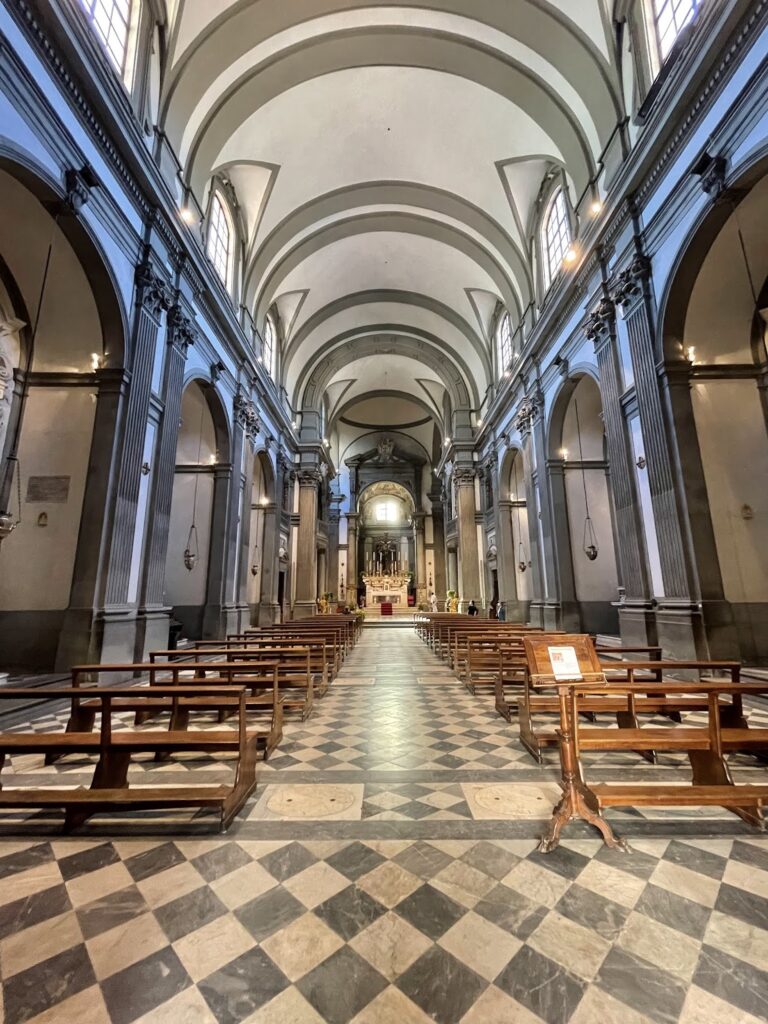
San Giorgio alla Costa is a Catholic church in Florence, Italy, in the city’s Oltrarno district. Dedicated to Saint George, the church predates the year 1000 and became one of the principal priories of medieval Florence. Its present interior largely reflects an extensive renovation carried out between 1705 and 1708, when the architect Giovan Battista Foggini introduced an eighteenth-century Rococo scheme.
Early churches and the medieval priory
Three small churches once occupied the site. One was dedicated to the martyr Saint George, another to Saint Sigismund, and a third to Saint Mamilian. The church of San Giorgio was established before the year 1000, and a convent was attached to it soon afterward. The convent was enlarged and completely renovated during the fifteenth century, as the institution passed among several religious communities.
The complex first belonged to the Canons of Sant’Andrea a Mosciano, a religious community governed by canons. In 1435, a bull issued by Pope Eugene IV transferred it to the Dominicans of Fiesole. After the Dominicans moved to San Marco through the intervention of Cosimo de’ Medici, the Silvestrines took possession. The Silvestrines were a Benedictine congregation founded by Saint Silvester Guzzolini.
Vallombrosan administration and the Holy Spirit convent
As Silvestrine influence declined, the monastery came under the authority of the Vallombrosan abbey of San Salvi. The Vallombrosans were a Benedictine reform congregation associated with the abbey of Vallombrosa. In 1520, at the request of Lucrezia de’ Medici, daughter of the Florentine ruler Lorenzo de’ Medici, a new convent dedicated to the Holy Spirit was built for Vallombrosan nuns who had previously lived at Santa Verdiana.
The monastery was enlarged and embellished during the sixteenth century. A substantial bequest from Simone Zati, a benefactor of the institution, helped support this work. The church and its annexes also accommodated several confraternities, including the Company of Saint George of the Cornacchioni. Confraternities were lay religious associations formed for devotional, charitable, or mutual-support purposes.
Foggini’s renovation and later transformations
Between 1705 and 1708, Foggini extensively renovated the church. The changes gave the interior its Rococo character, a decorative style associated with elaborate stucco, curved forms, and ornamental refinement. Several paintings and crafted elements were produced for this new scheme, including works by Alessandro Gherardini, Anton Domenico Gabbiani, Giovanni Battista Ciceri, and Jacopo Pini.
The convent was suppressed in 1808 during the Napoleonic reforms. Between 1926 and 1933, portions of the former convent, together with spaces incorporated from the nearby monastery of San Girolamo alla Costa, were converted into the Vittorio Veneto Barracks. The barracks trained medical and pharmaceutical officer-cadets for the Military School of Medicine, an institution devoted to preparing military medical personnel. The complex remained operational until 1998 and later fell into abandonment.
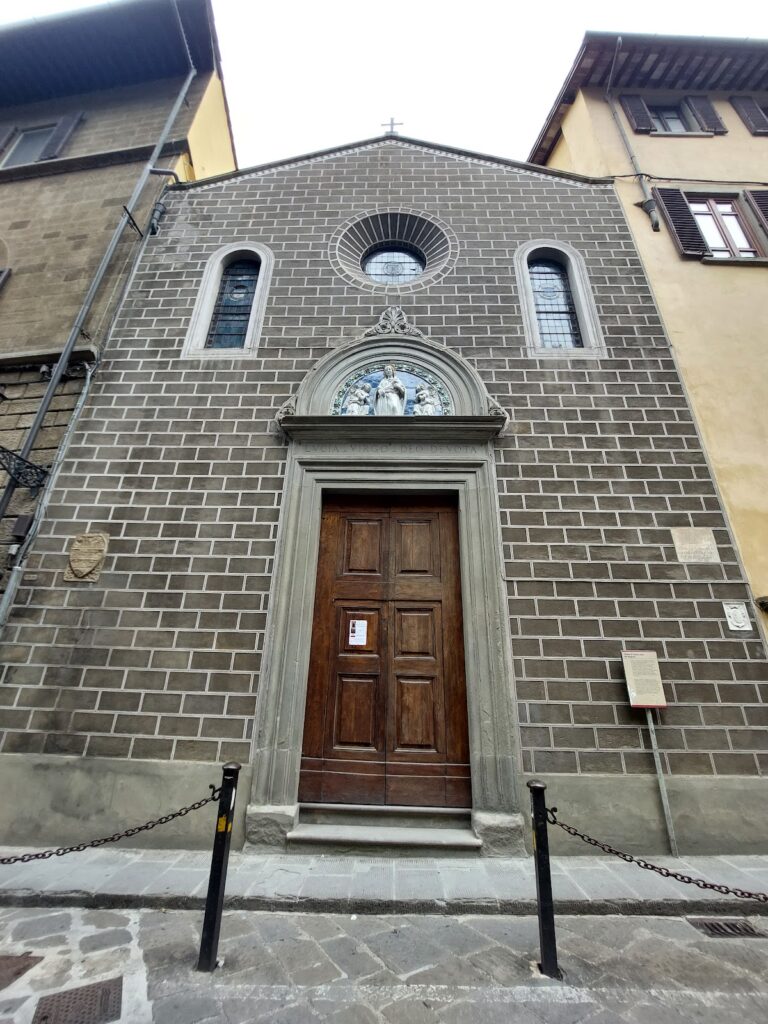
In 1954, the Committee for Civic Aesthetics uncovered the church’s well-preserved coursed-stone facing beneath plaster. The building later served the Romanian Orthodox Church until 2017. Structural damage to the roof had made the main church unusable for about 35 years, so Orthodox services took place in an adjoining room. Following restoration, the church reopened as a Catholic church in September 2017. The future of the former monastic complex remained uncertain after a private owner acquired the entire property.
Paintings associated with San Giorgio alla Costa
San Giorgio alla Costa had important connections with Florentine painting. When he was still young, Giotto painted an altarpiece for the church, the Madonna and Child Enthroned with Two Angels. The panel was later removed and exhibited at the Museo dell’Opera del Duomo in 2018.
During the Silvestrine period, around 1457, Alesso Baldovinetti received a commission for the Annunciation, a tempera painting on wood. The work is now held in Florence’s Uffizi Gallery. Giorgio Vasari, a painter and art historian, incorrectly attributed it to Pesellino, while some interpretations have seen a reference to the architect and sculptor Michelozzo in its architectural background. Paolo Uccello’s Thebaid was also formerly associated with the church and is now in Florence’s Galleria dell’Accademia.
Remains
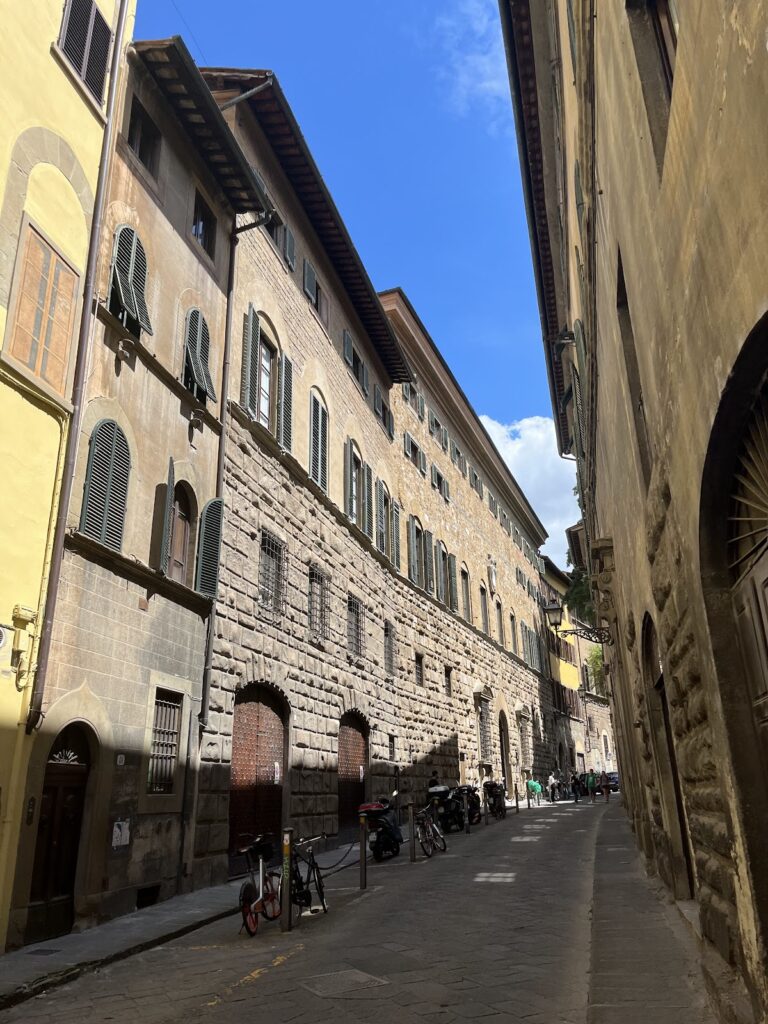
San Giorgio alla Costa stands on the steep Costa San Giorgio in Oltrarno, along the route rising from Ponte Vecchio toward Forte di Belvedere. The surviving church consists of a single nave preceded by a broad narthex, an entrance or vestibular space before the main body of a church. Above the narthex is the nuns’ choir, an enclosed gallery that allowed the nuns to take part in worship while remaining separated from the nave.
Exterior and layout
The church retains a side portal, a bell tower, and its coursed-stone facing. The stonework was found beneath plaster in 1954 and is described as well preserved. Inside, the nave leads toward the high altar, while the broad entrance space and the choir above it preserve the arrangement associated with the church’s female religious community.
Foggini’s interior
Stucco and painted decoration
The interior created between 1705 and 1708 follows Foggini’s designs and is decorated in the Rococo style. Giovanni Battista Ciceri executed the stucco work. Alessandro Gherardini painted Saint George in Glory on the vault, and Anton Domenico Gabbiani painted the Descent of the Holy Spirit in the oval above the high altar. Jacopo Pini made the grilles according to Foggini’s designs, including the grille enclosing the nuns’ choir.
Altars and earlier painting
Other interior paintings include Tommaso Redi’s Saint Benedict Resurrecting a Child, made around 1705. The right-hand altar in the nave contains Nicodemo Ferrucci’s Miracle of Saint John Gualbert, painted in 1610 for Sister Veronica Ginori. The work was damaged by earlier burning and depicts the interior of San Miniato al Monte.
Above the door on the left side of the rear wall is a panel of the Effusio Sanguinis. It is attributed to Carlo Portelli and dates from before the eighteenth-century renovation. Together with the later decoration, it represents an earlier layer of the church’s artistic history within the renovated interior.
Organ and transferred artworks
The church’s organ was built by Onofrio Zeffirini in 1527. It was transferred to Santa Felicita in 1771, where it remains. Because the instrument was intended for nuns, its console opened through the rear rather than the front wall, keeping the organist out of view from the nave.
The Giotto altarpiece and Baldovinetti’s Annunciation were both formerly kept in San Giorgio alla Costa and are now held in Florence museums. Their subjects and original association with the church preserve a connection between the surviving building and the artistic commissions that once formed part of its interior.