St. Mary and Michael Church: Former Premonstratensian Monastery Church in Churwalden


Site at a Glance
- Rating
- 4.5
- Popularity
- Very Low
- Country
- Switzerland
- Primary era
- Early Modern
- External website
- Open
- Eras represented
- Medieval, Early Modern, Modern
- Civilizations
- Holy Roman Empire
- Site type
- Religious
- Remains
- Church
On this page16 sections
History
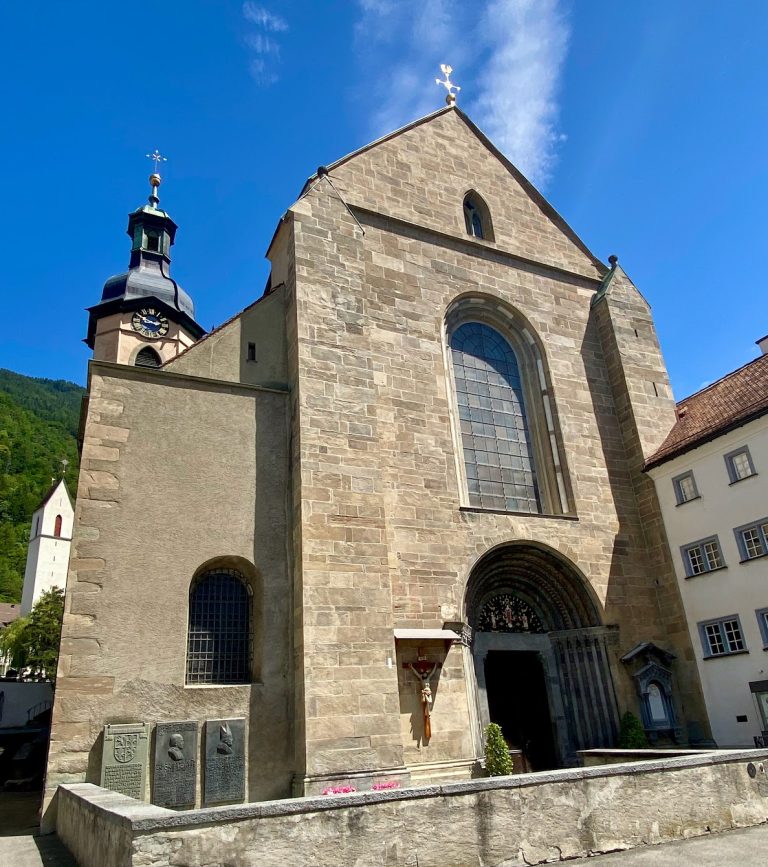
St. Mary and Michael Church is a Catholic church in Churwalden, Switzerland, built for the former Premonstratensian monastery during the first half of the thirteenth century over a pre-Romanesque predecessor. The Premonstratensians were a Catholic order whose members combined monastic life with pastoral and clerical work. The church was dedicated initially to Saint Michael and later became a richly furnished centre of worship for the monastery and local congregations.
From the early monastery to the fifteenth century
The monastery’s first church stood farther south, near the bridge over the Rabiusa. A new church was established at the present site in the first half of the thirteenth century. Its six-storey tower was probably added in the fourteenth century, forming part of the developing monastic complex.
On 3 May 1472, during the abbacy of Ludwig von Lindau, a fire destroyed the church. Ludwig von Lindau led the Churwalden monastery from 1461 to 1488. The church was rebuilt on its earlier foundations, with a longer choir, a new ossuary on the north side, and an enlarged sacristy. The rebuilding also produced the late Gothic furnishings that remain central to the church’s identity.
Consecration and later changes
The rebuilt church was consecrated on 29 September 1502 in honour of Mary, Saint Michael, and all the holy angels. A roof turret served in place of the main tower until the tower was restored in 1511. The west face of the tower received a painted clock face dated to that year.
Around 1800, a new sacristy was built and the former sacristy became a Marian chapel. The choir seating dates from 1890, and the Klinger firm installed the organ in 1895. Benches were added to the nave in 1915.
Shared worship and modern restoration
From 1646 until 1967, both Catholic and Reformed congregations used the church. After a separate Reformed village church was completed, St. Mary and Michael became Catholic. Archaeological investigation and restoration between 1967 and 1976 renewed understanding of the building and its successive phases.
The former abbot’s building stands about 100 metres south of the church. It was built before the middle of the fifteenth century and acquired its present appearance after the monastery fire of 1472. Around 1870, it was substantially altered for use as a parish residence.
Remains
The church has a relatively short lay nave, formed as a two-bay, three-aisled stepped hall. Chapel extensions flank the square monk’s choir, the part of a monastic church reserved for the community’s communal prayer, while the square tower stands on the north side. Massive piers divide the broad rectangular nave, and net-rib vaults rise from piers fitted with half-columns.
Layout and tower
Nave and choir
A substantial walkable rood screen, a medieval partition between the nave and choir, rests on three arcades and separates the lay nave from the square monk’s choir. The western keystone of the nave carries the monastery’s red-and-white coat of arms. A round-arched window from the Romanesque predecessor remains in the north wall, with star decoration preserved in its reveal.
Tower clock and bells
The west side of the tower bears a painted clock face dated 1511. It shows wild men associated with the League of the Ten Jurisdictions, a political association in the region now known as Graubünden, and includes the coat of arms of Abbot Gebhard Vittler. The clock is the oldest dated large clock in Graubünden. Three bells hang in the tower. The largest measures 136 centimetres in diameter, and the bells were cast between 1843 and 1896 by the Theus brothers of Felsberg.
Medieval paintings and sculpture
Rood screen paintings
The west face of the rood screen carries a Last Judgment painted in 1481. Its upper section was destroyed when an organ was installed, and the organ was later removed. Further paintings on the choir-facing side of the screen and on the north side of the choir have not been uncovered.
Marian fresco
In a round-arched niche on the east wall of the north aisle, the Waltensburg Master painted a fresco around 1330 to 1340. The anonymous painter is associated with important medieval wall paintings in Graubünden. The image shows the Coronation of the Virgin, with Christ blessing Mary while luminous angels accompany them. The fresco was uncovered in 1970 after the niche had been closed and whitewashed. It probably replaced a sculptural figure or altarpiece connected with an earlier altar dedicated to Saints Catherine and Dorothy.
Crucifixes and devotional images
Two statues of the Man of Sorrows are attributed to the altar-maker’s workshop. Above the rood screen stands a life-sized rood crucifix from around 1480, fitted with horsehair and a crown of thorns. A Pietà in the Marian chapel dates from the first quarter of the fifteenth century, and a small fifteenth-century crucifix stands opposite it.
Late Gothic altarpieces
High altarpiece
The late Gothic high altarpiece was made around 1477 for the rebuilt church. It is 7.18 metres high and is among the largest and most important altarpieces in Switzerland. It is also among the earliest altarpieces brought from Swabia to Graubünden. Its maker is unknown, and stylistic evidence has associated its production with Ulm.
The painted predella, the section beneath the shrine, is fitted to the altarpiece’s width and shows Christ with the twelve apostles, several identified by their attributes. Five statues occupy the shrine: the Madonna and Child at the centre, Saint Augustine and Saint Emerita on the right, and Saint Luzius with an unidentified female saint on the left. Emerita and Luzius were among Graubünden’s most popular local saints, while tradition held that Emerita suffered martyrdom at Trimmis.
Above the shrine are the crucified Christ, Mary, and John, accompanied by Saint James on the left and Saint Margaret on the right. The two outer angel figures were added later. At the summit, Saint Michael holds a device for weighing souls. The inner face of the left wing depicts the Annunciation with scrolls, while its exterior shows the Visitation. The inner face of the right wing presents the Nativity, and its exterior shows Saint Lawrence of Rome and Saint John the Baptist.
Luzius altarpiece
The late Gothic Luzius altarpiece dates from around 1511 and comes from the circle of Jakob Russ, a late-medieval sculptor and altar maker. After a dispute between Protestants and Catholics, the Gottfried Keller Foundation acquired it in 1926 and placed it in Chur Cathedral. Following restoration from 1997 to 2000, it returned to its original position in the south aisle.
Its shrine contains statues of Saints Emerita, Luzius, and Mary Magdalene. Reliefs of John the Baptist and Saint Peter fill the wings, while the carved predella presents scenes from Christ’s Passion beneath three arches. The painted wooden antependium, the decorative frontal covering of an altar, shows the Last Supper and bears the coat of arms of Abbot Gebhard Vittler together with that of the former Churwalden monastery.
Memorials and associated buildings
A late-fifteenth-century sacrament house remains in the church. Several tombstones from the thirteenth or fourteenth century and the seventeenth century are displayed on the west wall, alongside a fragment of a twelfth- or thirteenth-century tomb slab belonging to the Barons of Vaz.
The former abbot’s building retains original panelling and a Renaissance wall cabinet in the abbot’s room on the third floor, preserving elements of the monastery’s domestic and administrative setting.