Murad Agha Mosque: An Ottoman Mosque in Tajoura, Libya


Site at a Glance
- Rating
- 4.6
- Popularity
- Low
- Country
- Libya
- Primary era
- Early Modern
- Eras represented
- Early Modern, Modern
- Civilizations
- Ottoman
- Site type
- Religious
- Remains
- Mosque
On this page8 sections
History
Murad Agha Mosque is a Sunni Muslim mosque in Tajoura, Libya, built under Ottoman rule during the 1550s. Commissioned by Murad Agha, the first Ottoman beylerbey, or senior provincial governor, of Tripoli, it is regarded as the first Ottoman mosque in Libya and remains a prominent landmark of Tajoura.
Ottoman conquest and foundation
Murad Agha was an Ottoman naval officer who took part in Hayreddin Barbarossa’s unsuccessful 1532 campaign against the Knights of Saint John, a Christian military order that controlled Tripoli before the Ottoman conquest. The campaign brought the Tajoura oasis under Ottoman occupation, and Murad established himself as its ruler. In 1551, he served under Sinan Pasha during the Ottoman capture of Tripoli on 15 August. Sinan Pasha was the commander and statesman who led that campaign. Murad then governed the Ottoman province of Tripoli until about 1556.
The mosque’s construction is dated either to 1552, while Murad was beylerbey of Tripoli, or to approximately 1553–1556, after Dragut had replaced him and Murad had returned to Tajoura. Dragut was an Ottoman naval commander and admiral active in the sixteenth-century Mediterranean. Murad reportedly first intended to build a fortress but was compelled to construct a mosque instead. The building nevertheless appears to have been planned with defence in mind, particularly against Spanish or Hospitaller incursions.
Local construction and later history
Maghrebi architects and engineers were probably involved in the work, which relied on local materials and building methods rather than an Ottoman architectural style. Enslaved Christians are said to have participated, and one of them has been suggested as the building’s designer. Murad reportedly offered freedom to 300 Spanish or Sicilian captives if they completed the mosque within a short period.
Murad Agha died around 1556 and was buried in a tomb outside the mosque. The tomb was deliberately destroyed by an explosion in 2013. Libyan Prime Minister Ali Zeidan and UNESCO Director-General Irina Bokova condemned the destruction. The mosque’s original minaret collapsed in an earthquake in 1901. Restoration followed during the 1920s under Italian colonial rule, and a government decree dated 12 April 1922 declared the mosque a historic monument. A replacement minaret was later added in a different design.
In 2011, anti-Gaddafi protests took place outside the mosque before the beginning of the Libyan civil war. This episode added a modern political association to a building already connected with the establishment of Ottoman authority in Tripoli and Tajoura.
Remains
Plan and construction
The mosque has a rectangular plan measuring approximately 40 by 32 metres. Its exterior walls are plain but imposing, and the building combines Berber features with elements derived from ancient classical architecture. A courtyard forms part of the complex, while the prayer hall is arranged beneath a series of barrel vaults, continuous curved vaults that cover the space from one end to the other.
Prayer hall and reused columns
Horseshoe arches support the barrel vaults in the prayer hall. The arches rest on 48 reused ancient Roman columns, a practice known as spolia, meaning architectural elements taken from earlier buildings or ruins and used again. The columns include pink and red breccia, cipolin, black granite, and limestone. Tradition holds that they came from Leptis Magna, the major ancient Roman city on the Libyan coast, and were salvaged from a ship that sank near Tajoura while carrying them to Europe. Another possibility is that they came from Roman villa ruins near Tajoura.
Defensive openings
Openings at the ends of the vaults appear to have been built as musketry loopholes, narrow apertures that allowed firearms to be used from a protected position. Their form supports the view that the mosque had a defensive purpose as well as a religious one, linking the physical design to the insecurity surrounding the early Ottoman presence in the region.
Courtyard and minaret
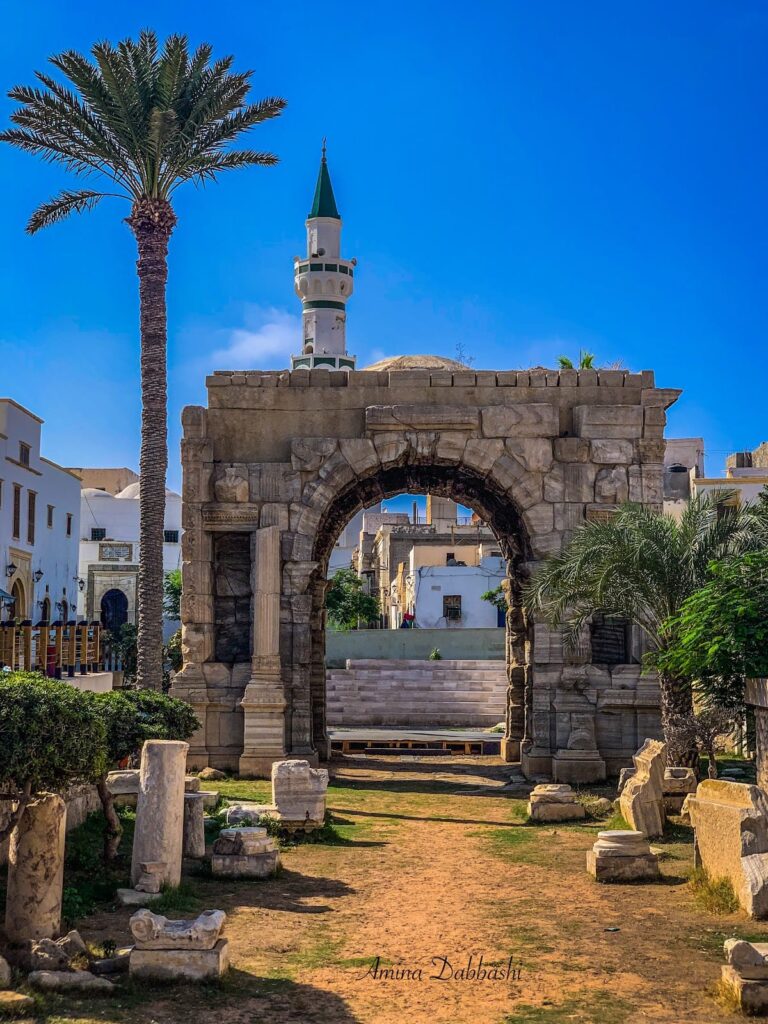
The mosque’s square-plan minaret follows a traditional Maghrebi design and resembles the minaret of the Great Mosque of Kairouan in Tunisia. It is the twentieth-century replacement for the original tower, which collapsed in the 1901 earthquake, and its design differs from that earlier minaret. Murad Agha’s former tomb stood outside the mosque until its destruction in 2013.