St. Martin Morsum: A Romanesque Evangelical-Lutheran Church in Germany


Site at a Glance
- Rating
- 4.6
- Popularity
- Very Low
- Country
- Germany
- Primary era
- Medieval
- External website
- Open
- Eras represented
- Medieval, Early Modern, Modern
- Civilizations
- Danish
- Site type
- Religious
- Remains
- Church
On this page16 sections
History
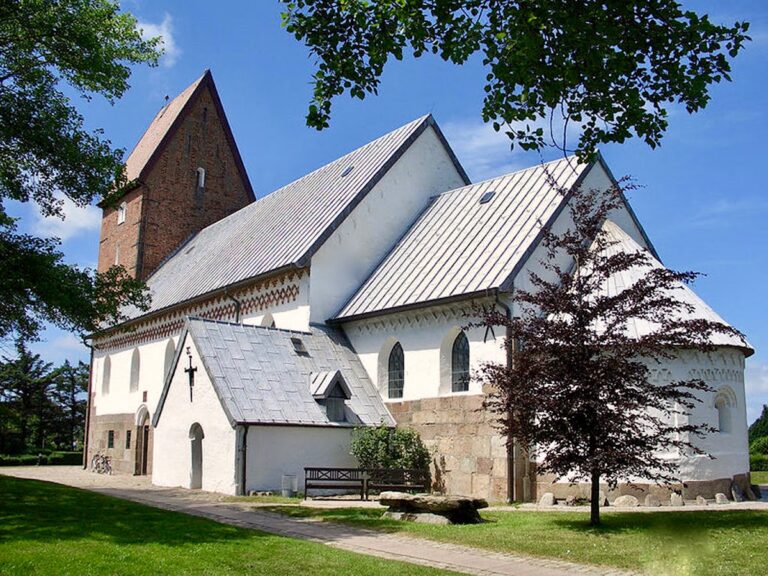
St. Martin Morsum is a Romanesque Evangelical-Lutheran church in Morsum, Germany, on the island of Sylt, dedicated to Martin of Tours, a fourth-century Christian bishop and widely venerated saint. Its construction is generally placed in the last third of the twelfth century, before the main period of brick building, and the church was first documented in 1240. It belongs to the Evangelical-Lutheran Church in Northern Germany and stands slightly outside the village on a low hill amid marsh meadows.
Medieval Origins
The church is a twelfth-century building with a set-back choir and semicircular apse (the rounded end of a church beyond the choir). Its masonry reflects the materials available on the North Frisian islands. Granite ashlar forms the lower courses, tuff was used in the choir and apse, and brick forms the nave. The building has remained without a tower, with its bell suspended in a separate frame.
Later Alterations
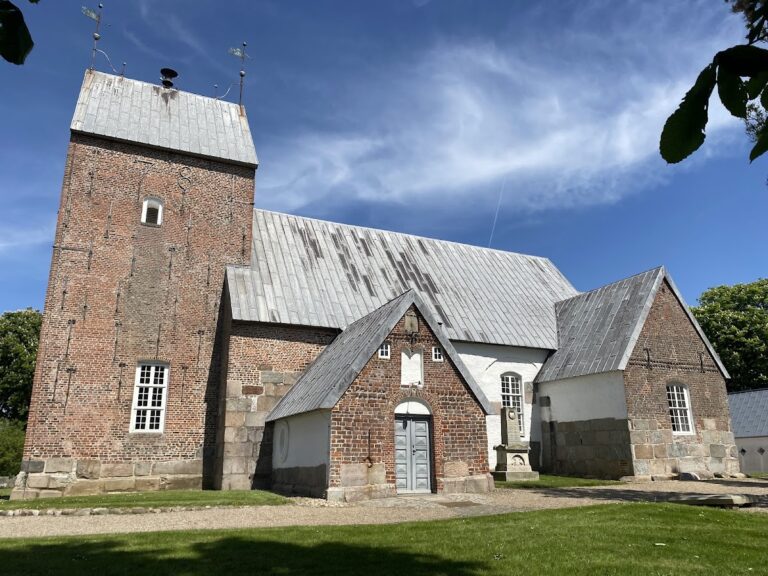
A southern porch was added in 1793 to provide a room for the pastor and a sacristy. It was renewed in 1933. The lead roofing of the nave was sold in 1895 and replaced with slate, while the southern side of the choir roof received new lead covering in 1790. The church’s furnishings and fabric were extensively reorganized during restoration in 1931 to 1933. The north gallery, dated 1684, was removed, choir seating was taken out in 1932, the pulpit was moved toward the edge of the choir, the baptismal font was relocated, and the arch between the nave and choir was renewed in 1932.
The restoration also returned older objects to their ecclesiastical setting. A holy-water basin that had long been used as a rain-collection basin was brought back into the church in 1932. The blocked apse windows were reopened during the 1932 to 1933 work, and their designs were remade from plans by the Flensburg artist Käte Lassen. In 1999, the believed-lost central section of an earlier altar, showing the Last Supper, was rediscovered while the present altar was being restored. The pulpit soundboard, stored for decades in the attic of the parsonage, was returned above the pulpit in 2004.
Community and Continuing Use
The church also preserves memories of the maritime life of Morsum. Fifty sailors from the village died in the storm surge of 15 March 1744, and a memorial plaque inside the church commemorates them. The organ was built in 1965 by Kemper of Lübeck with twelve stops. Eberhard Tolle of Preetz revoiced it in 1973, and Rudolf Neuthor of Kiel restored and enlarged it in 1984. It now has twenty-two speaking stops, three couplers, and the principal divisions known as the Hauptwerk, Rückpositiv, and pedal.
St. Martin Morsum is recognized as a protected cultural monument in Schleswig-Holstein. Its surviving structure, furnishings, inscriptions, and memorials bring together medieval construction, early modern alterations, and the continuing religious and communal history of the church.
Remains
The church is a compact Romanesque building organized around a nave, a narrower choir, and a semicircular apse. Granite ashlar blocks form the lower masonry, while tuff appears above in the choir and apse and brick was used for the nave. The nave and choir have wooden beam ceilings; the apse is covered by a half-dome vault. A brick semicircular arch on imposts, the projecting blocks from which an arch begins, separates the apse from the choir, and a second, depressed round arch marks the transition between the nave and choir.
Exterior and Bell Frame
Windows, Roofs, and Gables
The nave retains its old northern windows, and the apse has three original openings. After being blocked, the apse windows were reopened in 1932 to 1933, with their designs remade according to plans by Käte Lassen. Diamond and stepped friezes decorate the apse and choir. The lead-covered apse roof carries the initials “HPZ,” “HOL,” “HUF,” and “A.O. 1694.” These refer respectively to Peter Zitscher, provost in Tondern; Otto Lorenzen, pastor in Morsum from 1657 to 1701; Urban Flor, assistant pastor from 1692 to 1701; and the date 1694.
The lead covering renewed in 1790 on the southern side of the choir roof bears the initials of Pastor Gottfried Witt and his church wardens. A sundial dated 1759 is set into the gable. Its initials “MLK” refer to Martin Ludolf Krohn, pastor in Morsum from 1741 to 1781, while “KLJA” also appears on the sundial.
Bell Frame
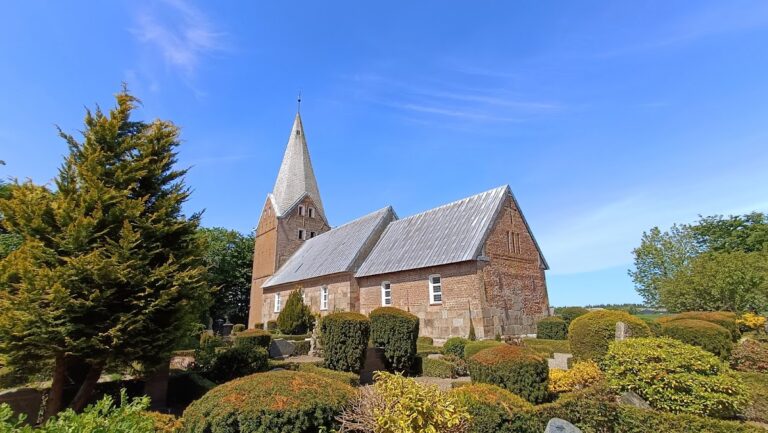
A freestanding bell frame stands slightly apart from the church. It has four uprights and an octagonal spire and was last renewed in 1984. The bell bears the inscriptions “Glori gloria in exelsis Deo 1767” and “me fecit Johann Nicolaus Bieber in Hamburg,” naming the Hamburg bell maker Johann Nicolaus Bieber and the year 1767. It continues to be rung by hand.
Altar and Baptismal Font
Winged Altar
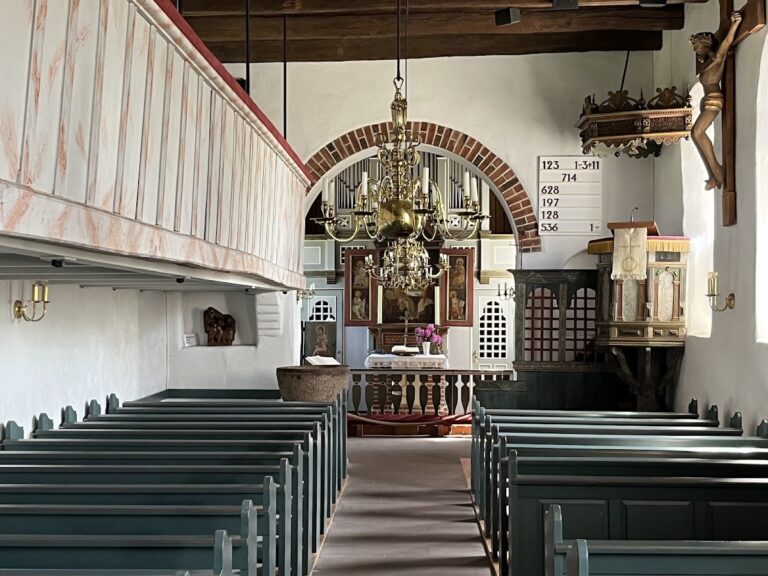
The winged altar contains Late Gothic figures, although most of its case dates from 1933. Its central image is a Gnadenstuhl, a representation of the Trinity in which God the Father holds the dead Christ in a Pieta-like manner. The customary dove representing the Holy Spirit is not included in this scene. St. Severin stands on the left and St. Martin on the right, while the side wings contain the twelve apostles.
The altar stipes, the supporting base beneath the altar table, is made of tuff. Its carved wooden front was created by Alvin Blaue in 1933 and shows the Tree of Life with the symbols of the four Evangelists. The rediscovered central section of an earlier altar, depicting the Last Supper, hangs on the north wall of the choir in a gabled frame flanked by two twisted columns.
Baptismal Font
The baptismal font was made in the mid-thirteenth century from three blocks of Gotland limestone. Its bowl includes round-arched elements. A brass basin dating from 1682 and a baptismal jug from 1760 belong to the font’s later furnishings.
Pulpit and Galleries
Pulpit
The six-sided pulpit basket was carved from oak in 1698. Pilasters divide its six relief panels, which depict the Annunciation, Nativity, Baptism, Crucifixion, Resurrection, and Ascension. The carving is associated with the circle of Süncke Jensse, a sculptor from Langenhorn. Above it is a five-sided soundboard dated 1656, decorated with obelisks, volute finials, and a gilded dove representing the Holy Spirit. The west gallery remains in place, while the north gallery of 1684 was removed during the twentieth-century restoration.
Historic Objects and Organ
Holy-Water Basin and Chandeliers
A holy-water basin more than one thousand years old stands on the left side of the choir. It was carved from two granite blocks and decorated with four crosses. The nave contains a two-tier brass chandelier made in 1979 after an old Danish model. In the choir is a Flemish brass chandelier dated 1713. It has two light rings and is crowned by a pelican. An inscription names its donors, the whaling captains and brothers Johann Pietersen de Haen and Engel Jansen de Haen, who gave it in thanks for their safe return from whaling voyages.
Portraits and Organ
Two half-length portraits show the pastors Flor Senior, who died in 1739, and Flor Junior, who died in 1759. The organ, built by Kemper of Lübeck in 1965, was later revoiced, restored, and enlarged. Its twenty-two speaking stops are distributed among the Hauptwerk, Rückpositiv, and pedal divisions, with three couplers connecting the organ’s sections.