Spånga Church: A Medieval Church in Sweden


Site at a Glance
- Rating
- 4.5
- Popularity
- Very Low
- Country
- Sweden
- Primary era
- Medieval
- External website
- Open
- Eras represented
- Medieval, Early Modern
- Civilizations
- Swedish
- Site type
- Religious
- Remains
- Church
On this page12 sections
History
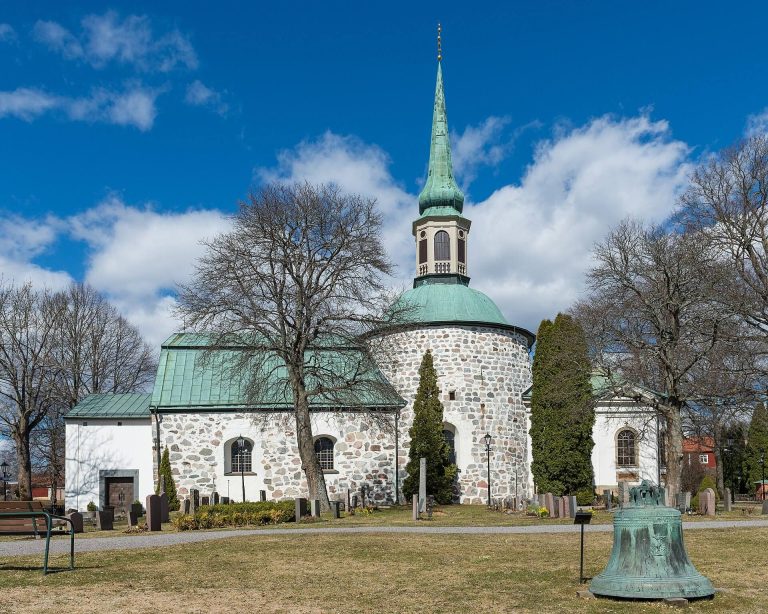
Spånga Church is a Church of Sweden church in Sweden, with its oldest parts dating to approximately 1175–1200. Formerly Roman Catholic and now part of the Church of Sweden, Sweden’s Lutheran national church, it belongs to the Diocese of Stockholm and Spånga-Kista Parish. The church is regarded as one of Stockholm’s oldest monuments.
Medieval development
The church began as a medieval place of worship, with substantial extensions and alterations carried out during the fourteenth and fifteenth centuries. A sacristy, the room used by clergy to prepare worship and store sacred objects, was built in the first half of the fourteenth century. The porch and present choir followed in the middle of the fifteenth century.
Further changes took place late in the fifteenth century, when the triumphal arch, the arch separating the nave from the chancel, was installed and a new choir was added. These successive building phases shaped the church that survives today.
The Bonde tomb
Baron Gustaf Bonde of nearby Hässelby Palace made substantial donations to the church. After his death in 1667, a chancel tomb designed by Nicodemus Tessin the Elder was added. Tessin was a prominent seventeenth-century Swedish architect whose work influenced the development of Baroque architecture in Sweden. Bonde and his descendants were buried in the tomb.
From rural church to urban landmark
Spånga Church served a rural community until Stockholm’s expansion reached the area during the 1960s. The church is now surrounded by the modern development of Tensta, placing the medieval building within a much later urban setting.
Architect Erik Lundberg directed a major restoration from 1953 to 1955. The work sought to recover medieval wall paintings and also introduced new benches, lighting, and an organ. It followed earlier changes to the interior, including the whitewashing of the paintings in 1789 and their rough repainting during a restoration around 1900.
Remains
Church building and painted interior
The surviving church is organized around a long nave, a bell tower, a sacristy, a porch, and a later choir. The nave and bell tower are the oldest parts, dating to approximately 1175–1200. The sacristy belongs to the first half of the fourteenth century, while the porch and present choir were built in the middle of the fifteenth century. The triumphal arch and a new choir were added late in the fifteenth century.
Medieval wall paintings
The earliest church paintings probably date from the fourteenth century, when the long nave was built. Their decoration consists chiefly of abstract forms, geometric patterns, and ornamental designs.
Paintings from the early fifteenth century show scenes and figures from the Old Testament, including the prophets Elijah and Elisha. Their landscapes, houses, clothing, and tools reflect the period in which they were made. The painter or painters are unknown.
A later group associated with the late-fifteenth-century choir has a different style. It includes subjects from both the Old and New Testaments, together with later saints.
Later coatings and restoration
The medieval paintings were covered with white paint during the 1789 restoration. The interior remained white until a restoration around 1900, when the walls were repainted roughly. The restoration of 1953–1955 attempted to reveal the earlier paintings beneath these later coatings.
Chancel tomb
The chancel contains the tomb designed by Nicodemus Tessin the Elder for Gustaf Bonde and his descendants. The tomb was added after Bonde’s death and contains their remains, preserving a seventeenth-century commemorative feature within the medieval church.
Runestones
U 61
One of the three Viking Age runestones outside the church is designated U 61. Made of granite, it carries a runic inscription on one side, enclosed within bands that contain an internal Christian-cross design. The other side bears a second cross.
The inscription belongs to runestone style RAK, an archaeological classification defined by straight-ended inscription bands without attached serpent or animal heads. For stylistic reasons, it has been attributed to the runemaster Gunnar, who is also associated with U 226 at Arkils tingstad, a place connected with a historical Scandinavian assembly or court. The inscription includes personal names with forms meaning “Thor’s Bear,” “Battle Bear,” “Half Dane,” “Wolf,” and “Bear.”
Other Viking Age stones
Two further Viking Age runestones stand outside Spånga Church, and several runestone fragments are located inside. Together with U 61, these stones provide surviving evidence of the site’s runic material and its earlier Scandinavian setting.