Igreja de São Salvador, matriz de Sines: A Historic Parish Church in Portugal


Site at a Glance
- Rating
- 4.5
- Popularity
- Very Low
- Country
- Portugal
- Primary era
- Early Modern
- Eras represented
- Medieval, Early Modern, Modern
- Civilizations
- Portuguese
- Site type
- Religious
- Remains
- Church
On this page13 sections
History
Early Christian and Medieval Origins
Igreja de São Salvador, matriz de Sines, is a Roman Catholic parish church in Portugal, dedicated to the Saviour. Its earliest Christian sanctuary may have been a sixth-century basilica. Another Christian temple may have occupied the site in the seventh century or during the Mozarabic period. Part of this early sanctuary was later incorporated into the walls of Sines Castle.
During the Middle Ages, the basilica was replaced by a Gothic church. In 1480, Vasco da Gama underwent a tonsure ceremony there, a religious rite involving the cutting of the hair, when he entered the Order of Santiago. The ceremony was performed by the Bishop of Safim. The Order of Santiago was a Catholic military order with religious, military, and territorial importance in medieval and early-modern Portugal.
Burials and Religious Traditions
A necropolis beside the church was used mainly from the thirteenth century until the beginning of the seventeenth century. Its graves contained evidence of punishment or torture practices, possible superstitious practices, and materials dating from the Roman period. The burial ground remained part of the historical landscape around the church and castle.
In 1591, excavations near the mouth of the Junqueira stream uncovered human remains and other objects inside a prehistoric dolmen, a megalithic burial monument. They were mistakenly identified as relics of Saint Torpes and were kept in the Igreja Matriz. When José Leite de Vasconcelos examined them in the early twentieth century, the remains and objects were held in the Misericórdia Chapel.
Eighteenth-Century Reconstruction
By the beginning of the eighteenth century, the medieval church was too small for its congregation. With the approval of the Order of Santiago, extensive remodeling began in the 1730s, and decorative work continued until the middle of the century. The intervention was probably coordinated by João Antunes, a Portuguese architect associated with late seventeenth- and early eighteenth-century Baroque and the royal administrative body known as the Mesa da Consciência e Ordens, or by one of his collaborators.
The reconstruction produced a church that combines Joanine Baroque, the Portuguese Baroque associated with the reign of King John V, with the restrained Portuguese tradition known as Chão. The church was damaged by the earthquake of 1755 and was subsequently restored. It is classified as a Monument of Public Interest under an ordinance issued on 30 May 2014.
Archaeology and the Surrounding Area
Archaeological monitoring in Largo Poeta Bocage in 2013, during the redevelopment of Avenida Vasco da Gama, identified the necropolis associated with the former Church of São Salvador. In 2011, the municipality had begun work on pedestrian areas around Sines Castle, including the former cemetery area between the church and the statue of Vasco da Gama.
Remains
The Eighteenth-Century Church
Exterior and Plan
The present building dates chiefly from the eighteenth-century reconstruction. Its facade reflects the plainness of the Chão tradition, while the church as a whole combines that restrained approach with Joanine Baroque. The plan has a single nave, several lateral chapels, and one attached bell tower. The baptismal chapel stands on the Gospel side, where remains of the medieval church were found.
Chapels and High Altar
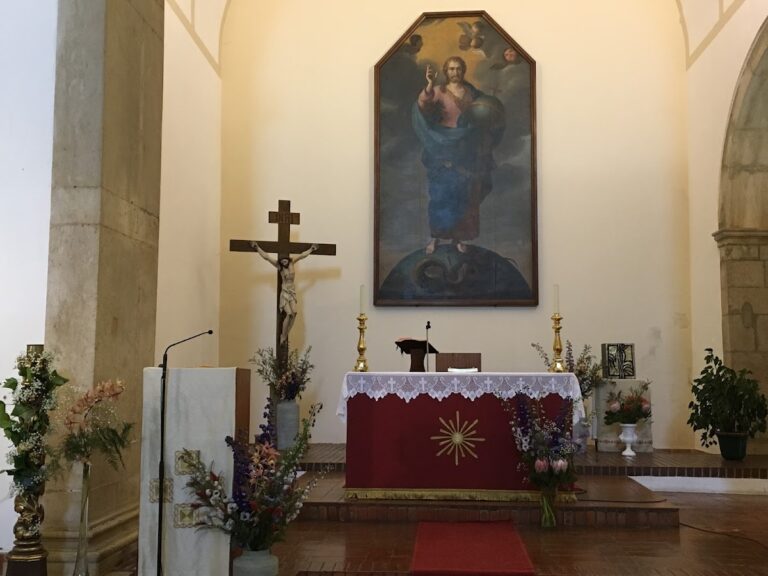
The lateral chapels have vaults with semicircular arches and contain altarpieces in gilded and polychrome carved wood. Their decoration combines Baroque and Neoclassical styles. At the high altar, a tabernacle holds the Blessed Sacrament, and the altarpiece dates from the nineteenth century.
Tiles, Ceiling, and Images
Eighteenth-century figurative azulejos, glazed ceramic tiles, cover the interior walls. Their subjects include the Four Evangelists, the Saviour of the World, and an allegory of the Eucharist. The ceiling includes a panel by Emmerico Nunes, a Portuguese modernist artist known for painting and illustration. The church also contains images of Saint John the Baptist, Our Lady of Grace, Saint Catherine, and the Lord Jesus of the Souls.
Archaeological Features
The Largo Poeta Bocage Necropolis
The necropolis at Largo Poeta Bocage consisted largely of graves cut into sandy soil. Grave 11 contained the remains of an individual of African origin and a rich group of coins. These finds suggest a possible connection with the slave trade linking Portugal and South America, while the individual may have been a wealthy free man at the time of death.
Other discoveries included human skeletal and monetary remains, fragments of common and glazed pottery, and the remains of molluscs, mammals, and fish. Roman materials included terra sigillata, ornaments, and amphorae, adding evidence of activity from the Roman period to the archaeological record around the church.
The Prehistoric Dolmen Finds
The human remains and objects recovered in 1591 from the prehistoric dolmen were brought into the Igreja Matriz after being identified as the relics of Saint Torpes. By the early twentieth century, they were held in the Misericórdia Chapel. Their changing location preserves the history of a religious interpretation that was later reconsidered by José Leite de Vasconcelos.