Santi Jacopo e Filippo: A Medieval Church in Certaldo, Italy


Site at a Glance
- Rating
- 4.6
- Popularity
- Very Low
- Country
- Italy
- Primary era
- Medieval
- External website
- Open
- Eras represented
- Medieval, Early Modern
- Civilizations
- Republic of Florence
- Site type
- Religious
- Remains
- Church
On this page19 sections
History
Santi Jacopo e Filippo is a Roman Catholic church in Certaldo, Italy, whose church and convent complex probably developed toward the end of the twelfth century alongside the fortified medieval center. Originally dedicated to Saints Filippo and Jacopo, it became a religious complex that remained active through successive communities and is associated with the fourteenth-century writer Giovanni Boccaccio and Blessed Giulia Della Rena, regarded as Certaldo’s patron saint.
Medieval Origins and Religious Communities
During the Middle Ages, the complex housed a community of canons, clerics belonging to a collegiate religious community. An Augustinian community, following a rule attributed to Saint Augustine, occupied it from 1422 until its suppression in 1783. The adjacent convent continued to serve different religious orders until the 1990s, extending the religious life of the complex well beyond the medieval period.
Changes to the Church and Convent
The arrangement of the church entrance changed in 1633. Before that alteration, the square in front of the facade functioned as a cemetery, and worshippers entered through the side doors facing present-day Via Boccaccio. The building was later altered again in the nineteenth century, when the original bell-tower roof was demolished to raise the bell chamber and a chapel dedicated to Blessed Giulia Della Rena was added.
During the 1960s, restoration promoted by the Florence Superintendency removed later additions, including the nineteenth-century chapel, and demolished the Baroque altars. Much of the furnishing was rearranged, while numerous artworks were moved to the adjacent convent. Since 2001, that complex has housed Certaldo’s Museum of Sacred Art, whose collection includes works formerly kept in the church.
Memorial and Devotional Associations
The church remains connected with the mortal remains of Giovanni Boccaccio and Blessed Giulia Della Rena. It also received the Petrognano Crucifix in recent years after the large wooden sculpture had been kept in the adjacent Museum of Sacred Art. Its date has been debated, with current dating placing it around 1240 to 1245.
Remains
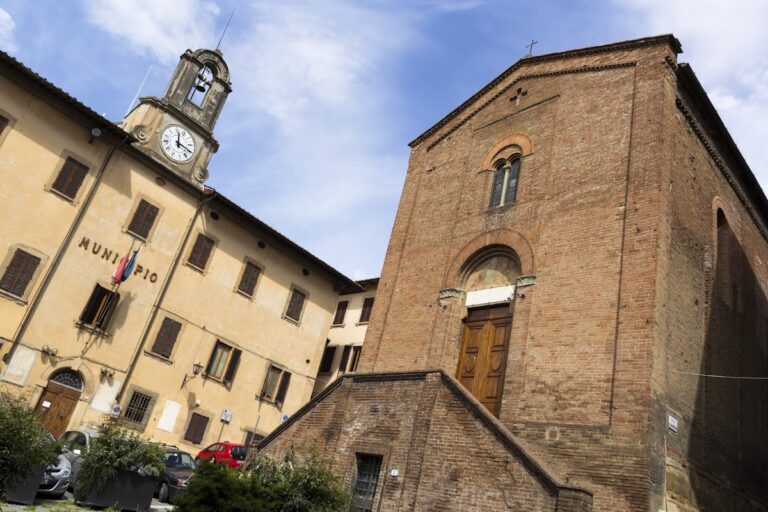
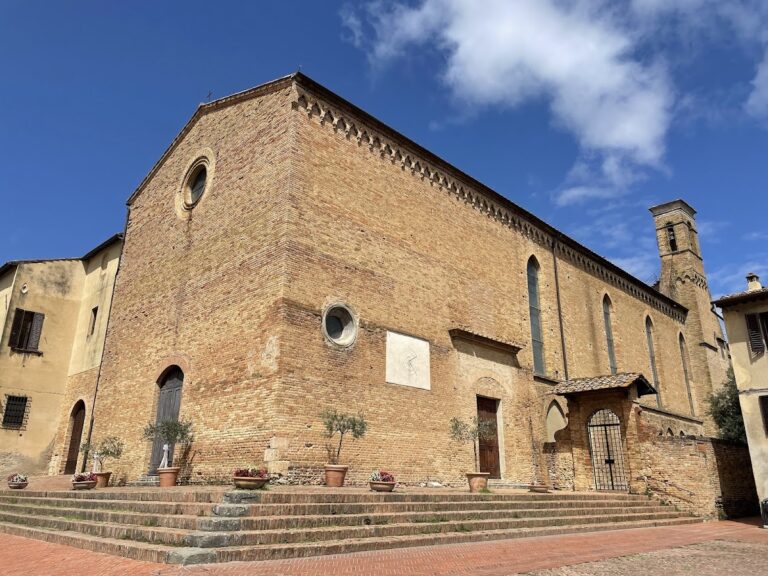
The church stands in Certaldo’s upper medieval area. Built of brick on a sandstone base, it has a broad single nave ending in a semicircular apse. Terracotta details enrich the exterior, including the arched frames around the single-lancet windows and the apse cornice, where the bricks form a saw-tooth pattern. Above the apse roof is a cross-shaped window flanked by two small stepped lozenges of Pisan derivation.
Exterior and Interior Structure
Bell Tower
The bell tower is aligned with the facade and is capped by a pyramidal roof. The present roof belongs to the 1960s restoration, which replaced the nineteenth-century arrangement created when the earlier roof was removed to increase the height of the bell chamber.
Nave and Apse
Inside, the brickwork is exposed and the appearance is comparatively bare as a result of the 1960s restoration. That campaign removed neo-medieval decoration, including an image of Christ in the apse basin that may have been made by the workshop of Galileo Chini in the early twentieth century. A series of very large wooden trusses supports the roof. On the left side, the former chapel of Blessed Giulia once extended into the adjoining cloister; after its demolition, the opening in the wall was blocked.
Memorials and Images of Blessed Giulia
Giulia Della Rena’s Urn and Predella
On the right side, an altar set in a niche holds an urn made in 1687 for the remains of Blessed Giulia Della Rena. A predella, the horizontal lower part of an altarpiece, stands on the altar. Made in the second half of the fifteenth century, it shows episodes from Giulia’s life, including a child saved from flames, flowers appearing miraculously in winter in her cell, her funeral, and the rescue of a knight. The two outer ends display the arms of the Tinolfi family, a noble Florentine family related to Giulia.
Painting Above the Altar
Above the urn and predella is a painting probably dating from 1581 and attributed to Tiberio Billò. It consists of the two wooden panels that enclosed Giulia’s body until the transfer of her remains to the urn in 1687. The painting was installed in its present position in 2016.
Boccaccio’s Tomb and Cenotaph
A large marble floor slab marks Boccaccio’s grave in the center of the nave. Sculpted by Mario Moschi, it reproduces, with minor variations, Andrea del Castagno’s fresco of Boccaccio from the Florentine painter’s series of illustrious men, now in the Uffizi. Boccaccio’s presumed remains lie beneath a small white tile between the slab and the high altar, rather than directly beneath the large marble marker.
The church also contains a cenotaph, a commemorative monument for someone whose physical remains are elsewhere, with a marble bust by Giovan Francesco Rustici. Vicar Lattanzio Tedaldi commissioned it in 1503. Above the bust is an epitaph composed by the humanist Coluccio Salutati.
Paintings, Terracotta, and Wooden Sculpture
Fourteenth-Century Fresco
A fresco in a niche on the left as one enters the church was discovered in 1861. Dating approximately to 1315 to 1320 and attributed to Memmo di Filippuccio, it depicts the Madonna and Child with Saints Jacopo and Pietro and a donor.
Glazed-Terracotta Ciboria
Two glazed-terracotta ciboria, decorated architectural containers associated with the Eucharist, stand on either side of the apse. Benedetto Buglioni made the older one on the left, which Vicar Ludovico Pucci donated in 1499 to 1500. The other came from the workshop of Andrea della Robbia and was donated by Vicar Ristoro d’Antonio Serristori in 1502 to 1503.
Madonna of the Snow Altarpiece
A large glazed-terracotta altarpiece, measuring about 200 by 111 centimeters and dating to around 1520, was produced by the workshop of Giovanni della Robbia. It represents the Madonna of the Snow with Saints Antonio and Bartolomeo. The work was made for San Martino a Maiano near Certaldo and later transferred to Santi Jacopo e Filippo for security reasons.
Petrognano Crucifix
The Petrognano, also called the San Donnino, Crucifix is a wooden sculpture measuring 2.20 by 2.05 meters. It was associated with the churches of San Pietro at Petrognano and San Giovanni Battista in Jerusalem at San Donnino, although the modest dimensions of those buildings have been considered unsuitable for accommodating it. The author is unknown. The sculpture has been related to the classicizing tradition associated with Nicola Pisano and, more recently, to the youthful work of Arnolfo di Cambio. It is a triumphans crucifix, showing Christ alive with open eyes and victorious over death.
Works Now in the Museum
Two large wooden statues formerly kept in the church represent Saint Nicholas of Tolentino and Saint John of San Facondo. Measuring 1.62 and 1.73 meters in height, they were made by an unidentified Sienese sculptor in the mid-seventeenth century and now belong to the permanent collection of the adjacent Museum of Sacred Art. The museum also houses goldsmiths’ works formerly associated with the church, including a silver chased reliquary bust of Blessed Giulia made by Paolo Laurentini in 1652 to 1653.
Convent Cloister
An adjoining cloister with small brick columns dates from the end of the fourteenth century. It forms part of the former convent complex, which now contains the Museum of Sacred Art and preserves works originating from the church.