Saint Nicholas Church in Skwierzyna: A Medieval Parish Church and Sanctuary


Site at a Glance
- Rating
- 4.2
- Popularity
- Very Low
- Country
- Poland
- Primary era
- Modern
- Eras represented
- Medieval, Modern
- Civilizations
- Kingdom of Poland, Kingdom of Prussia
- Site type
- Religious
- Remains
- Church
On this page12 sections
History
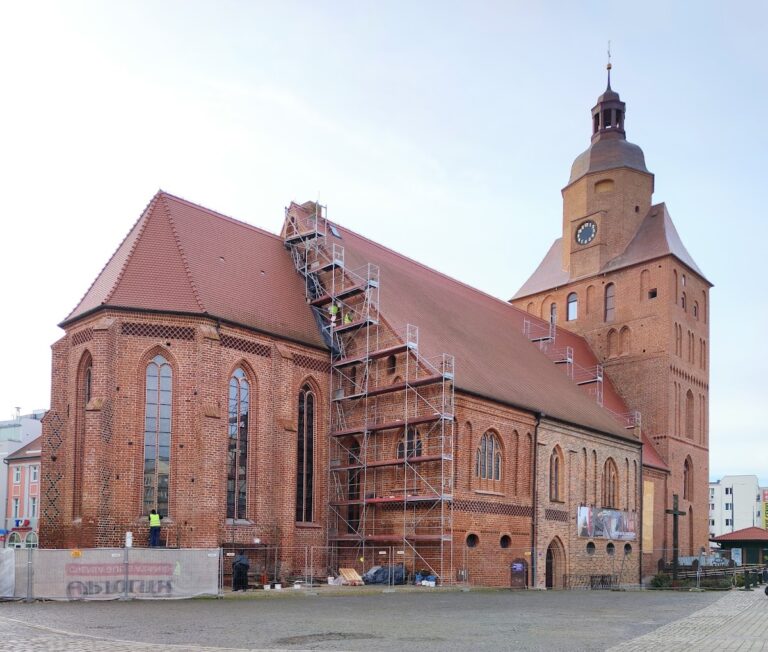
Saint Nicholas Church in Skwierzyna is a Roman Catholic parish church in Poland, with origins reaching back to the thirteenth century and a present late-Gothic form shaped by extensive rebuilding in 1861–1863. It is the only surviving building from Skwierzyna’s original medieval urban layout.
Medieval origins and rebuilding
The church is first mentioned in 1226, when the settlement was known as Skwirzyna. Parts of the chancel walls are thought to date from approximately this period, although the earliest church was probably built mainly of wood. During the fifteenth century, a new brick church replaced the earlier building. Its plan corresponded closely to the form that survives today.
Confessional change and fires
Saint Nicholas became the church’s patron in 1507. In 1540, the Międzyrzecz starost, a historical Polish administrative official, Stanisław Myszkowski, transferred the church to the Protestant community, reflecting the faith of most of Skwierzyna’s inhabitants. In 1605, Poznań bishop Wawrzyniec Goślicki appealed to the Międzyrzecz starost Jan Zamojski and demanded its return to Catholic possession.
Fires that struck Skwierzyna repeatedly damaged the church, including major town fires in 1624 and 1712. A comprehensive rebuilding between 1861 and 1863 gave the building its present form. The rebuilt church was consecrated on 17 May 1863 by the Poznań auxiliary bishop Franciszek Stefanowicz.
Post-war Catholic life
After Soviet forces entered Skwierzyna in 1945, the church avoided being burned because its interior was used as a warehouse for equipment requisitioned from local residents. After the Second World War, Skwierzyna became part of Poland. Felicjan Gomółczak, a Bernardine friar from the Observant branch of the Franciscan Order, became the first Polish parish priest. In November 1945, the Congregation of the Missionaries, a Catholic religious congregation whose members undertake priestly and pastoral work, took over the church and parish and continues to administer them.
Polish expatriates from Klewan in Volhynia, a historical region now divided chiefly between Ukraine and Poland, secretly brought the seventeenth-century painting of Our Lady of Klewan to the church after the war. Fear of the Communist authorities led to the image being hidden for several years. It was officially placed in the high altar in 1968 and formally enthroned on 23 May 1992.
Sanctuary and protected monument
On 22 May 2021, Bishop Tadeusz Lityński established Saint Nicholas Church as the Sanctuary of Our Lady of Klewan. A sanctuary is a sacred site formally associated with a devotional tradition or venerated religious image. The church belongs to the parish of Saint Nicholas, the Rokitno deanery, the Diocese of Zielona Góra–Gorzów, and the Szczecin–Kamień ecclesiastical province. It is one of eleven sanctuaries in that diocese. The building is entered in the historic-monument register under registration numbers L-335/A, dated 16 March 1961 and 22 October 1976.
Remains
Saint Nicholas Church is a brick, late-Gothic, three-aisled hall church. In this type of building, the nave and side aisles are approximately equal in height, creating a unified interior rather than a separately raised central nave. The main nave is divided lengthwise into four bays. Early chancel wall fragments survive from approximately the thirteenth century, while other wall sections belong to the fifteenth-century building. Although the church was extensively rebuilt in 1861–1863, its fifteenth-century plan largely matches the present layout.
Church building and furnishings
Interior furnishings
Most of the interior furnishings date from the nineteenth century and were installed mainly around 1864. They include a Neo-Gothic high altar, side altars, and a wooden Neo-Gothic pulpit. The oldest surviving furnishing is an eighteenth-century crucifix positioned in the entrance vestibule beneath the tower. The church also contains eighteenth- and nineteenth-century monstrances, vessels used to display the consecrated Eucharistic host, together with Neo-Gothic stone stoups, which hold holy water near a church entrance.
Our Lady of Klewan
The most valuable object in the church is the seventeenth-century painting of Our Lady of Klewan. Brought to Skwierzyna after the Second World War, the image is regarded as miraculous and is housed in the high altar. Its placement gives the interior its role as the setting of the Sanctuary of Our Lady of Klewan.
Tower and church surroundings
Bell tower
The church bell tower has a pointed top and contains a bell dated 1926. It forms part of the surviving church structure associated with the rebuilt nineteenth-century building.
Outdoor sculptures
Two nineteenth-century sculptures stand in the immediate surroundings of the church. One depicts Saint Nicholas, the patron of the church and parish. The other is a stylized angel, probably originating from the tomb of one of Skwierzyna’s formerly wealthy residents.