Eastbridge Hospital of St Thomas the Martyr: A Medieval Pilgrims’ Hospital in Canterbury


Site at a Glance
- Rating
- 4.4
- Popularity
- Very Low
- Country
- United Kingdom
- Primary era
- Medieval
- External website
- Open
- Eras represented
- Medieval
- Civilizations
- English
- Site type
- Religious
On this page14 sections
History
Eastbridge Hospital of St Thomas the Martyr is a medieval pilgrims’ hospital in Canterbury, United Kingdom, founded during the twelfth century to provide overnight accommodation for poor travellers visiting the shrine of St Thomas Becket. Becket, the archbishop of Canterbury murdered in 1170, was soon venerated as a martyr, making Canterbury Cathedral an important pilgrimage destination. The hospital may have been established as early as 1176, and its original buildings were constructed around 1180.
Foundation and early endowments
Edward FitzOdbold is the earliest recorded founder, associated with the hospital around 1180. Archbishop Hubert Walter provided further endowments around 1203. For many years, Eastbridge operated without special statutes or regulations governing the treatment of pilgrims. All Saints Cottage in Canterbury may have served as a subsidiary hostel.
The institution was created to support poor pilgrims rather than to provide a permanent religious community. Its early charitable purpose was therefore closely tied to the growth of Becket’s cult and the movement of travellers to Canterbury Cathedral.
Fourteenth-century reform
During the reign of Edward III, Archbishop John de Stratford reorganised the hospital and established ordinances for its operation. Healthy pilgrims were required to pay four pence for one night’s lodging, while weak and infirm applicants were to receive preference. Women over forty were assigned responsibility for bedding and for administering medicines to the sick.
Stratford also appointed a Master in priest’s orders, assisted by a secular chaplain. Archbishop Simon Sudbury later sanctioned funding for a chantry chapel in 1375. A chantry chapel was intended for prayers and religious services for the souls of the dead, supported by an endowment. Stratford and Sudbury also granted further lands and parish revenues to the hospital.
Reformation and changing charitable use
The chantry was abolished in 1547 during the Reformation and subsequently fell into disrepair. Eastbridge itself survived the dissolution of the monasteries and other religious houses under Henry VIII and Edward VI, although pilgrimage to St Thomas of Canterbury ended during this period.
In 1569, Archbishop Matthew Parker issued new ordinances requiring the hospital to maintain twelve beds for the “wayfaring poor”. They also established a school for twenty boys in the chapel. Archbishop John Whitgift confirmed the arrangement through an Act of Parliament in 1584, and the school continued until 1880.
Restoration and present charitable role
The chapel was little used until the Master restored it in 1927. Further work continued during the twentieth century, supported in part by the sale of some hospital lands at Blean when the University of Kent was founded in the 1960s. In 1969, the former chantry chapel was reclaimed and restored for its original use.
Between 2014 and 2019, extensive restoration preserved rooms built directly over the River Stour. The restored area was formally opened on 23 March 2019 by the Bishop of Dover and named after Archbishop William Juxon, who had donated money in 1660 to repair the Brothers’ Lodgings.
Eastbridge remains an almshouse, a charitable institution providing housing for people in need, and accommodates elderly citizens of Canterbury. Its residents are known as Indwellers, while trustees maintain the historic buildings and oversee the welfare of those who live there. The building closed to visitors in 2025 because significant structural repairs were required. In January 2026, it was announced that Eastbridge would be placed on Historic England’s Heritage at Risk Register. The hospital is a Grade I listed building, the highest category of statutory protection for historic buildings in England.
Remains
Eastbridge stands on King’s Bridge beside the Franciscan Gardens at Greyfriars, near Canterbury’s Westgate. The complex includes rooms constructed over the River Stour. Its original arrangement, built around 1180, comprised an entrance hall or vestibule, an undercroft, a refectory, and a chapel. These spaces preserve the changing functions of the hospital from accommodation and communal dining to worship, education, and charitable housing.
Chapel and entrance hall
Pilgrims’ Chapel
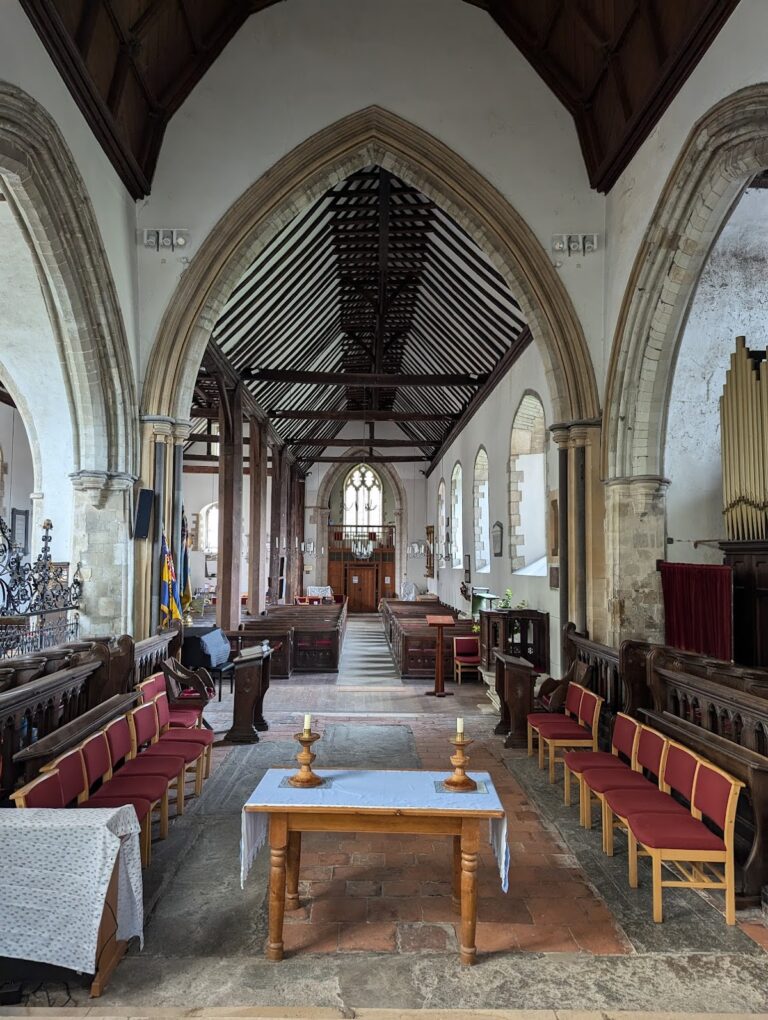
The Pilgrims’ Chapel dates from the twelfth century, although it acquired its present proportions in the fourteenth century. Its roof is a notable example of medieval woodwork and joinery. The form of the timber suggests a date around 1285. Most of the beams are authentic, while those in the first two panels were replaced after the original sections collapsed.
Ancient Entrance Hall
The ancient Entrance Hall lies beneath the chapel and also dates from the twelfth century. Together with the chapel above it, the hall forms part of the earliest surviving core of the hospital. Its position beneath the later-proportioned chapel illustrates how the complex developed vertically as well as institutionally.
Undercroft and refectory
Undercroft
The undercroft, an enclosed lower room beneath a larger building, originally served as a dormitory. Its arches preserve a transition from round-headed forms to the pointed arches associated with Gothic construction. The space therefore records an architectural change within the medieval development of the hospital.
Refectory
The refectory is a large open room that originally functioned as the hospital’s dining hall. Its north wall contains a thirteenth-century painting of Christ in Majesty, also called “Our Lord in Glory”, placed between the symbols of the four Evangelists.
The painting was uncovered in 1879 after a chimney and fireplace installed around the time of the dissolution were removed. It has been conserved since its discovery. A pillar in the refectory carries inscriptions made by the final group of pupils from the hospital school, which closed in 1880.
Later lodgings
Brothers’ Lodgings
The Brothers’ Lodgings form a named part of the hospital complex. Archbishop William Juxon supplied funds for their repair in 1660, and rooms over the River Stour were later included in the extensive restoration carried out between 2014 and 2019. The surviving lodgings connect the post-medieval history of the institution with its continuing charitable use.