St. Mary of the Mountain Boitzenburg: Evangelical Parish Church in Germany


Site at a Glance
- Rating
- 4.1
- Popularity
- Very Low
- Country
- Germany
- Primary era
- Medieval
- External website
- Open
- Eras represented
- Medieval, Early Modern, Modern
- Civilizations
- German, Holy Roman Empire, Kingdom of Prussia, Margraviate of Brandenburg
- Site type
- Religious
- Remains
- Church
On this page15 sections
History
St. Mary of the Mountain Boitzenburg is an Evangelical parish church in Germany, built in the second half of the thirteenth century. It is first recorded on 25 July 1271, when the Margraves of Brandenburg mentioned it in a donation charter to the Cistercian monastery of Boitzenburg. The Cistercians were a Western Christian monastic order known for disciplined communal worship, manual labour, and comparatively austere religious practice.
Medieval parish church
The 1271 charter places the church within the religious and institutional setting of medieval Boitzenburg. It later became the burial place of the von Arnim-Boitzenburg family, a role it retained until the end of the nineteenth century. A new hereditary burial ground was then created for the family in Boitzenburg Castle Park.
Expansion and later use
The western tower was built in 1650 and raised to four storeys during the eighteenth century. The nave received its present round-arched windows during the same period, and the brick polygonal chancel was supplemented. In the nineteenth century, transept-like additions were constructed on the north and south sides in a Romanesque-revival design, drawing on forms associated with Romanesque architecture, including heavy masonry and rounded arches.
The church remains part of the Uckermark church district of the Evangelical Church of Berlin-Brandenburg-Silesian Upper Lusatia. The Boitzenburg united parish, which includes seven other congregations, has the same institutional affiliation.
Renovation and protection
Comprehensive renovation took place between 2000 and 2008. Earlier work had blocked the crypt’s ventilation shafts with brickwork, leading to moisture damage, mould, and infestation by dry rot fungus. A further renovation of the crypt was estimated to cost a six-figure sum that the congregation could not raise. The church, together with its 1849 organ, is listed in the Land of Brandenburg’s monument register as a protected architectural monument.
A war memorial near the church commemorates Boitzenburg residents who died in the First World War. Its inscription refers to their deaths for “King and Fatherland” in 1914–1918 and quotes John 15:13, while the names of the fallen appear below.
Remains
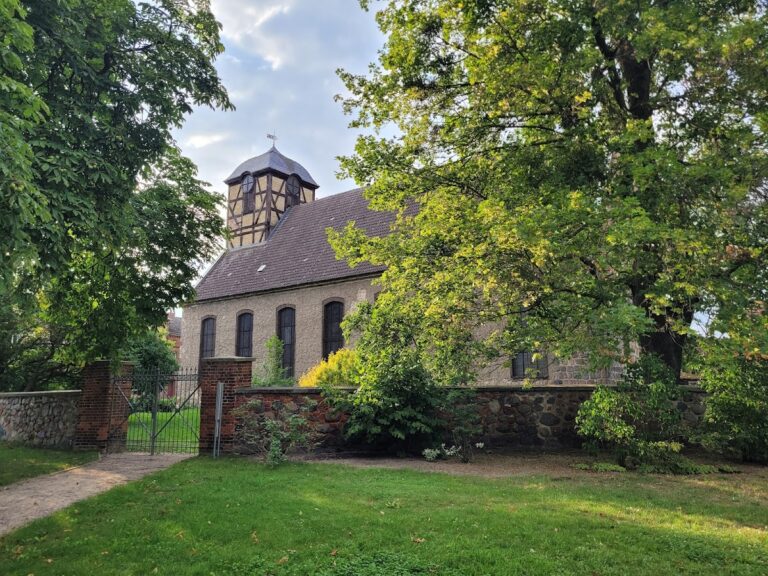
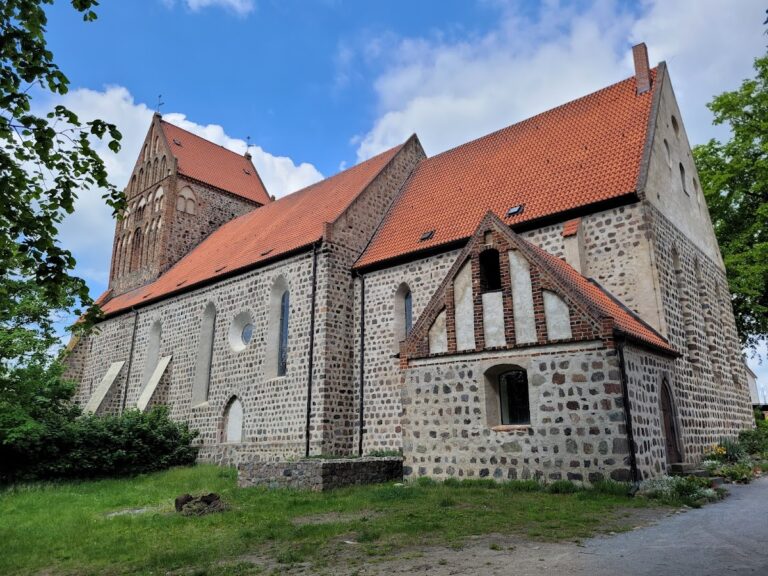
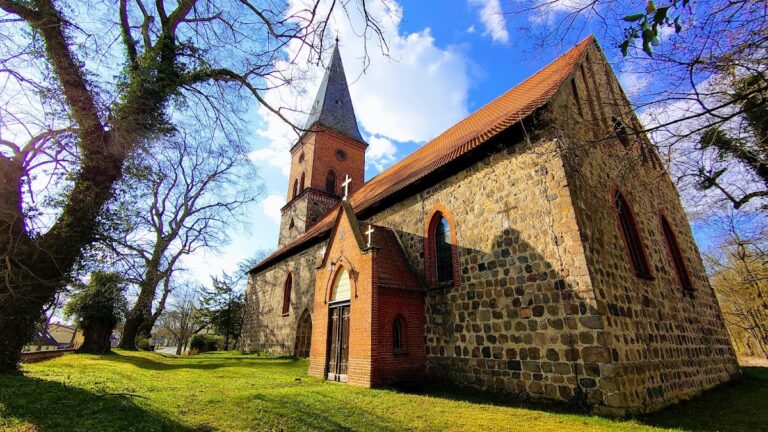
The church stands on an elevated site near Boitzenburg’s highest point. Its surviving structure combines an elongated rectangular hall built of fieldstone, a western tower, a brick chancel with a three-sided polygonal end, and later additions on the north and south. The additions are plastered and create the church’s distinctive cross-shaped external arrangement.
External structure
Western tower
The western tower is approximately as wide as the nave and rises to about 47 metres. Its two upper storeys are articulated by pilasters, which are flat, column-like projections attached to the walls. The tower’s present height reflects the eighteenth-century addition of further storey space above its 1650 core.
Chancel and side additions
The brick chancel ends in three sides of a polygon. During the eighteenth century, its corners were emphasized with projecting elements resembling pilasters. The north and south additions are divided by lesenes, shallow vertical strips of masonry used to organize a wall’s surface. Each end wall has three pointed gables, and the central addition contains a rose window.
Interior furnishings
Altarpiece and pulpit
The wooden altarpiece dates from 1718 and was probably made by the altar builder Bekmann. Four Corinthian columns on each side support an openwork entablature, the horizontal architectural element carried by columns. Above it is a crowned Eye of God on a flat segmental form. The Eye of God represents divine watchfulness or providence, while angels flank it and the side pedestals carry figures of Moses, the four Evangelists, and John the Baptist. The Evangelists are Matthew, Mark, Luke, and John, traditionally associated with the four canonical Gospels.
The curved altar table rests on eagle claws and contains four carved reliefs. The wooden pulpit belongs to approximately the same period as the altar. Its low-relief decoration includes carved foliage garlands, while allegorical figures of Hope and Charity support the pulpit basket.
Baptismal font and funerary monuments
A cast-iron baptismal font from 1841 has an octagonal base decorated with scenes of the Circumcision of the Lord, the Baptism of Jesus, and the Lord’s Supper.
The church contains a marble funerary monument to the Prussian minister Georg Dietloff von Arnim-Boitzenburg, who died in 1753. A tall niche with a heraldic crown frames a life-size sculpture of von Arnim. Beside it stands a sarcophagus with an inscription panel, a mourning putto, and a figure of Sapientia. A putto is a childlike winged figure used in European religious and funerary decoration, while Sapientia personifies divine or sacred wisdom in Christian art.
Churchyard memorials
The churchyard contains further elaborate seventeenth- and eighteenth-century tomb monuments belonging to the von Arnim family. Nearby stands a black-painted wooden epitaph made in 1724 for the pastor’s wife Sybille Schüsseler. It is decorated with gilded carved ornament.
Organ and war memorial
Buchholz organ
The organ was built in Berlin by Carl August Buchholz in 1849, replacing an instrument made by Ernst Julius Marx in 1770. The earlier organ had been sold in 1848 to the Protestant congregation of Falkenwalde, now part of Uckerfelde. The Buchholz instrument has two manuals, a mechanical slider chest, fourteen stops, and a pedal division. A mechanical slider chest is a wind-chest system in which sliding mechanisms direct air to selected ranks of pipes, while each stop controls a set of pipes with a particular tonal character.
The organ was first restored around 1900. During that work, the Flauto traverso stop was removed and replaced by an Aeoline. These names refer respectively to a transverse-flute tone and a reed-like stop. During the Second World War, Karl Gerbig replaced the visible prospect pipes with zinc pipes. Christian Scheffler carried out the latest stated restoration in 1999.
First World War memorial
The nearby First World War memorial is formed by two walls. An oak stands at the centre of the memorial site, accompanied by a separate stele topped by a sphere.