San Michele Arcangelo: A Historic Roman Catholic Church in Empoli


Site at a Glance
- Rating
- 4.3
- Popularity
- Very Low
- Country
- Italy
- Primary era
- Early Modern
- Eras represented
- Medieval, Early Modern, Modern
- Civilizations
- Grand Duchy of Tuscany, Republic of Florence
- Site type
- Religious
- Remains
- Church
On this page17 sections
History
San Michele Arcangelo is a Roman Catholic church of the Roman rite in Empoli, Italy, standing within the former castle of Pontorme. Its earliest recorded mention dates to 27 May 1192, when it was identified as Ecclesia Sancti Angeli de Castello Ponturmi and confirmed as a suffragan church, meaning a dependent church, of the parish church of Empoli. The earliest building was Romanesque, a medieval architectural tradition known for solid masonry and simple, massive forms.
Medieval foundations and patronage
In 1260, the church community contributed two moggia and six staia of grain to support the Florentine army. The church also received several gifts through wills, including the largest bequest from Countess Beatrice of Capraia. Its financial position later weakened, as shown by the tithes paid between 1276 and 1303.
From 1217, San Michele was an episcopal fief, a jurisdiction held under the authority of a bishop. The right of patronage passed to the Company of Orsammichele in 1346 and to the local community in 1363. During the fourteenth century, the church also owned a hospital dedicated to Saint Mary within the castle of Pontorme.
Expansion and early modern administration
Between the fifteenth and sixteenth centuries, the church was enlarged with six chapels. Pope Eugene IV granted a baptismal font in 1435, and it was installed in a chapel decorated with frescoes. The parish maintained an Opera, an institution responsible for preserving, decorating, and enlarging the building.
In 1572, patronage passed to the Knights of Saint Stephen, a Catholic military order founded by the Medici in Tuscany during the sixteenth century. In 1616, the order had the adjacent Oratory of the Company of Saint Michael built to a design by Gherardo Mechini. A compagnia was a religious confraternity whose members supported worship and communal or charitable activities.
Before the pastoral visitation of 1673, the church had undergone another enlargement. It then had three aisles, nine brick altars, and a bell tower with three bells. A tenth altar was added in 1736. In 1786, a fourth bell was acquired from the demolished tower of the castle of Pontorme. This bell was an ancient work dating from the thirteenth century.
Nineteenth-century alterations
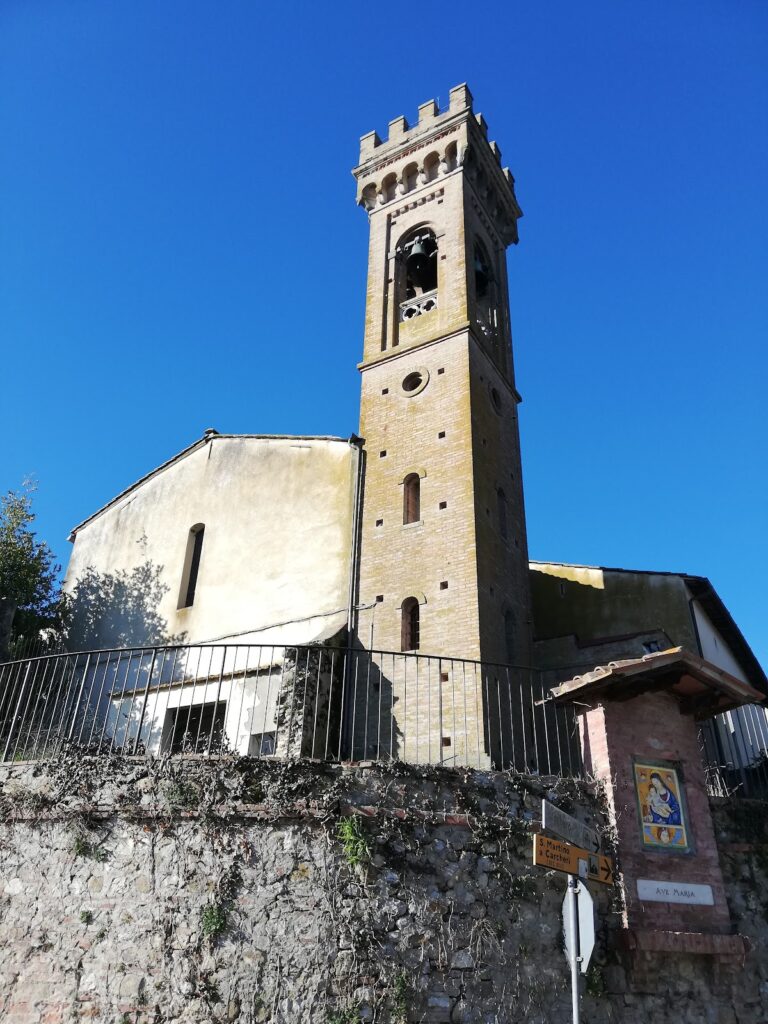
The church was raised in 1803, an alteration that led to the destruction of four altars. A new bell tower was built between 1815 and 1819. These changes form part of the building’s later transformation from its medieval foundation and successive early modern enlargements.
Remains
San Michele Arcangelo is arranged as a three-aisled hall with a transept and three distinct terminal chapel-like volumes, known as scarselle. Its surviving fabric combines the brick facade of the early Romanesque church with later chapels, altars, and painted furnishings added during successive expansions.
Medieval fabric and spatial form
Romanesque facade
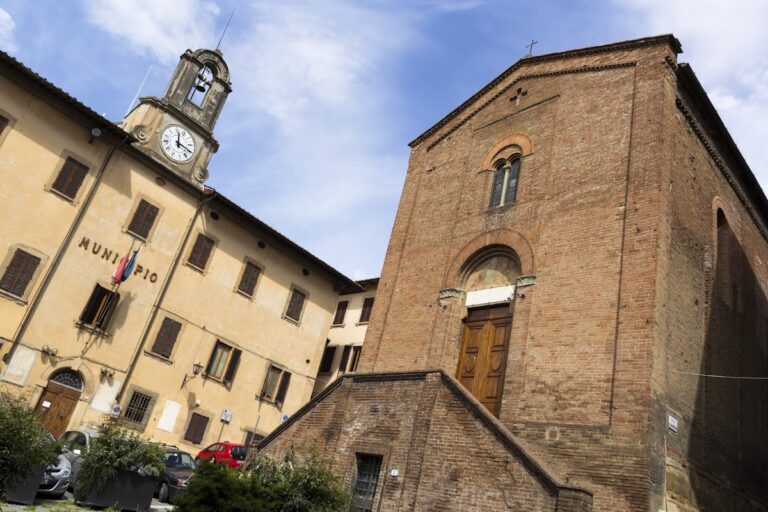
A drawing made by Francesco Baglioni in 1582 shows the first church as a simple apsidal hall covered by a roof. The surviving brick facade has a gabled form and several masonry coats of arms. It originally contained a bifora, or twin-arched window, which was later blocked. The window’s elaborate decoration dates from the late twelfth century.
Three-aisled interior
The present church has three aisles, a transept, and three terminal chapel-like volumes. The building’s internal arrangement reflects the enlargements that introduced chapels between the fifteenth and sixteenth centuries and the later alterations carried out in the eighteenth and nineteenth centuries.
Chapels and devotional works
Crucifix altar
The last chapel on the right contains the Crucifix altar, made of pietra serena and dated to 1736. A fourteenth-century wooden Crucifix occupies the altar and is regarded as miraculous. It once formed part of a larger wooden altar that also included celebrated panels of Saint John the Evangelist and Saint Michael the Archangel, commissioned by members of the Company of Saint Michael and painted by Pontormo around 1519.
Baptismal chapel
The chapel to the right of the high altar contains a large fresco of the Baptism of Christ attributed to Lorenzo Bonini. At its center stands the fifteenth-century marble baptismal font granted by Pope Eugene IV in 1435.
High altar and painted furnishings
Altarpiece of the Blessed Sacrament
The high altar contains the imposing Altarpiece of the Blessed Sacrament, a gilded wooden structure with a ciborium and painted panels. A ciborium is a canopy-like structure over an altar. The wooden framework and ciborium were probably made around 1565–1568 and were still unfinished when Bishop Antonio Altoviti described them during a pastoral visitation.
The ensemble follows the type of late-fifteenth-century altarpiece represented by Botticini’s Empoli altarpiece rather than the later monumental and theatrical ciborium made by Vasari for Santa Croce in Florence. Girolamo Macchietti painted the panels, although his responsibility for the complete ensemble remains uncertain. The side panels, showing Saints Michael and John the Baptist, date from around 1575–1576, and the figure of Saint Michael echoes Pontormo’s treatment of the same saint.
The predella, the lower section of an altarpiece, contains eight scenes from the lives of Saints Michael and John the Baptist, with the Last Supper at the center. These narrative scenes are attributed to Niccolò Betti.
Altar of the Company of the Conception
To the left of the high altar, the altar of the Company of the Conception contains the Immaculate Conception by Lodovico Cardi, known as Cigoli. The confraternity commissioned the painting in 1589, and it was installed in 1590. Its composition derives from Giorgio Vasari’s 1540 prototype for Bindo Altoviti, while its treatment of figures, color, light, and shadow reflects Cigoli’s early movement away from Mannerism.
Canvas in the left aisle
The left aisle contains Cesare Dandini’s Madonna and Child with Saints Dominic, Agatha, and Francis, painted around 1640. Its polished execution and rich coloring are characteristic of Dandini’s style.
Oratory of the Company of Saint Michael
Saint Michael and the Bishop of Siponto
The adjacent Oratory of the Company of Saint Michael was built in 1616 to Gherardo Mechini’s design. Its altar contains Ottavio Vannini’s canvas of the Apparition of Saint Michael to the Bishop of Siponto in procession toward the bull’s cave. The work was commissioned in 1628 and remained unfinished when Vannini died in 1644.