Church of the Assumption in Wrocław Ołtaszyn: A Gothic Roman Catholic Parish Church


Site at a Glance
- Rating
- 4.5
- Popularity
- Low
- Country
- Poland
- Primary era
- Medieval
- External website
- Open
- Eras represented
- Medieval, Early Modern, Modern
- Civilizations
- Holy Roman Empire
- Site type
- Religious
- Remains
- Church
On this page11 sections
History
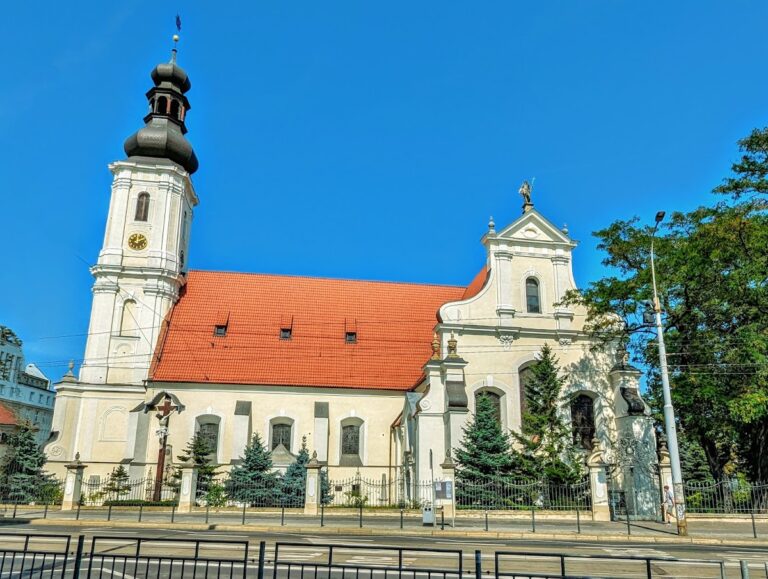
The Church of the Assumption in Wrocław Ołtaszyn is a Roman Catholic parish church in Wrocław, Poland, whose Gothic form was erected in the early fifteenth century and consecrated on 17 May 1450. It belongs to the Archdiocese of Wrocław and reflects Ołtaszyn’s historical affiliation with the Wrocław cathedral chapter.
Medieval foundation and rebuilding
The church was first mentioned in 1254. Local tradition holds that a wooden church had stood on the site since 1248 and had been founded by Saint Hedwig, the medieval duchess and Christian saint associated with Silesia. The earlier building was probably burned or destroyed during the Hussite incursion of 1428. The Hussites, followers of the religious reformer Jan Hus, conducted military campaigns across parts of Central Europe during the fifteenth century.
A new Gothic church was built in the early fifteenth century. By the end of that century, it had acquired a sacristy and a northern entrance crowned by a late-Gothic ogee arch, sometimes called a “donkey-back” arch. The entrance is now blocked. At this time, the church was dedicated to Almighty God, the Assumption of the Blessed Virgin Mary, and Saint Thomas Becket, the twelfth-century archbishop of Canterbury who was murdered in Canterbury Cathedral and venerated as a martyr.
War, repair, and nineteenth-century remodelling
In 1632, during the Thirty Years’ War, a European conflict fought from 1618 to 1648 amid religious and dynastic struggles, the church was abandoned. Its parish priest, Mateusz Bleich, took refuge in Wrocław and removed valuable furnishings, including a silver Mass chalice dated 1518.
Building work at the church and nearby properties resumed toward the end of the seventeenth century. The tower was renovated in 1753, and its upper section was rebuilt in 1768. During the tenure of parish priest Ernest Hirschberg from 1766 to 1785, the rectory was repaired, while the roofs of the barn and stable were repaired after damage from the Thirty Years’ War. The cemetery wall had been destroyed in 1775.
On the night of 11–12 February 1848, the church was robbed of all its valuable objects. It was partly restored and remodelled in the Neo-Gothic style in 1855–1856 under the direction of G. Bergmann and parish priest Augustyn Kintzel. From 1867 to 1871, its Baroque interior decoration was replaced with Neo-Gothic furnishings, and the church was plastered in 1887.
Johannes Soffner served as parish priest of Ołtaszyn from 1865 to 1905. A church historian, he published a history of the parish and its associated settlement of Bettlern in 1875.
Destruction and later care
In 1945, during the German army’s withdrawal from Wrocław, the church was used as a defensive position. An anti-aircraft gun and machine guns were placed on the tower. Soviet forces shelled the position for several days, destroying half of the church, while the rectory burned completely.
In 1991, during the tenure of parish priest Stanisław Dudek, an electronic clock with chimes replaced the old tower clock. Repairs in 2005 included the reconstruction of two tower pinnacles. Parish archives, the Ossolineum Library, and the University Library in Piaski preserve the names of 38 parish priests who served from 1350 to the present. The church observes the liturgical feast of the Assumption of the Blessed Virgin Mary on 15 August.
Remains
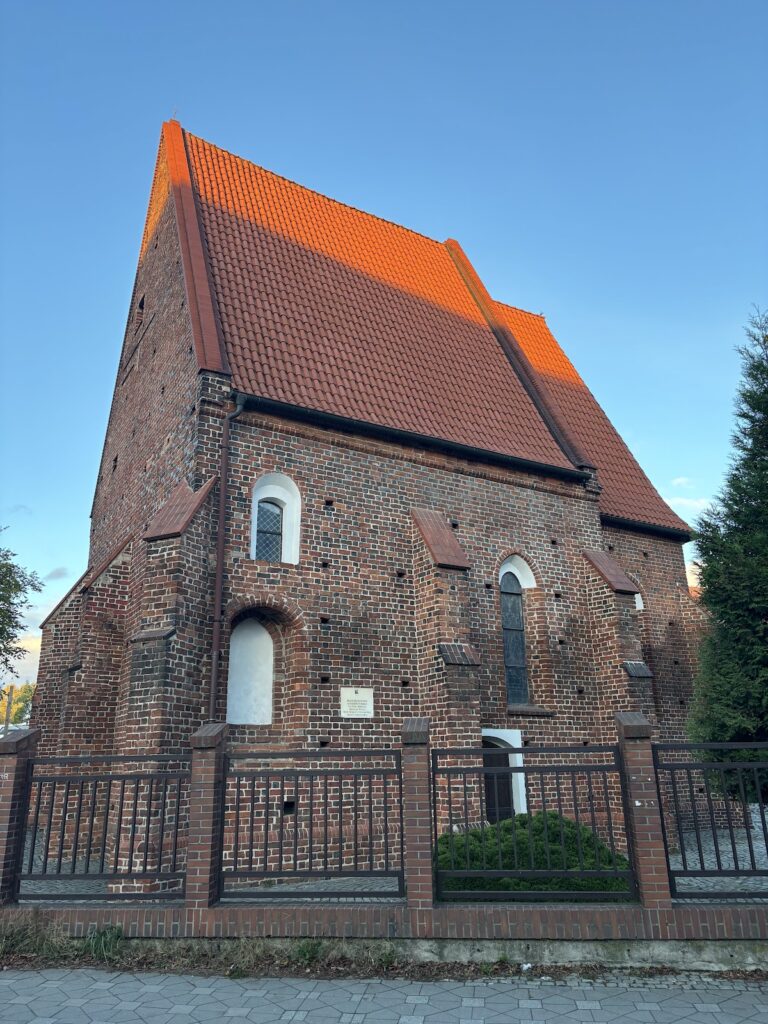
The surviving church is a three-nave brick hall church, meaning that its nave and side aisles are approximately equal in height rather than having a raised central nave. Its plan comprises a three-bay chancel with a polygonal end, a sacristy attached on the north, a three-bay nave block, and a tower at the west end. Ribbed cross vaults cover the interior. The relatively elaborate design is unusual for a rural church and is explained by Ołtaszyn’s affiliation with the Wrocław cathedral chapter.
Church building and churchyard
The late-Gothic northern entrance is topped by an ogee arch and is now blocked. The sacristy stands against the northern side of the chancel. At the west end, the tower retains the results of later rebuilding, including its reconstructed pinnacles. The churchyard is enclosed by a medieval wall and contains an eighteenth-century statue of Saint John of Nepomuk.
Altars and devotional art
Main altar
The main altar has a Gothic figure of the Virgin and Child at its centre. Saints Barbara and Catherine stand at the sides, while six figures of apostles, formerly placed on the wings of a Gothic altarpiece, are also incorporated into the ensemble.
Northern side altar
The northern side altar presents the Crucifixion, with figures of Saints Apollonia and Agnes. A relief of the Last Supper is positioned below these figures.
Southern side altar
The southern side altar centres on a relief of the Dormition of the Blessed Virgin Mary, with a Pietà, a representation of the Virgin mourning over the dead Christ, below it. Figures of Saints Elizabeth and Hedwig accompany the altar, together with two of the eight surviving apostle figures.
Paintings and liturgical furnishings
Four older paintings remain in the church: the Virgin and Child, Saint Hedwig, Prayer in the Garden of Gethsemane, and Saint Thomas Becket. Johann Jacob Eybelwieser, a Baroque painter from Wrocław, painted the last two in 1715. A sandstone sacrament house, a built-in cabinet for reserving the consecrated Eucharist, is set into the northern chancel wall and protected by a hand-forged fifteenth-century grille. The organ has 12 stops and two manuals.