St. Matthew’s Chapel: A Medieval Roman Catholic Chapel in Qrendi, Malta


Site at a Glance
- Rating
- 4.7
- Popularity
- Very Low
- Country
- Malta
- Primary era
- Medieval
- Eras represented
- Medieval, Early Modern, Modern
- Civilizations
- British, Kingdom of Sicily, Knights Hospitaller
- Site type
- Religious
- Remains
- Chapel
On this page7 sections
History
St. Matthew’s Chapel is a medieval Roman Catholic chapel in Qrendi, Malta, dedicated to Matthew the Apostle. Its origins are traditionally placed in the eleventh century, although a thirteenth-century date has also been proposed, and the chapel is known to have existed by at least the fourteenth century. Matthew was one of the Twelve Apostles of Jesus and is traditionally regarded as the author of the Gospel of Matthew. The chapel stands beside the il-Maqluba sinkhole, a natural feature closely associated with its history and local traditions.
Origins and the il-Maqluba tradition
A local legend places a dramatic event beside the chapel in 1343. It tells that a sinful village was swallowed by the earth, while the chapel and an elderly devout woman inside it survived. The adjacent sinkhole most probably formed during a violent storm in November 1343, possibly accompanied by an earthquake, rather than through the legendary destruction. The tradition nevertheless became an enduring part of the chapel’s cultural history.
Ecclesiastical administration
The chapel was not included in Bishop De Mello’s 1436 report, which dealt with parish churches, prebends, canonries, and benefices and did not necessarily cover small chapels. Bishop Pietro Dusina recorded it during his apostolic visitation of 1575. An apostolic visitation was a formal ecclesiastical inspection by an authorized church representative. Dusina stated that the chapel possessed the necessities for celebrating the divine office.
Until 1618, St. Matthew’s Chapel belonged to Żurrieq parish. After Qrendi became a separate parish, its administration passed to the new parish. Between 1674 and 1682, the larger Church of St. Matthew was built beside the medieval chapel. The smaller building was connected to the church and its sacristy by stairs and a doorway and came to be treated as the larger church’s crypt. Its lower level, reduced size, and possible burials may have encouraged this interpretation, although it may be mistaken. Dusina had described the building as a rural church and had not identified it as a crypt.
Damage and later use
An air raid in 1942 severely damaged the larger church and also harmed the chapel’s small belfry. The belfry was later dismantled and never rebuilt. The chapel and the adjoining Church of St. Matthew were added to the National Inventory of the Cultural Property of the Maltese Islands on 23 September 2013, under inventory number 1788.
Religious activity now takes place in the larger church rather than in the chapel. The annual feast of St. Matthew, celebrated on 21 September, is also held there. Formerly more elaborate, the September celebration continues on a smaller scale and is organized by one of Qrendi’s two musical societies.
Remains
Exterior and setting
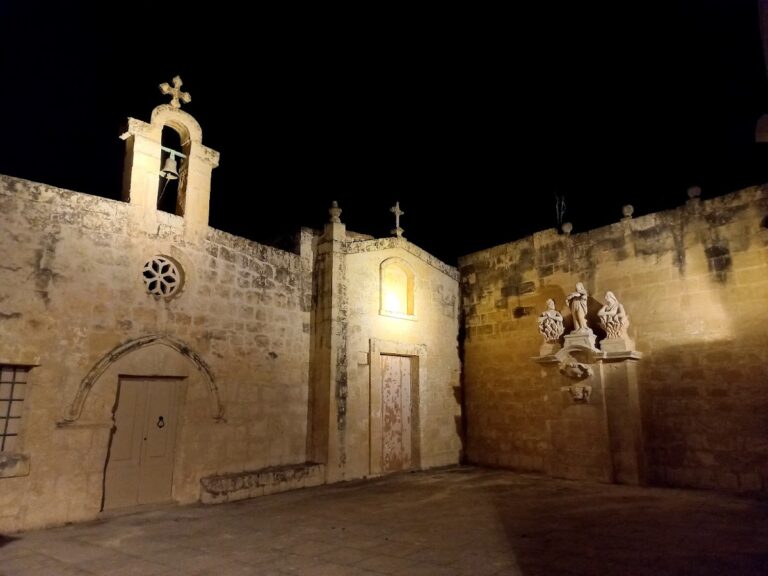
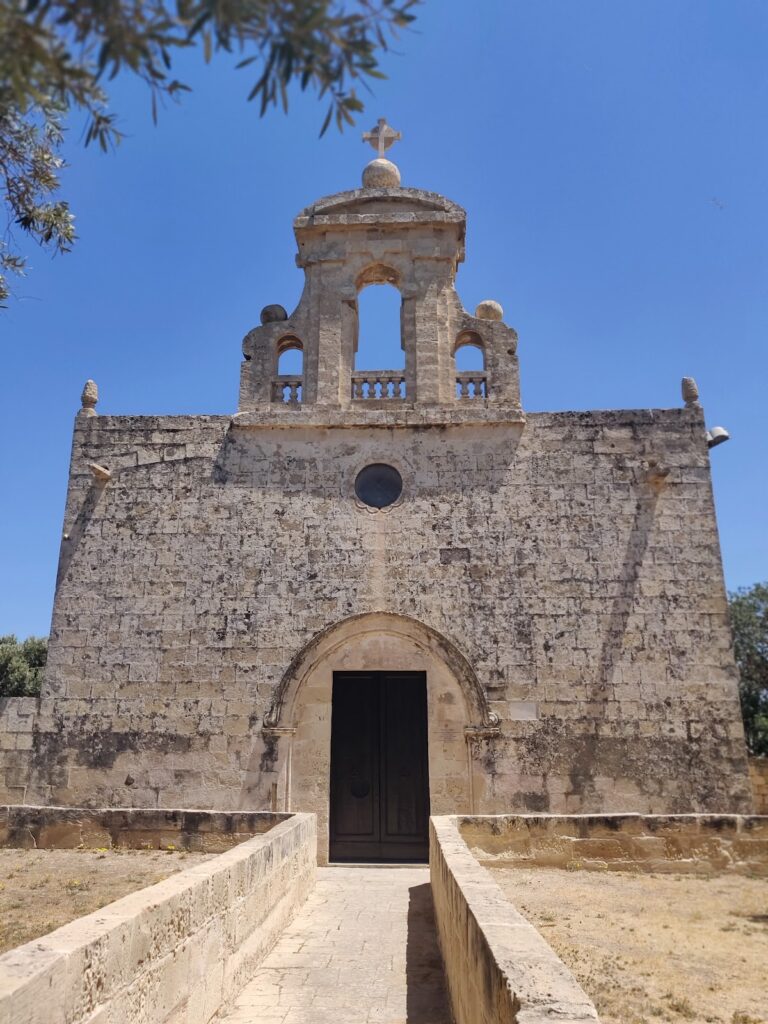
St. Matthew’s Chapel is a small, single-nave medieval building beside the larger Church of St. Matthew, at the edge of the il-Maqluba sinkhole. Built from limestone, it has a rectangular plan and a plain, undecorated facade with a wooden door. A small bell-cot, an open structure for suspending a bell, formerly stood above the facade. The eastern wall is positioned at the edge of the sinkhole and is supported by a buttress containing a window. Stairs and a doorway connect the chapel with the larger church and its sacristy. The stairs occupy part of the former chapel space, substantially reducing its area, while the chapel itself remains at a lower level than the church.
Interior and furnishings
The interior is rectangular and supported by pointed arches characteristic of medieval Maltese churches. At the eastern end, the altar stands in a small apse decorated with a well-preserved scallop-shell fresco. The shell is a Christian symbol probably dating from the seventeenth century. The single altar is carved and decorated in local globigerina limestone, a Maltese limestone widely used in traditional construction and carving, and bears the date 1897. A terracotta statue of St. Matthew stands above it. A painting of St. Matthew was reportedly once kept in the chapel, but its present location is unknown. The chapel is currently described as being in very good condition.