Yakovalı Hasan Paşa Mosque: An Ottoman Mosque in Pécs, Hungary


Site at a Glance
- Rating
- 4.6
- Popularity
- Low
- Country
- Hungary
- Primary era
- Early Modern
- External website
- Open
- Eras represented
- Early Modern
- Civilizations
- Habsburg, Ottoman
- Site type
- Religious
- Remains
- Mosque
On this page7 sections
History
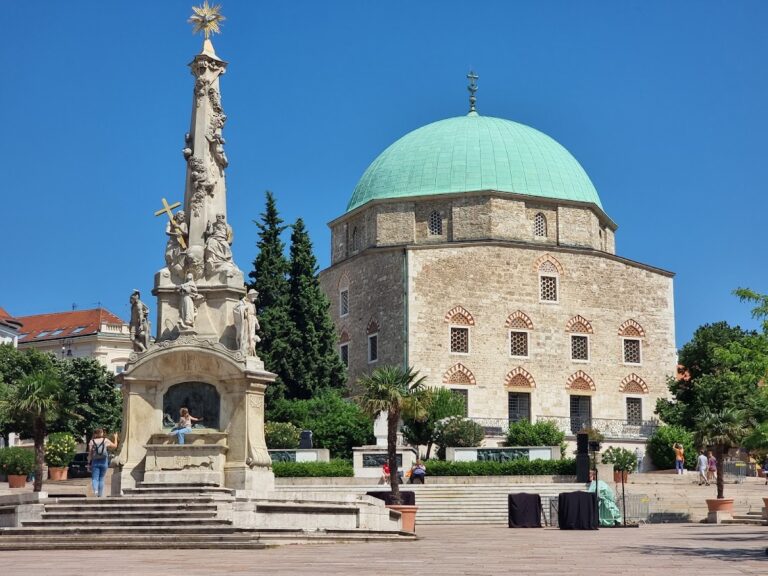
Yakovalı Hasan Paşa Mosque is an Ottoman-period mosque in Pécs, Hungary, probably built during the 1630s after the Ottoman conquest of central Hungary. A late-sixteenth-century date has also been proposed, but the exact construction date and architect remain unknown. The building is regarded as one of Hungary’s oldest surviving mosques and as the country’s most intact surviving Ottoman mosque.
Foundation and Ottoman use
The mosque was commissioned and endowed through a vakuf, an Islamic charitable endowment that could provide resources for a religious institution, by Yakovalı Hasan Paşa, also known as Hasan Pasha of Yakova. The name may refer to Gjakova in present-day Kosovo or to Đakovo in present-day Croatia. The seventeenth-century Ottoman traveler and chronicler Evliya Çelebi attributed the building to Yakovalı Hasan Paşa and placed it among the major Ottoman works raised in Pécs during that period.
Yakovalı Hasan Paşa later became pasha of Kanizsa and a Bosnian beylerbey, a governor of a large Ottoman province. He took part in the Ottoman siege of Oradea in 1660, defended Pécs and Kanizsa against the forces of Miklós Zrínyi in 1664, and participated in boundary demarcations after the Peace of Vasvár.
Conversion and restoration
The mosque remained in use for about half a century. It was probably abandoned from late 1686, after Austrian forces captured Pécs, and was later used as a hospital. Between 1702 and 1732, Bishop Wilhelm Franz von Nesselrode converted it into a Catholic chapel dedicated to Saint John of Nepomuk. Baroque ornament was added, along with a choir gallery and a more elaborate roof structure, while the minaret was adapted as a bell tower.
The hospital conversion also altered the building’s surroundings. The northwest foyer was demolished when the hospital’s ground floor was built. Damage to the upper part of the minaret led to its replacement by an open belfry, and the present crowning section was added in the nineteenth century.
A major restoration followed research by Győző Gerő in the 1960s and designs by Károly Ferenczi. Baroque additions were removed, and the interior was brought closer to its Ottoman appearance. Another restoration took place in the late 2000s as part of the European Capital of Culture project. The mosque reopened on 22 May 2010 after several years of closure.
Yakovalı Hasan Paşa Mosque remains an active Sunni Muslim place of worship, serving Friday prayers and Ramadan observances. The Pécs Muslim community belongs to the Hungarian Muslims’ Church. A permanent exhibition opened in 2022, with sixteenth-century interior furnishings provided by Turkey, and the building also houses displays of Turkish handicrafts and historical material related to Hungary’s Ottoman past.
Remains
Prayer hall and entrance
The mosque has a simple Ottoman layout, with a square prayer hall covered by a low octagonal drum and a slightly curved Turkish dome. Its northwest to southeast axis is directed toward Mecca, and the windows have ogee or keel-shaped forms. A four-columned open entrance porch once stood on the northwest side, covered by a series of domes. The present entrance is through a room separated from the adjoining hospital building, while the former porch and hospital structure remain physically associated with the mosque.
The northwest entrance ends in a finely worked gable with stalactite decoration. Its restoration, together with that of the mihrab, the prayer niche indicating the direction of Mecca, was guided by fragments and details found on the site. The building also contains a mirror room with a temporary exhibition explaining the Five Pillars of Islam, the central ritual and religious obligations of Sunni Islam.
Minaret
The minaret stands at the western corner beside the former porch. Finely cut stone forms its twelve-sided base, which rises 6.5 metres and ends in a cornice beneath a series of blind arches. Above this is a truncated-conical section, whose upper part is separated from the mosque wall. The principal shaft rises another 14.5 metres and appears narrower because of its gently curved fluting. Cylindrical mouldings encircle the shaft near both its lower and upper ends.
Eighty-seven steps lead inside the minaret to its circular balcony, and the tower reaches approximately 22.5 metres in height. The balcony was formerly enclosed by a stone railing and illuminated with oil lamps during religious holidays. The staircase entrance is now sealed for structural-stability reasons, and the minaret is not open to visitors. It is one of three surviving Ottoman-era minarets in Hungary and the only one still attached to a mosque while retaining its original function.
Former complex and later features
The mosque once formed part of a larger religious complex that included a tekke, or Sufi lodge, an imaret, or charitable soup kitchen, and a madrasa, an Islamic school. Excavations in the 1960s and 1970s revealed the course of the former dervish monastery’s walls in the entrance area.
Historical columns displayed in the room leading into the mosque came from the Mosque of Pasha Qasim rather than from Yakovalı Hasan Paşa Mosque. In front of the building, a bronze statue of the Ottoman chronicler Ibrahim Pecevi, created by Turkish sculptor Metin Yurdanur, has stood since 2016.
Nearby sites