St. Michael the Archangel’s Church in Dębno: A Gothic Wooden Parish Church


Site at a Glance
- Rating
- 4.7
- Popularity
- Low
- Country
- Poland
- Primary era
- Medieval
- External website
- Open
- Eras represented
- Medieval, Early Modern, Modern
- Civilizations
- Habsburg, Kingdom of Poland, Polish–Lithuanian Commonwealth
- Site type
- Religious
- Remains
- Church
On this page12 sections
History
St. Michael the Archangel’s Church in Dębno is a Roman Catholic parish church in Poland, built in the second half of the fifteenth century in the Gothic period. Its nave and presbytery occupy the site of an earlier church, probably erected in the thirteenth century. Dedicated to St. Michael the Archangel, a Christian figure associated with protection and the struggle against evil, the church belongs to the Archdiocese of Krakow and remains an active place of worship.
Medieval foundation and parish use
The present building was raised after the first church at Dębno had served the local community. The fifteenth-century structure retained its original form as a single-nave wooden church, while its continued religious use preserved the relationship between the building and the parish. The liturgical feast of St. Michael the Archangel is celebrated on 29 September.
The church is regarded as one of Poland’s best-preserved Gothic wooden churches and as a monument of international importance. In 2003, during the 27th session of the World Heritage Committee, it was inscribed in the UNESCO World Heritage property Wooden Churches of Southern Małopolska. The inscription uses criteria (iii), concerning exceptional testimony to a cultural tradition or civilization, and (iv), concerning an outstanding example of a building type illustrating an important stage in history. The church is also protected as a Polish cultural-heritage monument and forms part of the Wooden Architecture Route of the Małopolska region.
Later changes and conservation
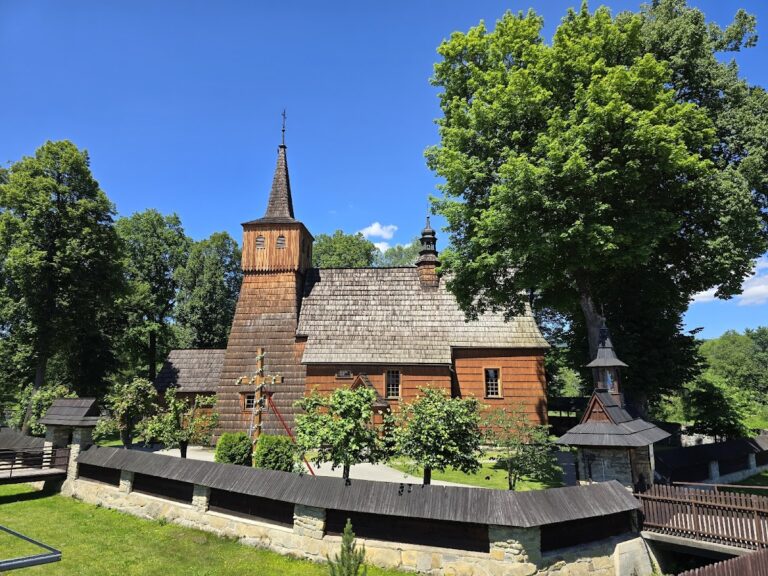
A separate tower was added in 1601, creating the principal later addition to the medieval church. The covered galleries known as soboty were also part of the building’s long development. Originally intended to protect the foundations from rainwater, they later offered shelter to worshippers after their height and roof surfaces were increased. The galleries seen today were built at the beginning of the nineteenth century.
Conservation carried out from 1933 to 1935 included the preservation of carved decoration. A comprehensive programme followed in 1958–1963. Research undertaken in 1999 and the first half of 2000 assessed the condition of the monument and found it to be good. Work around 2003 aimed to restore the original appearance of the walls. The church appeared on the World Monuments Watch list in 1996 and 1998 as a valuable monument considered at risk of destruction.
The building has also entered modern popular culture. It provided the setting for the wedding of Janosik and Maryna in the 1973 television series Janosik, although the scenes showing the couple entering and leaving the church were filmed elsewhere. An unconfirmed tradition connects the church with the troops of King John III Sobieski, who were said to have left a sixteenth-century embroidered war banner there while returning from the victory over Ottoman forces at Vienna in 1683.
Remains
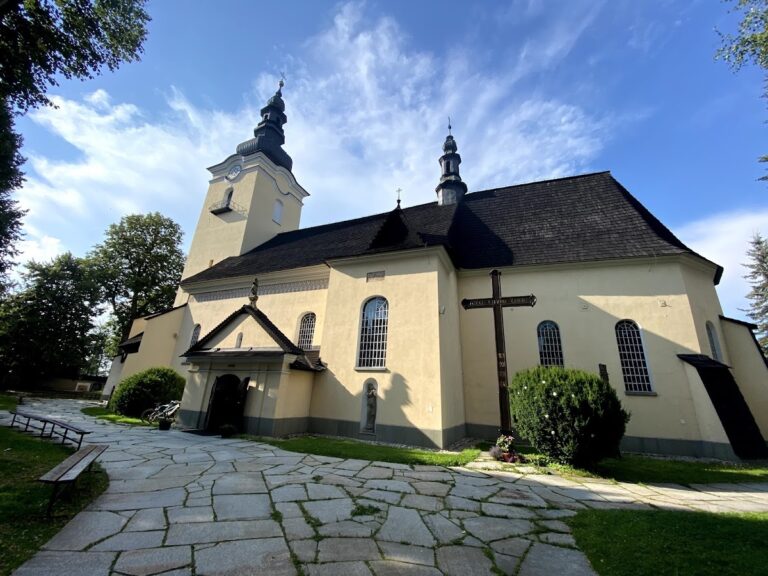
The church is an east-oriented, single-nave wooden building made from larch logs joined with wooden wedges rather than metal nails. Its nave measures approximately 7 by 8.3 metres, while the nearly square presbytery measures about 5 by 5.9 metres and ends in a rectangular eastern wall. The nave and presbytery stand beneath a single-ridge roof covered with wooden shingles. Shingles also cover the galleries, tower walls, and tower cap, giving the surviving complex a consistent timber character.
Church body and exterior
The present soboty surround the nave and presbytery. Their raised form and enlarged roof surfaces reflect the galleries’ later protective and practical functions. A consecration cross, marking a place associated with the formal consecration of the church, survives on the exterior facade. The church’s original form and its close integration with the surrounding landscape remain legible in the surviving timber structure.
Sixteenth-century tower
Built in 1601, the separate tower is approximately 15 metres high. It uses post-and-frame construction and contains an upper bell chamber. Its walls slope sharply inward toward the top, while the bell chamber is boarded with planks whose lower edges have intricate, lace-like cuts. The tower is among the oldest surviving structures of its type in Poland. The church complex has one tower, together with three altars and a small organ with one manual and two stops.
Painted decoration
The interior preserves a uniquely valuable banded stencil polychromy from around 1500. Polychromy is architectural or artistic decoration executed in several colours, while stencil work applies paint through cut-out templates. This decoration is the oldest fully preserved polychromy executed on wood in Europe and is regarded as the best-preserved example of its type in Poland. It uses 33 colours to form 77 motifs arranged in 12 patterns, chiefly plant and geometric designs, with figurative subjects and animals, especially deer. The stencils appear to have been reused several times in different buildings and may have originated in secular residences belonging to nobles or magnates.
A Jagiellonian eagle is painted above the rood beam. This beam spans the boundary between the nave and presbytery and traditionally carries a crucifix with images of the Virgin Mary and St. John. The painted decoration forms part of the church’s wider group of furnishings, most of which were made from boards covered with painted ornament.
Altars and devotional furnishings
High altar
The high altar is an early-sixteenth-century triptych, an altarpiece made of a central panel and two hinged wings. Its central panel shows the Virgin and Child, St. Michael the Archangel with a sword and scales, and St. Catherine of Alexandria. The left wing depicts St. John the Evangelist and St. Stanislaus, while the right wing shows St. John the Baptist and St. Nicholas. When the wings are closed, paintings show Christ in Gethsemane, Ecce Homo, the Flagellation, and the Fall beneath the Cross. These exterior paintings probably date from around 1530 and show a clear Renaissance influence.
Baroque side altars
Two side altars are Baroque in style. The left altar dates from 1651 and contains a shrine with Gothic sculptures made around 1440. The Virgin and Child occupy the centre, with St. Cecilia and St. Catherine on the left and St. Barbara and St. Dorothy on the right.
Medieval sculpture and painted objects
A painted wooden tabernacle from the fourteenth century is set into the north wall. A tabernacle is a secure receptacle for the Eucharist. Hanging from the rood beam is a crucifix dating from around 1380, probably the oldest object in the church and possibly a survival from the earlier building. Its cross arms are natural tree branches. Three circular discs at their ends and lower end bear the emblems of the Evangelists, while wooden figures of the Virgin Mary and St. John the Evangelist stand on either side.
A statue of St. Nicholas, made in 1420 for a Gothic altar, is mounted on the north wall inside a rectangular wooden case. The case’s inner walls are painted with images of St. Stephen and St. Lawrence. The church also contains a copy of a panel painting dated to 1280, depicting St. Agnes and St. Catherine with palm branches. Painted on limewood, the original was removed and transferred to the Archdiocesan Museum in Krakow.
Metal plates and embroidered banner
A group of very old bell-like metal plates, usually kept in the presbytery, may date from the fifteenth century. Their distinctive sound is associated with a special alloy and with a production process in which the plates were buried in the ground for a period. The longer plates produce the higher tones. A sixteenth-century embroidered war banner bearing an image of St. Stanislaus of Szczepanow is also preserved in the church.