Duomo of Berceto: A Lombard and Romanesque Parish Church


Site at a Glance
- Rating
- 4.6
- Popularity
- Low
- Country
- Italy
- Primary era
- Medieval
- External website
- Open
- Eras represented
- Medieval, Modern
- Civilizations
- Holy Roman Empire, Lombard
- Site type
- Religious
- Remains
- Church
On this page14 sections
History
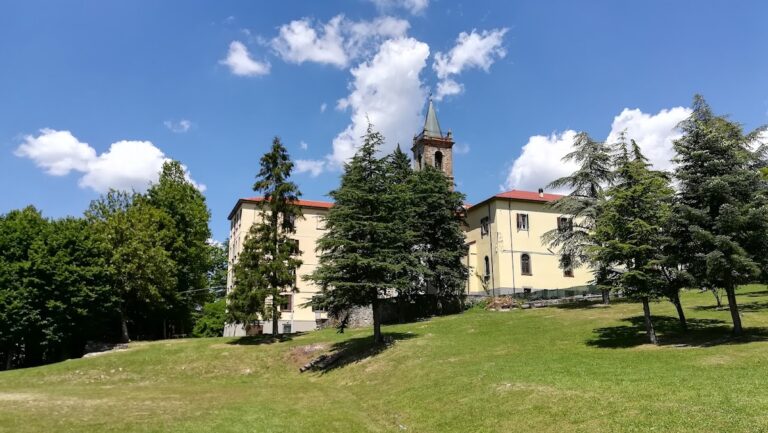
The Duomo of Berceto is a Roman Catholic church in Italy, developed from a Lombard monastery founded in 719 and rebuilt in the late twelfth century in the Romanesque style. Dedicated to Saint Moderanno, it remains the seat of a parish in the Diocese of Parma and belongs to the Mountain pastoral zone.
Early church and the tradition of Saint Moderanno
A small church dedicated to Saint Abbondio occupied the site from the first years of the eighth century. In 718, Moderanno, traditionally identified as the bishop of Rennes, passed through the area while travelling to Rome as a pilgrim. According to local tradition, he had obtained relics of Saint Remigius at Reims and accidentally left them hanging from a tree near the Cisa Pass, along the Monte Bardone route between Parma and Lunigiana. The relics could be taken down only after Moderanno promised to leave them at Berceto.
After returning from Rome and making a final journey to his native city, Moderanno came back to the area. In 719, Liutprand, the Lombard king, founded a monastery beside the earlier church and dedicated it to Saint Remigius. He appointed Moderanno as its prior, and the small church became the monastery’s abbey church. The Lombards ruled much of northern and central Italy before the later Carolingian and medieval political order took shape.
From monastery to rural parish
In 879, the monastery was assigned in commendam to Guibodo, bishop of Parma. This arrangement placed the institution under the administration or beneficial control of a person who was not necessarily its regular abbot. The monastery closed in 1007, after which the church was dedicated to Saint Moderanno and raised to the status of a pieve, a rural parish church exercising religious authority over a surrounding district. It came under the direct authority of Sigefredo II, bishop of Parma.
Toward the end of the twelfth century, the earlier Lombard place of worship was completely rebuilt. The Romanesque reconstruction established the church’s Latin-cross layout, with a long nave crossed by a transept, three naves, and three eastern apses. This medieval rebuilding created the basic architectural form that continues to define the church, although later works substantially changed its interior and exterior.
Renaissance renovation and modern rebuilding
Between 1480 and 1502, Bertrando de’ Rossi, count of Berceto, commissioned extensive renovations. The work rebuilt the pillars, replaced the arches, removed one bay, reconstructed the principal apse in a squared form, and raised the side naves and chapels. Numerous rampant-lion symbols placed throughout the interior belong to this Renaissance phase.
Ground subsidence led to the rebuilding of almost the entire façade between 1845 and 1856. The new work followed a Romanesque design by Giuseppe Rizzardi Polini and also affected the upper part of the bell tower. The Renaissance portal, however, was retained. Consolidation and conservation-restoration took place in 1971. During that work, an exceptionally thin glass chalice was found beneath the presbytery inside a tomb dating from before the eleventh century.
Remains
Plan and exterior
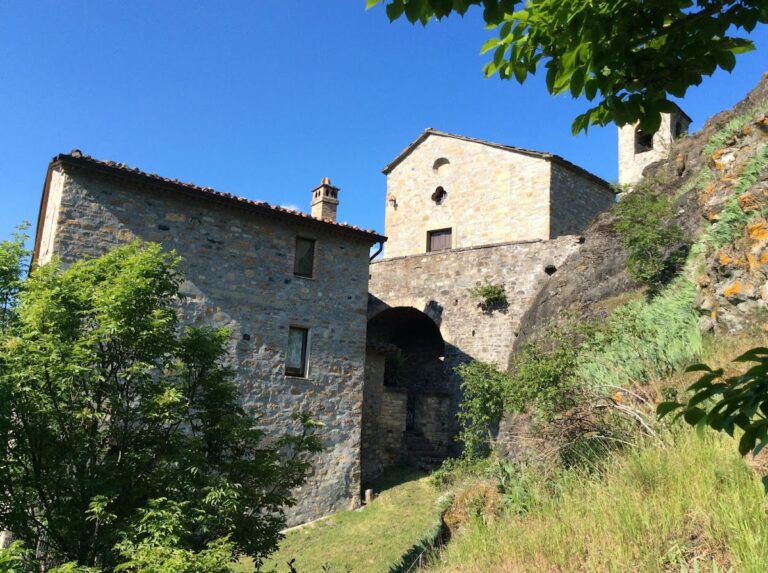
The surviving church follows a Latin-cross plan with three naves, a transept, and three apses facing east. Its elevations are faced entirely in sandstone, while the exterior decoration combines corbel arches, sculptures, and metopes from different periods. Full-length sculptures appear within the corbel-arch decoration on the Romanesque north side, around the apses, and in the lower part of the bell tower, or tiburium, a tower-like structure rising above part of a church.
Façade
The nineteenth-century gabled façade is also built of sandstone. A small rose window occupies the upper section, with a bifora, or window divided into two openings by a central shaft, beneath it. Two tall single-lancet windows flank the large splayed portal, whose opening widens toward the exterior.
Principal portal
The principal portal belongs to the Renaissance renovation and is formed by successive colonnettes and several moulded arches. At its centre is a Romanesque lunette, possibly connected with the pre-Antelamic school of sculpture, meaning work produced before or apart from the art associated with Benedetto Antelami. The relief shows Christ crucified, with Mary, Saint John or the martyr Saint Abbondio, and Saint Moderanno on one side. On the other are the centurion piercing Christ’s side and a youth collecting the blood in a cup.
The richly carved architrave contains human figures and fantastical animals. Two telamons, sculpted human figures used as architectural supports, carry it. The portal therefore preserves elements from different periods within the entrance reconstructed and enlarged during the Renaissance works.
Secondary portal
The secondary portal dates from the twelfth century. Its lunette contains a fresco of the Adoration of the Magi dated 1198, flanked by seated sculptures of Saints Peter and Paul.
Interior and medieval furnishings
Inside, a solemn stone colonnade divides the three naves. The capitals vary individually, and the columns support pointed arches. Wooden roof trusses remain visible above the interior. The two larger pillars in the presbytery belong to the medieval church, while the wider interior reflects the changes made during the Renaissance renovation.
Presbytery and high altar
The medieval presbytery contains two fifteenth-century chests holding the bones of Saint Moderanno and the martyr Saint Abbondio. Set into the centre of the high altar is an eighth-century Lombard pluteus, a carved stone screen or panel once used in early medieval church furnishings. Its bas-relief shows a cross surrounded by two peacocks drinking from two chalices, an image associated with immortality.
Ark of Saint Boccardo
In the left nave stands the medieval Ark of Saint Boccardo, a white-marble sarcophagus supported by four small columns. It is thought to contain the remains of Saint Burcardo, bishop of Würzburg. An inscription on the upper triangular crest states that the ark was made in 1355 at the command of Charles IV, the Holy Roman Emperor and king of Bohemia. The Parma architect Lamberto Cusani reassembled it in 1916.
Later works of art
The church contains several seventeenth-century altarpieces and an eighteenth-century crucifix. An eighteenth-century painting by Paolo Ferrari depicts the Madonna and Child with Saints Francis, Margaret of Cortona, and Vincent Ferrer.
Chapel museum and movable remains
A small museum occupies the eighteenth-century Chapel of Saint Apollonia, which was probably first used as the baptistery. Its collections preserve objects that accumulated at the site over the centuries, including the traditional vestment associated with Saint Moderanno and the glass chalice found during the 1971 conservation work.
Known as the Cope of Saint Moderanno, the vestment is a semicircular liturgical cloak traditionally believed to have belonged to the saint. It may be a Lucchese textile from the twelfth century. Green silk satin covers a white linen lining, and a red ribbon forms the edging.
The glass chalice has exceptionally thin walls with iridescent reflections. Its foot, stem, and cup were joined by drops of glass, yet the fragile vessel remained intact. It was found in an unmarked tomb beneath the presbytery, a burial that predates the eleventh century.